






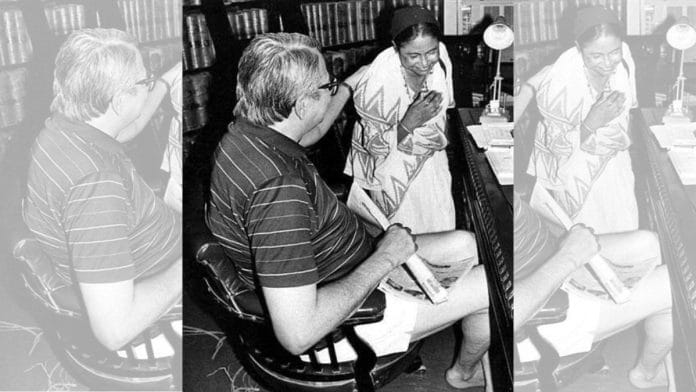



There is a scene from my early years that plays out in my memory’s theatre, with the quality of a period film. In the 2000s, Mita Walia, a Congress worker, storms into the anteroom and announces, in breathless Bengali, with a distinct Punjabi twang: “Manu Da’r flight land koreche!’—Manu Da’s flight has landed. Ashfaque, his political secretary, stubs out his fifth consecutive cigarette. Heaps of ‘chai-er bhaand’ or earthen tea cups pile up in the corner, reflecting the mood of the entire room. The red-dial telephone is picked up, and calls begin.
Within minutes, Youth Congress workers have materialised outside 2 Beltala Road: INC flags, party paraphernalia, the particular atmospheric charge of imminent arrival. They jostle outside the red fortress-like facade of the house that political and legal circles simply called “Beltala”.
Some were admitted into its sprawling lawn, others pressed against the wrought iron gates in the hope that a moment of eye contact or an exchange with Beltala’s resident might foster a brighter future within the Congress fold.
‘Manu Da’ or Siddhartha Shankar Ray was the last Congress Chief Minister of West Bengal, and by any honest reckoning, one of the two or three politicians of genuine national consequence this state has produced.
For decades, the Bhabanipur constituency was synonymous with Siddhartha Shankar Ray, and as a Congress bastion. Its bulwark was a red house in ‘Beltala’.
“The Congress is in my blood,” he once declared—and that, as it turned out, was not mere rhetoric but historical fact.
In 1884, two of his forebears, great-grandfather Durga Mohan Das and great-grand uncle Bhuban Mohan Das, Calcutta barristers, Brahmo reformers, were founding signatories of the Indian National Congress.
Bhuban Mohan’s son and Ray’s grandfather was none other than Chittaranjan Das or “Deshbandhu”, arguably the most towering Moderate figure of the Independence Movement.
Deshbandhu’s residence on what was then Russa Road was where his life as a prominent nationalist took shape, and from where his final journey to the burning ghat took flight, amidst a sea of his countrymen, led by MK Gandhi and Lala Lajpat Rai. One a Gujarati, the other a Punjabi. Perhaps that cortege offered the earliest indication of how cosmopolitan Bhabanipur would one day become.
Beltala, too, carries its own resonance. During Deshbandhu’s long sojourns at his daughter’s home there, the aforesaid anterooms and lawn, in effect, turned into a satellite office of the Bengal Provincial Congress, often hosting a nationalist pantheon with the likes of MK Gandhi, Motilal Nehru, Fazlul Haq and others, in attendance.
Also read: Mamata Banerjee vs the mighty Establishment. That’s what Bengal election is really about
Basu at Beltala
Ray was first elected from Bhabanipur in 1957, entering Bidhan Roy’s cabinet as Minister for Tribal and Law Affairs. A falling-out with Atulya Ghosh, the most formidable of Congress Bengal’s fixers, led him to contest as an independent in 1962. He won regardless.
In 1959, during Bengal’s food movement, Jyoti Basu sought refuge in Beltala for a week on the request of veteran CPI leader, Snehanshu Acharya. He turned the thakur ghor (prayer room) into his personal quarters and quietly designed Bengal’s Marxist agenda.
The shifting sands of Bengal politics saw the rise of the Communist-Marxist movement. What ensued after the China-India war was a rupture within the CPI, giving birth to Basu’s CPI(M).
Ray and Basu’s friendship ran back to Presidency College and the Inns of Court in London. For posterity, it must be recorded that despite their stark political differences, Ray proved emphatically to be the opposite of a fair-weather friend; Basu, somewhat the very definition of it.
Long before Raisina Hill and the Presidency, long before he became ‘Pranab Da’ to an entire nation, a young Pranab Mukherjee, then just an ordinary party worker from Birbhum, paced the precincts of Beltala, occasionally stopping to pensively smoke his pipe and calculating his place in Congress’s elaborate pecking order and how best to secure it with Manu Da’s backing.
Also read: Why Bengal’s election outcome matters. The world wants to know how SIR will play out
Banerjee at Beltala
Through the turbulent late 1960s and into the 70s, including his tenure as Chief Minister, Beltala’s red walls were under literal assault: Crude bombs and Molotov cocktails from Naxal activists who had taken sharp exception to Ray’s muscular approach to restoring order in the state. The south gate was eventually bricked up.
And it was precisely during this period that a generation of Youth Congress politicians found their education in its garden and anterooms, eventually culminating in Ray’s chamber: Priyaranjan Das Munshi, Saugata Roy, Subrata Mukherjee, Shovan Deb Chatterjee and a firebrand law student from Kalighat-Mamata Banerjee.
It was Ray, then Bengal Congress President, who had first taken notice of an adolescent Mamata during a youth congress rally outside Bhabanipur’s iconic ‘Jadu Babu’s Bazaar’. Congress party workers often reminisced that Ray stopped his car and got out to hear her speak. Later, he remarked in private, ‘Ei meye tah onek dur jaabe’ (This girl will go very far).
Of course, her defining moment came a few years later when she jumped on JP Narayan’s car bonnet in a stout display of defiance in North Kolkata.
When Mamata finally broke with the Congress in the mid-1990s, furious at the WBPCC’s drift under Somen Mitra, the Trinamool Congress was officially born in 1998, but shaped much before in no small part by those long evenings of conversation at Beltala, with Ray’s quiet but entirely deliberate blessing.
He understood that the Congress State unit had become largely a vehicle for its own survival and that Mamata represented something the Left could actually be threatened by.
It was to Manu Da that she and her trusted lieutenants—Mukul Roy, Subrata Bakshi & Saugata Roy et al—returned to for counsel, time and again. Through the Nandigram farmer agitation to legal counsel during the Singur land matter or the Rizwanur Rahman murder case, Beltala was witness to it all.
In those Congress years, Sisir Adhikari, the Congress politician from Kanthi in Purba Medinipur, also frequented Beltala. His eldest son, Suvendu, would have grown up understanding, in the way that political children do, exactly what Manu Da & Beltala represented in erstwhile Congress politics. Today, Adhikari is the man Amit Shah and the BJP have dispatched to lay claim to present-day, cosmopolitan Bhabanipur—a fortress built by Ray’s most formidable protégé, faces its gravest test.
The Special Intensive Revision of electoral rolls to strike thousands of names from Bhabanipur’s voter list, a move critics see as one from Amit Shah’s vast playbook, was potentially targeted rather than routine. Simultaneously, BJP’s Adhikari is focusing on Hindi-speaking pockets of Bhabanipur where TMC’s influence is weaker.
Siddhartha Shankar Ray is no longer with us. Beltala has receded into the kind of memory that Kolkata preserves in ‘deemed’ heritage tags. Bhabanipur today, with its bustling gulleys, was once a quiet patrician pocket of south Calcutta, steeped in the freedom movement in ways rarely captured by contemporary literature. However, it is the most watched constituency in the country right now. The BJP’s clarion call has been to take the fight right to the TMC’s jugular.
The garden and anterooms at Beltala are silent now, but the politics it once nurtured remains, in every sense, very much alive.
Ayan Ray is a practising Advocate and designated Government Counsel for the State of West Bengal. He writes on politics and history. He is a grand-nephew of Siddhartha Shankar Ray and a descendant of Deshbandhu Chittaranjan Das. Views are personal.
(Edited by Theres Sudeep)