





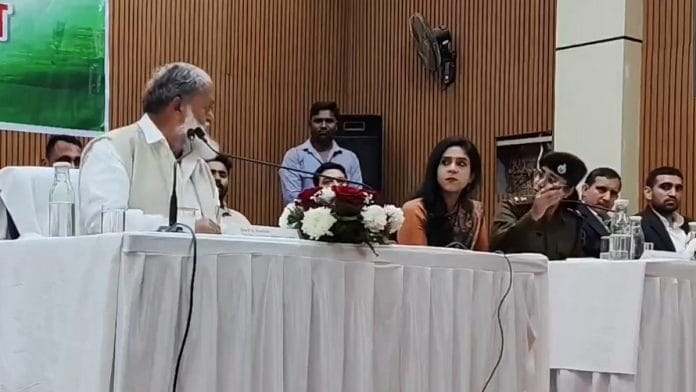



An uncomfortable exchange between Haryana minister Anil Vij and Kaithal SP Upasana during a District Grievance Redressal Committee meeting is going viral. But a minister berating a district Superintendent of Police in an open meeting is not merely bad manners. It is a governance signal.
The episode illustrates how fragile the boundary is between political oversight and operational policing at the district level.
The flashpoint was an alleged land fraud case involving a police employee. Vij pressed for immediate suspension during the meeting, and then lost his temper when Upasana responded that she could not do so on the spot as she lacked the necessary authority.
A passing reference was made to a ‘Zero FIR’, and the debate quickly got pulled towards that procedural detail. That is not where the real story lies. The deeper issue is more serious: a political executive issuing verbal directions to a district police chief in an open forum, treating those directions as binding commands, and reinforcing them with threats.
That practice does not merely embarrass an officer; it pushes policing away from record and law, and toward impulse and performance.
Also Read: IAS, IPS cadre allocation has structural problems. Why the revised policy doesn’t solve them
District policing cannot run on verbal orders
District policing is not stage-managed administration. A Superintendent of Police exercises statutory powers. Much of what an SP does—registration decisions, investigation, preventive action, the use of coercive powers, choices that affect liberty and reputation—must be capable of legal defence. Even when the public wants speed and ministers want visible action, the SP’s core obligation remains unchanged: act lawfully, on record, with reasons that can stand scrutiny.
That is why oral directions in open meetings are destabilising. They corner the officer into instant compliance, in public, often without time to test facts, check files, or apply the law. Comply too quickly and a procedural error becomes likely; insist on process and the officer is branded ‘non-cooperative’. Either way, the incentive shifts from doing the right thing to doing the safest thing—safe, that is, for optics.
Verbal directions in a closed setting are problematic; in an open meeting they turn into theatre. The minister is performing authority; the officer is forced to respond in the same theatre. The camera changes incentives for everyone: escalation becomes easier, retreat becomes harder, and nuance becomes impossible. What might have been resolved through a note, a file, or a recorded instruction becomes a public contest of will.
Public rebukes also undercut the standing of district police leadership. The SP is not a personal staff officer; she is the head of the district police. If she can be mocked or threatened on camera, the message to the police is that compliance is safer than correctness. Over time, this produces policing shaped by self-protection.
What the rule-book says
The All India Services were designed to resist this drift. Rule 3 of the All India Services (Conduct) Rules, 1968 is often invoked for its opening triad—integrity, devotion to duty, and conduct befitting the Service. But its operational importance lies in another proposition.
In performing official duties or exercising statutory powers, an officer is expected to act according to her best judgement, except when acting under the direction of an official superior. Crucially, the discipline around ‘direction’ is clear: such directions should ordinarily be in writing, and if initially given orally, should be confirmed in writing promptly.
This is the backbone of accountable hierarchy. The written-word discipline fixes responsibility, forces clarity, and creates a record—protecting the citizen, the officer, and ultimately the state when its actions are tested in court. At the same time, “best judgement” is not an escape hatch. It is a reminder that the officer cannot keep running to seniors for cover on matters where the law expects the officer herself to decide. The balance is straightforward: decide where you must; and if you are being directed, ensure the direction is recorded.
Oversight vs operational command
None of this is an argument for insulating the police from democratic control. Ministers have every right to demand responsiveness. They can ask why complaints are pending, why stations are unresponsive, why outcomes are poor, why certain crime patterns are rising, and why resources are being poorly used. They can insist on timelines, review performance, and fix accountability. That is democratic oversight, and it is proper.
What is different is directing operational policing actions in real time—especially in individual matters—through verbal commands in public. Policing is a coercive function. It must be exercised under law, not under a running commentary of political authority.
Once “my order” becomes the governing principle, the state begins to resemble a hierarchy of temperament rather than a system of rules. The discipline of written directions is the boundary marker. They do not weaken oversight, but make it accountable.
What a district SP should do when pressed verbally
Oral pressure will not disappear. The question is how a professional officer should respond when pressed verbally in public.
If a direction is being issued, the officer should ask that it be communicated through the proper channel and recorded. She should place her factual and legal position on record—briefly and professionally. If the direction is lawful and within the superior’s remit, she should comply, with the written direction forming the basis. If the direction appears unlawful or inconsistent with procedure, she should seek written clarification and record her reasons.
The system must also allow the officer to do this without being punished for it. If asking for written direction is treated as defiance, the rule becomes meaningless and verbal governance becomes the real constitution of the district.
Also Read: Anil Vij gets his way in bureaucratic reshuffle hrs after meeting with Haryana BJP chief
What should change after Kaithal?
If Kaithal is treated as a passing clip, nothing changes. If it is treated as an institutional warning, there are some uncomplicated remedies.
Grievance meetings should be governed by a protocol. Ministers may demand status, timelines, and explanations, but operational police directions must be routed formally and recorded. Public platforms should not be used to issue coercive instructions. Home Departments and police leadership must make it clear that no officer will be threatened or penalised for asking that directions be given in writing; that request is compliance with the service framework.
Training should teach the craft of handling pressure: how to insist on record without provoking a showdown, how to state the legal position without sounding adversarial, and how to document dissent when necessary.
The Kaithal episode is not, in the end, about one procedural doctrine. It is about the daily boundary between political authority and district policing. That boundary holds only when authority submits itself to record—when directions, if they must be given, are written and owned. The alternative is verbal governance: fast, performative, deniable, and corrosive.
Rule 3’s logic is practical: judgement first; direction only when necessary; and direction, as far as possible, in writing. That is how you keep policing accountable without turning it into an extension of personal power—and how you keep ministers powerful without making the state arbitrary.
KBS Sidhu is a former IAS officer who retired as Special Chief Secretary, Punjab. He tweets @kbssidhu1961. Views are personal.
(Edited by Asavari Singh)
Sir very well articulated.. But in my view this is the conflict between two sets of Govt one permanent and other political… The political set is answerable to the public every 5 years so wants the permanent Govt to deliver otherwise he or she will be penalized by the public. The other set is good for 30-35 years so always wish to play safe. Further the performance appraisal system of bureaucracy including ACR or it’s modern avtars are dated and do not reflect the present times. As a result there is no motivation or job pressure over the permanent representative to bring outcomes.. If the entire service delivers outcomes as per law and citizens feel that they are getting justice without fear or favour, the perception of the people towards service will change leading to appreciation and continuity of political executive. Actually both the political and permanent service are complimentary to each other and not against each as the case shows. But both have to see each other’s points.. The political one has to give policy support, space and respect to the permanent and the latter has to provide outcome governance which is citizen centric. Once this happens the friction will be eliminated otherwise the chasm will widen… Many congratulations Sir for putting it so well.. Highly appreciated