





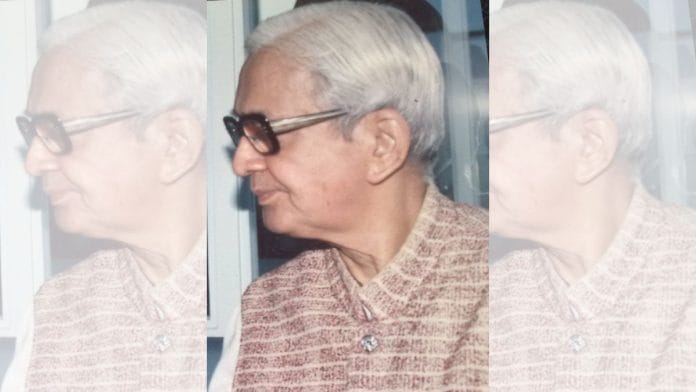



The theme of my lecture is of perennial interest in a democratic republic, but it is much more topical in today’s perplexing atmosphere. Indeed, the theme is also full of anxiety and concern for all who want to see that the newly won democratic freedoms are not lost again. In all countries of the world today, because of technological and other factors, the impact of politics on other areas of life has been increasing at a very fast rate. Therefore, the preservation of democratic freedoms is very essential. There is a perplexing atmosphere in the country today. Intellectuals must see to it that a sense of direction, which has been lost sight of by the people at large, should be restored to them by the work and creative role that intellectuals play and ought to play in India of today and tomorrow. Public life in a democracy is at its core creative and social. In fact, where there is no democracy, there is no public life.
It is only in democracy that the public or the public spirit are valued, respected, honoured, recognised. It is only in democracy that public spirit is affirmed, whereas in dictatorship it is suppressed.
There are three key words in the title of my lecture, Intellectual, public life and the role of intellectuals. These terms as in the case of other terms like democracy, freedom, right, liberty, equality, justice, fair play etc. are much abused and misused. For instance, people who do not believe in democracy at all shout loudest for democracy. Therefore, we must be very very cautious about the use of these terms because there is a lot of loose talk and confusion which should be avoided. Intellectual has become a fashionable word in modern times. Magazines, books, periodicals, articles and public lectures frequently refer to intellectuals. Either they damn or praise them. The fact remains that intellectuals in any society are few. In our own country, they are fewer. If any one wanted evidence to find out whether there were intellectuals in this country, one should only analyse what happened during the years 1975 to 1977. In fact, non-intellectual commoners were more creative and brave than intellectuals who can be called pseudo-intellectuals or fake intellectuals. The question is who is an intellectual. An intellectual is one who is
Intelligent but not clever, sensible but not smart, wise but not wilful, witty but not wicked, sane but not sullen, and surely not swollen sarcastic, but not satirical Idealist but not romanticist artist but not artisan.
A very interesting description of intellectuals was given by no less a leader than Mao Tse-Tung. He described intellectuals as “swollen in head, weak in legs, sharp in tongue but empty in belly”.
An intellectual is a rare commodity, as John Stuart Mill said in his book on “Liberty” : they survive because of an atmosphere of freedom and they thrive because of a climate of liberty but they do not thrive in large numbers. If there are many intellectuals, we should begin to feel nervous! True intellectuals should be distinguished from the intelligentsia because in their spheres of work and influence there are significant differences. Intelligentsia, we must have in a good measure. Intellectuals few and far between are adequate.
An intellectual is one who lives in intelligence and does not live on intelligence. He uses his intellect creatively, critically and constructively; he has courage of his convictions; he is not too sure of his views and opinions. The problem in democracy is that most of the leaders are very sure of what they say. In fact, some of them have the mannerism of saying, “I have ·no doubt”. In a democracy, we must have leaders, who will say, “I said this firmly but I am not too sure whether I am right in saying this firmly”. That means there is some sense of tolerance and understanding of other man’s point of view.
While an intellectual should not be too sure of his views and opinions, he should have the stamp of clarity, certainty, confidence and charity in all his intellectual bearings and moorings. He is one who is open and receptive and is, therefore. growing all the time. An intellectual, besides being intelligent. has four very essential qualities. Otherwise, he is likely to use his intelligence in a perverted way. These four qualities are, imagination, integrity, independence and incorruptibility. It is very difficult to find such individuals. If they are incorruptible, perhaps they are not independent. If they are incorruptible and independent, they are not having imagination. If they are having imagination, they may have no integrity. It is rare to have a combination of all these four qualities.
***
The great poet Gurudev Rabindranath sang, “go alone”. The trouble is that when one is going alone, one thinks that he is heading his followers. but before he knows that they are all gone. If an intellectual is alone, surely on the right path, then such a man is never alone, because he never bothers to see behind who is following him. The world is following him. Socrates never looked behind. Abraham Lincoln never looked behind. Mahatma Gandhi never looked behind but for time immemorial he will live. As Einsten put it, generations from now on would scarcely believe that such a man with flesh and blood ever tread on this mother earth. Gandhiji belonged to eternity; yet in many senses, he was a lone individual. If some intellectuals describe Gandhiji as non-intellectual, those intellectuals themselves are non-intellectuals, because Gandhi was one of the greatest intellectuals. Socrates was one of the greatest intellectuals. They did not write many books.
Gandhiji was once asked by Julian Huxley to contribute an article on “human rights”. Gandhiji wrote in reply a small letter, while he was on the running train, a deeply depressed man seeing the sorry spectacle of India divided and her people madly killing each other in thousands. With deep agony in his heart but clarity in his thoughts and purity in his heart, Gandhi wrote: What kind of article I can write for you? I am not an intellectual – (he said I am not a Pundit). I cannot write an essay on ‘human rights’. “I learnt from my illiterate but wise mother that all rights to be deserved and preserved came from duty well done.” I have yet to come across a better and more meaningful definition of inevitable togetherness or inseparableness of rights and duties. How beautifully he described in such simple and short words ! An intellectual should possess daring to do the right thing even when left alone on a forsaken island. If he is a Robinson Crusoe, he would still go ahead with these ideas because, he, though alone by himself, still has tools and equipment of a we~ cultivated mind and body and he should be able to sustain himself with enough strength and spiritual force.
Public life is something more than mere discussion on public platforms on issues, problems and challenges the people are confronted with. Public life is, in that sense, also vaster and larger because it contains many projections of ideals and values for which mankind has struggled so far. So. public life is a concept in itself. It is, of course, a reality. This concept of public life was available in ancient Greece as also in ancient India. In ancient Greece, there was a monarchy of chieftainship. It was always tampered by public opinion which found expression in the public assembly. In Socratic times, public assembly was a street corner meeting. Socrates used to have a dialogue or converse with any one whom he came across in the street of the citystate of Athens. That was Socrates’ contribution to the development of public life. So was it in ancient India.
In India, even in pre-Buddhist times, there did exist several republics apart from kingdoms and monarchies. Equality of all rights, rejection of arbitrary power, appointments to offices by lot and the responsibilities of officials in common deliberations and decisions in the popular assembly were common in ancient Indian republics – Ganatantras, as they were called. An intellectual’s contribution to public life in terms of his role is not merely to enunciate but also, whenever necessary, to participate in it. If he stops at enunciation and does not participate in the affairs of the community, then his role as an intellectual is inadequate, incomplete and often misleading. He has not tested his ideas through practice. Gandhiji was a great man because he was experimental; an intellectual, therefore, is experimental. He experiments his ideas through his o\vn conduct, tests them, hypothesises, verifies them. removes errors, eliminates the wrongs and then gets strengthened by experience that he accumulates in the process. Socrates, unlike his disciple Plato, was eager to take part in public affairs. Plato wrote excellent books but never took part in public affairs. Socrates had the courage to take pan in public affairs and was also prepared to take the consequences. Therefore, it is better for intellectuals to take courage :in their hands and, participate in public affairs. When it comes to that, intellectuals should stand for elective posts, whether it is panchayat, corporation or assembly or council or parliament. Because Socrates participated in public life and Plato did not, that does not mean Plato was less of an intellectual. But it only means that Socrates was a greater intellectual, because he combined with his intellectual commitments valuable experience which the commitment needed in order to make it more fruitful, meaningful and more acceptable to times to come.
Let us analyse what is meant by public life and what is an ideal democracy.
***
The values of public life should be truth, justice, morality and humanism. The norms and standards of public behaviour and good conduct must be integrity, honesty, faithfulness and unselfishness. Many people say one thing today and do exactly the opposite tomorrow. Faithfulness is the capacity to inspire the confidence in the people that what you say and feel inside and outside are one and the same. Politicians who show one part of their mind to one section and another to another, and go on finding out which section wants which part may be successful sometimes, but they are not true intellectuals.
In India there has been a steady deterioration of public life. The role of the intellectual in public life is to remain steadfast to his intellectualism. The role of the intellectual in public life is to act as a catalyst for change. Secondly, his role in public life is to act as non-conformist critic, dogged but not rigid. One who observes the scene in his entirety, observes it objectively, analytically and what is more difficult disinterestedly and dispassionately. Large number of intellectuals write books after an event is over. But they have a certain ivory tower attitude or isolation. That creates a certain kind of despair which he must be free from. The role of the intellectual in public life in India or any other part of the democratic world is to participate in public affairs with a sense of commitment and involvement, because as an intellectual, who will have to feel and realise, he has a stake in what is happening and even in what does not happen but ought to happen. An intellectual’s role is to demolish but not to despair; to construct but not to crave. He does not, therefore, shun politics but may shun party politics. He does not necessarily share power. His role further is to stand for values and ideals. If compelled by conscience he should not hesitate to stand for parliament, assembly, council and corporation or for any elective post. Such a role for an intellectual is always a very difficult one, occasionally even a very dangerous role. It is only the intellectual who can tell the people how to live dangerously. Most of us are security minded. Therefore, we do not want to take a single step without first finding out all possible consequences. Dangerous living is an important contributory factor for making public life meaningful and for enlightened public life. We have far too many security-minded people in our country. That is why we find in the last 32 years of Independence, we have intellectuals or so-called intellectuals who seem to be sharing powers with the establishment. The role of the intellectual is to encourage, warn, inform and to inspire people. Therefore, the intellectual’s role is to help create an enlightened public opinion. He must have the humility and ability to be led by commoners, although he must have also daring of not being led by fake intellectuals.
Before Independence, it seems we had a galaxy of intellectuals. These intellectuals were patriots, leaders, social reformers, educationists in their own light who would be honourable in any society or in any country of the world. But after Independence we had three periods: first formative years, then period of consolidation and then the era of construction. The last 32 years or so of Independence have shown that the educated classes, with very rare exceptions, have growing affinity with the Establishment and increasing ‘Yesmanship.’ No one is prepared to say “no”, because saying “no” means denial of many things in life. Therefore. there is a tendency to agree with higher-ups and sometimes agree even before the higher-ups open their mouth to what they want to say. In 32 years of Independence, many of our intellectuals have become easy prey to office, comforts, security, facilities, social prestige, recognition etc. Therefore, according to the dictum that power corrupts, absolute power corrupts absolutely, the corrupting influence of the establishment has inevitably touched the intellectuals also.
The period of Emergency in this country was revealing in that the weakness of the intellectuals, the educated people, was poignantly revealed to the whole world. Intellectuals were not prepared to show the courage of their convictions. Thus, the pre-Emergency tensions with Emergency distortions and post-Emergency strains have combined to create an extraordinary crisis in public life in which the intellectuals are nowhere to be seen. However, I am not at all pessimistic about the future because I feel that it is in the very nature of a moderately intelligent person not to be pessimistic about life. If life offers pessimism, life also offers a greater dose of optimism. It is a question of toning up public life.
Therefore, intellectuals can tone up public life by using freedom of thought and expression in the right way. The freedom of thought and expression are nothing but the right to think, criticise, to speak, to publish and to create. If these things can be done, then we will come to a situation where we can say that truth after all is an eternal value and goal. Seeking truth, striving for the truthful, struggling for the triumph of truth must be an intellectual’s endless pursuit.
In fine, the intellectual’s role in India of today and tomorrow is dynamic and daring, demanding devotion and dedication. The life of Jayaprakash Narayan, which was one of dynamism, daring and dedication and provided spiritual momentum and strength to public life in India, is an inspiring model for all intellectuals. He insisted on the noble and poor to be part and parcel of the public life of this country.
If Indian intellectuals follow his example, they shall not fail either the country or their own conscience.
This is part of ThePrint’s Great Speeches series. It features speeches and debates that shaped modern India.
When intellectualism is confined within the boundaries of wordplay and presentation sans substance and a life of action, a society is bound to have several intellectuals because present era presents umpteen platforms to shoot off from the mouth without much lived experience or empirical evidence of theories being shot off. Maybe the intellectuals of the 80s didn’t foresee the medium but they must definitely have been surrounded by such motormouths even during their days.
To become an ‘intellectual’ in India, one must: adopt socialism or communism; think with the heart rather than the brain; and be an alumnus of JNU or DU. One should smoke, drink, and balance foul-mouthed banter with sophisticated formal speech. It is essential to dismiss God and Hinduism, eat beef, and—for men—sport a beard, a kurta-pyjama, and a cloth side bag. To complete the persona, one must loathe businessmen, love minorities, and master the art of the protest.”