









Epigraphists Charlotte Schmid and Ingo Strauch recently announced that nearly thirty Indian inscriptions—Tamil-Brahmi, Sanskrit, and Gandhari-Kharoshthi—have been found in six royal Egyptian tombs. The development came at the International Conference on Tamil Epigraphy in Chennai on 11 February.
One Tamil merchant, a man named Cikai Korran, had left his name eight times across five of those tombs. One inscription reads, in Tamil: vara kanta, meaning “came and saw”.
This is not the only time graffiti has made news in the Indian subcontinent. From 2020 onwards, archaeologists in the Upper Indus Valley have warned that tens of thousands of petroglyphs will be submerged when the Diamer-Basha dam becomes operational around 2028-2029, obliterating 2,000 years of carvings made by merchants, monks, and soldiers.
Records of this sort, by pilgrims and travellers saying, “I was here”, have sometimes been dismissed in Indian epigraphy. But, as Strauch and Schmid’s discovery shows, graffiti allows us an insight into the minds of the ‘average’ Indian throughout time, beyond kings and priests.
Ancient merchants, sailors, and teachers
Korran’s inscription is the most remarkable bit of graffiti in the Red Sea area, but it is not alone. Excavations at Berenike, a port through which Indian goods entered the Roman world, have turned up Tamil-Brahmi inscriptions on wine amphorae, mentioning the names of chieftains. What makes Korran’s inscriptions striking is not just the language—the furthest West that Tamil Brahmi inscriptions have been found—but their cultural context.
“I came and saw” is the exact formula used by other ancient visitors to the Valley of Kings, particularly those literate in Greek. Korran, then, was participating in the tourist culture and conventions of his times, very much like a tourist today might order a viral pistachio chocolate in Dubai and then post on Instagram.
Professor Strauch’s work on Socotra also allows us to peer into the minds of ancient Indian travellers. In his 2016 book chapter, ‘Indian Inscriptions from Cave Hoq at Socotra’, he studied a natural cavern that runs nearly two kilometres into the rock, at an altitude of 350 metres. Inside, nearly 250 texts and drawings had been left by visitors from across the ancient world—Greeks, Palmyrenes, Aksumites, South Arabians, Bactrians, and, most numerously, Indians.
Their inscriptions are in Brahmi and Kharoshthi, suggesting most were from western India. Their job titles recorded include navik (sailor), vani (merchant), and acharya (teacher). Some inscriptions are in Sanskrit, suggesting that in the early centuries CE, Sanskrit literacy was not restricted to Brahmins and aristocrats. Made to the light of flickering lamps, after an extensive trek, these marks are very much like Korran’s graffiti, and like graffiti on monuments today. They say: I arrived. I was here.
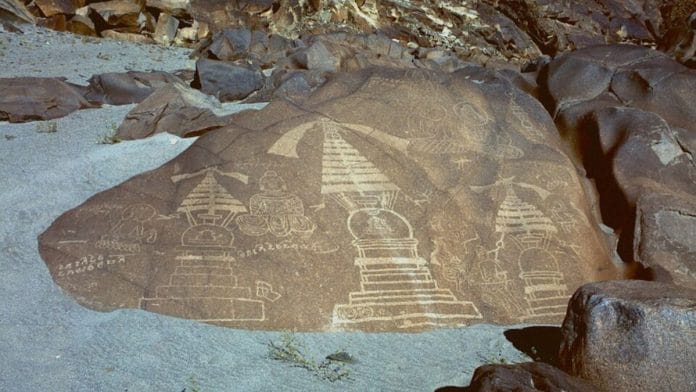
A similar, though more religious, impulse drove travellers stopping at Shatial, on the banks of the Upper Indus (now Kohistan in Pakistan). On this ancient, rocky riverbank, merchants and pilgrims waited for the torrent to slow before they attempted to cross. Historian Ahmad Hasan Dani, in Human Records on Karakorum Highway (1995), notes that there are more than 1,000 inscriptions here, many in Brahmi, with carvings of entire stupas and Jataka scenes—prayers for safety from the dangerous waters.
But, as with Socotra, Indians were not the only travellers at this site. Sogdian merchants, veterans of the Silk Routes, carved Zoroastrian fire altars on the same rocks where Buddhists carved stupas. The same anxiety, but addressed to different gods. While the World Monument Fund is attempting to digitise some of these inscriptions, many will be underwater before the end of the decade.
Also read: Corruption was widely documented in medieval India. Spies kept an eye on kings, bureaucracy
Medieval pilgrims and art enthusiasts
In a 2023 paper, Professor Strauch argued that graffiti should be considered a genre of Indian epigraphy (the study of inscriptions) using a powerful case study: the Ashokan pillar in Prayagraj. Three rulers, across three different periods, inscribed their polished surface: Ashoka in the third century BCE, Samudragupta’s poet Harishena in the fourth century CE, and the Mughal emperor Jahangir in the late 16th century. Each deliberately chose to write on a monument associated with long-forgotten kings.
But beneath all three, Strauch points out that Alexander Cunningham, the British Raj-era archaeologist, found dozens of smaller marks: Devanagari invocations of Vishnu and Shiva, dated between 1319 and 1397 CE, nearly all recording visits during the Magha pilgrimage season. Cunningham dismissed them as modern scribblings. But these marks attest to important developments in North Indian Hindu pilgrimage networks during the time of the Delhi Sultanate. They also suggest that not just rulers, but also more workaday travellers, sought to make inscriptions on royal monuments.
Something even stranger survives in Sri Lanka. The Mirror Wall at Sigiriya— a lime-plastered, reflective surface in a fifth-century palace compound—carries hundreds of inscriptions in Sinhala, Sanskrit, and Tamil made across half a millennium. They name royalty, soldiers, metalworkers, and merchants, including twelve women, who travelled to see frescoes of heavenly ladies painted on the rock face. All were made after the abandonment of the palace.
Thereafter, it seems, visitors turned it into an impromptu art gallery-cum- comments section. As researcher Sarthak Sharma writes for MAP Academy, some visitors praised the beautiful ladies, while Buddhist monks carved warnings against infatuation. Others, writing in the voice of the women, mocked them: “You dumb men, trying so hard to write songs; none of you brought us rum and molasses!”
Also read: India lived in ancient Europe as a positive ‘Other’. Ties are way older than colonialism
Graffiti for the ages
In 1819, Captain John Smith of the 28th Cavalry became the first European to enter the Ajanta caves, nearly 1,300 years after they had been abandoned. He promptly scratched his name across an ancient fresco in Cave 10, one of the oldest sites in the complex. His inscription is now a historical artefact, dutifully noted in every guidebook. Was Smith very different from Korran? Were they both very different from the “Amit Loves Neha 2018” graffiti still left by Indian tourists and travellers, to great consternation? Personally, I think they were not.
Schmid and Strauch’s discovery reminds us that every carved name, every craftsman’s mark in a quarry, every rude couplet or scrawled prayer, is evidence of a living site, of a person who stood there, who insisted on being remembered in some way. Just like an Allahabad pilgrim’s Magha date, a Sigiriya metalworker’s poem, and Korran’s name on the wall of a pharaoh’s tomb are priceless to us, the graffiti we continue to produce will tell a story to those who come after.
This article is a part of the ‘Thinking Medieval‘ series that takes a deep dive into India’s medieval culture, politics, and history.
Anirudh Kanisetti is a public historian. He is the author of ‘Lords of Earth and Sea: A History of the Chola Empire’ and the award-winning ‘Lords of the Deccan’. He hosts the Echoes of India and Yuddha podcasts. He tweets @AKanisetti and is on Instagram @anirbuddha.
(Edited by Saptak Datta)
🌹🌹🌹