






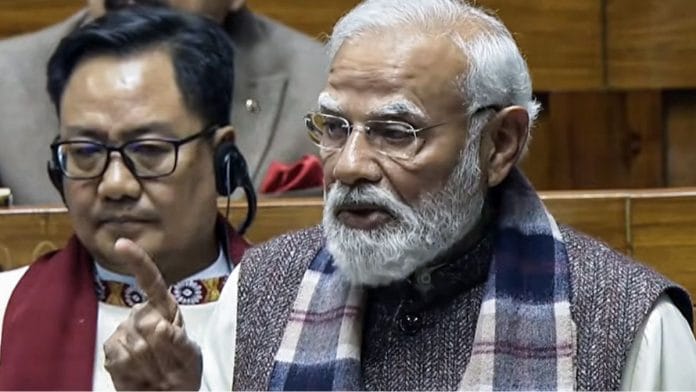



Commemorating 150 years of the national song, Vande Mataram, PM Modi opened his discussion in the Parliamentary session of the 18th Lok Sabha by stating, “Vande Mataram is the force that drives us to achieve the dreams our freedom fighters envisioned.” The debate left me wondering—why should commemorating the national song’s 150th anniversary make for a stormy debate or headlines in the media? What has become of us? This column is a response to those who questioned the relevance of such a discussion in the parliament and its timing.
When the highest representative body in a democratic polity pauses its usual business to celebrate the freedom struggle and the sacrifices made in that journey, it represents our continued struggle and evokes our shared vision of Bharat. Unfortunately, a few of my learned friends from the Opposition benches reduced it to the level of usual and casual debate.
History of the song
Vande Mataram was written by Bankim Chandra Chattopadhya. Before it made its official appearance in his novel Anandamath in 1882, it had already been published in a literary journal, Bangadarshan, on 7 November 1875.
It was an anthem for those clutching onto some semblance of notional nationality.
Rabindranath Tagore’s musical rendition at the 1896 Indian National Congress’ session in Kolkata struck the imagination of a nation desperate to rally against an oppressive, colonising regime. It is to be noted that Vande Mataram was widely accepted as the unofficial anthem of the INC (naram & garam dal included), and also by other liberal parties and the revolutionaries alike.
Post Kolkata, it was sung at Congress sessions in Varanasi and Lahore. For the opening of the first parliamentary session, Sardar Patel invited Shri Onkar Nath Thakur to sing Vande Mataram, who accepted the invitation on one condition that he would sing the whole song and not the truncated version, which was welcomed by all.
It was also the war cry of those who sacrificed everything and chose the noose around their neck rather than compromise with their morals.
As a political slogan, Vande Mataram was used to convey that we bow to our motherland and no one else. It was adopted in 1905 by students in Kolkata protesting against the Partition of Bengal. This partition, on the basis of religion, was initiated by Lord Curzon and set the stage for the eventual Partition of India into three—two Islamic states and one secular nation. A fine of Rs 5 was imposed on each of the 200 studentswho chanted the slogan.
Also read: Vande Mataram was anti-British. Here’s how it became ‘anti-Muslim’
Concerns in Congress
MK Gandhi professed support for the salutation “Vande Mataram” and said in a speech at Guwahati in 1946 that “Jai Hind should not replace Vande Mataram”. In the same speech, he reminded the attendees that Vande Mataram had been sung at Congress sessions since the very beginning, and this custom should be continued.
Vande Mataram has a poignant history, a history of bloodshed, a history of sacrifice, and Gandhi was concerned that this ethos would be forgotten by the coming generations.
In 1937, a committee, which included Jawaharlal Nehru, Subhas Chandra Bose, Tagore and others, recommended that all public renditions of Vande Mataram would be of only the first two stanzas, and the verses pertaining to Goddesses were removed. Circumstances in 1937 were different from those in 1947 and thereafter. This journey needs discussion and was missing in the recent parliamentary debate. We must deliberate on the formation of three separate countries with different motivations and how some radicalised forces continue to find space in Independent Bharat.
Bharat has been subjected to 26/11, Pathankot, attack on the Parliament, Red Fort, Pahalgam, etc. These instances are a front to nationhood and go beyond the acquisition of nationality.
Also read: Congress wasted a chance to turn the tables on BJP over Vande Mataram. It chose appeasement
Independent India and Vande Mataram
Today, at 150 years, why is it imperative to revisit and remember Vande Mataram?
At the dawn of Independence, the sacrifice, the struggle, the soul-stirring pathos in Vande Mataram were not forgotten; it was designated as the national song. Thus, Vande Mataram needs to be treated with the same respect as the other symbols of nationalist pride.
As PM Modi mentioned in Parliament, “The 150 years of Vande Mataram present an opportunity to re-establish that great chapter and glory, and neither the House nor the nation should let this occasion pass.” He highlighted that it was Vande Mataram which led the country to independence in 1947, and the emotional leadership of the freedom struggle was embodied in its clarion call.
Today, as Bharat battles unseen enemies and embarks on its journey for Viksit Bharat, the unifying spirit of Vande Mataram will take the baton forward.
But our representatives from the Opposition benches said in Parliament that bringing up Vande Mataram was a poor attempt by the BJP to “make Muslims sing” the hymn. In the same breath, they accused the party’s leaders of not being able to “sing it themselves,” stating the entire debate is a “badly scripted comedy”. The Opposition treated the discussion as a debate and a form of some organised political conspiracy.
It’s reminiscent of the deeds of the British Empire, which tried to ban Vande Mataram by treating the song as evil.
What critics of the Vande Mataram debate need to understand is that the song was the glue that bound our Independence movement together. From coastal Andhra Pradesh to Jallianwala Bagh in Punjab, from bonfires in UP to midnight pledges in Chennai and Lahore, the people of this nation found a war cry to galvanise them all towards azaadi. The national song found its relevance when the slogan of Purna Swaraj was adopted by Congress.
Members of various revolutionary groups spread across the country had adopted this song both as a code and a salutation. Irrespective of historical facts and subsequent political events, Vande Mataram continues to be revered by all. No disagreement on Vande Mataram has any place in Azad Bharat or the Independent State of India.
Naysayers who have been regurgitating the comparison between the national anthem and the national song need to remember that while the national anthem was chosen by the Constituent Assembly for the purposes of official protocol, the national song remains as venerable for its evocative and emotive significance for national dignity and self-rule. Without this emotional echo of dignity, self-rule, national pride and the bloodied history that made an Independent nation called Bharat, there would be no space for any protocol.
The activists who fight today for a chimeral “azaadi,” an illusion that exists only in utopia, would do well to remember the cost, the price our forefathers paid for us to have the “azaadi” today. It’s because of them we’re able to hold our heads up as a sovereign nation, a nation that is among the fab five, a nation that is balancing a diplomatic tight rope and wishes to remain a friend of all nations, protect its own citizens, sovereignty, territorial integrity and dignity of its own while according the same sanctity to all.
Meenakashi Lekhi is a BJP leader, lawyer and social activist. Her X handle is @M_Lekhi. Views are personal.
(Edited by Theres Sudeep)
A discussion becomes a debate when highly contentious points are made that cannot go unchallenged by the other side. In the case of this “discussion” , the PM did highlight the big role played by the song in inspiring the freedom fighters. But he took a negative track by trying to vilify the Congress for truncating the song. The references to Hindu deities in the latter part of the song would have made minorities like Jains, Muslims, CHristians, Buddhists uncomfortaable , since they have no such gods. Tagore and Nehru made this more acceptable as a national song by suggesting that only the first half be retained. The full song could aalways be sung in other contexts. Instead of understanding this, the PM stated that the Congress bent the knee to Muslims. In trying to score brownie points against the Congress , the PM unfortunately lost the fundamental purpose of the “discussion “. The importance of Vande Mataram was lost to the general public , who rely a lot on the PM’s words due to his popularity. For obvious reasons, Ms Lekhi has avoided mentioning this scooring of brownie points by the PM and has tried to dump the entire blame on the Congress for turning the discussion into a debate.