






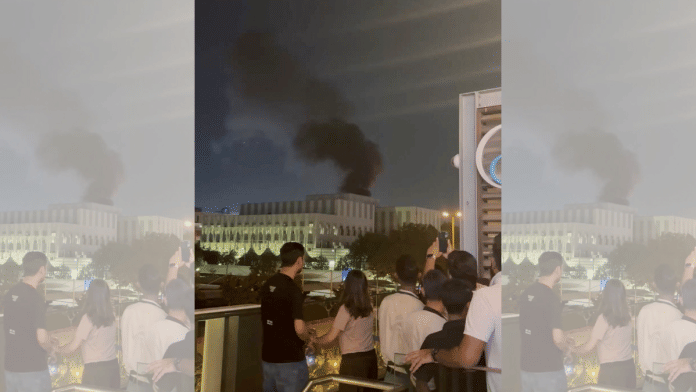



As the Iran War enters its 30th day, Dubai, the financial capital of the Middle East, is faced with a potential existential crisis. High Networth Individuals (HNIs) and affluent Indian Businessmen based in the Emirate are contemplating exiting the market, or watching with bated breath how and when this war will end. This is an opportune moment to nudge the flight of capital gently toward India. Let the winds of change blow toward the North Indian Plains or the islands in the Indian Ocean and the Arabian Sea. Lately, Dubai and Singapore have become popular choices for the global rich to build and store their generational wealth with laid-back taxation policies and welcoming open-door visa facilities.
The world today is interconnected, and geography is no longer a barrier. Rather, it has become a strategic asset. Small economies like Singapore and Dubai have shown how the right mix of policy, infrastructure, technology and vision can turn limited land into global hubs for finance, tourism, and better living. This raises an important question: Can India develop a similar model in places like Lakshadweep, Car Nicobar, Daman and Diu or any other Union Territory?
The idea is ambitious, but not unrealistic.
The country at this time, however, should grab the opportunity and gently redirect the Hindu deity for wealth and prosperity, Lakshmi’s chariot in India’s direction. This way, we could emulate the Dubai and Singapore models to redirect the inflow of capital to India.
The Singapore model
Singapore gained independence from the British in 1965, nearly two decades after India. Lee Kuan Yew, Singapore’s first prime minister, had a vision for the island nation that faced daunting constraints — limited land area, no natural resources and a volatile geopolitical regional
The city-state achieved this success in a short time by creating robust, transparent institutions, along with regulatory frameworks that operated with global standards and combined traditional Eastern philosophies with mantras of modernity. Compared to leading economic powerhouses like London and New York City, Singapore emerged as a disciplined and powerful regional economic centre. Agencies such as the Monetary Authority of Singapore ensured financial stability while actively courting international banks, multinational corporations and asset managers. Singapore simultaneously invested heavily in world-class infrastructure like ports, airports and digital connectivity, thus positioning itself as a seamless gateway between the East and the West and Australasia.
As political and economic uncertainties continu
Also Read: Why Bagher Ghalibaf and Abbas Araghchi are the most crucial negotiators in Iran war
The duralibility of Dubai
On the other hand, until the early 1980’s, the rise of Dubai from a small fishing outpost to a global financial and retail hub was neither accidental nor swift. A small Emirate, reliant on oil, evolved gradually from the launch of the Emirates Airline in 1985 and became Brand Dubai.
Dubai’s economy was primarily driven by non-oil sectors. Today, oil contributes less than 2 per cent to Dubai’s GDP, a diversified mix of trade, tourism, premium real estate and financial services form the backbone of its economy.
A supportive regulatory framework is consciously modelled on international financial centres like London and New York. Beirut was once the financial capital of the Middle East, but post the 1970s, political instability eroded its standing, and Dubai stepped up to fill the gap more than adequately. Bahrain, too, was a strong contender, but it was Dubai that delivered its promise of stability and openness, in stark contrast to the turbulent atmosphere in other parts of the Middle East.
Until now, that is.
Therin lies an opportunity
While there is a lot of chatter, both online and offline, on the “Dubai exodus”. Once a haven for upwardly mobile expats, Dubai is experiencing an exodus of mass proportions; driven by regional instability and attacks from Iran, high-net-worth individuals and professionals are reconsidering the tax haven.
A rich expat and oil professional currently hunkering down in his family home in New Delhi, having escaped the drone onslaught, told me that it’s very stressful to live in an environment of fear, especially for their families. Much like during the Covid-19 pandemic, schools have started online classes as US bases in the city are targeted by Iranian missiles. A return to the safe comforts of the motherland is the obvious choice for many of these expats.
For India, this is the opportunity to repatriate talent, attract capital inflows and boost domestic investments as investors are looking for a stable, growth-oriented economy to park their funds in, a chance to boost India’s economy. Lakshmi should be welcomed with open arms.
Dubai has in the recent past, attracted investments from Indians, offering a ten-year “Golden Visa” for investors to live hassle-free in the Emirate. Its low tax, business-friendly environment, and strong global connectivity with solid infrastructure have attracted over 18,000-20,000 Indians to live there. As of March 2026, the United Arab Emirates is home to 18-20 Indian billionaires, making it a prime location for Indians to park their wealth. In the last month, shares of Dubai-listed real-estate compa
Also Read: Gulf war exposed India’s fragilities. It’s time for navel-gazing, in the national interest
How can India bring capital back into the country?
What if all this wealth were to return to India, no questions asked. If India were to reassess its tax structure and tweak the laws related to ease of doing business in India, it could mine this golden opportunity.
India’s tax structure for business and traders, despite being comprehensive, is deeply complex. A high net worth, business income, and residents’ taxes could be adjusted based on one’s global earnings as long as special considerations specifically for this identified territory could be made.
A simpler taxation system free from a complicated maze to navigate could be evolved specifically for a designated investment-friendly territory to boost the economy. Business concerns must be addressed comprehensively, and burdens of compliance should be eased. It is easy to follow Dubai’s simplified tax model. No personal income tax, no capital gains tax and no taxation of global income. For business persons engaged in equities, forex, global derivatives and others, this compounds over time and leads to generational wealth building in less than a decade.
If India were to consider building a Dubai-type model, to attract all the expats and high-net-worth individuals, and invest in Indian infrastructure, there would be a huge inflow of capital. If Dubai-like investment opportunities, golden visas and a freer taxation environment were created in India, there could be an inward flow of capital. Capital flow from BRICS countries will also require greater integration into the Indian economy. We must work out a formula to integrate insurance and investment companies for capital to flow into our economy.
Welcoming back prosperity
India cannot replicate the Singapore or Dubai model without considerable adaptation. India’s demographic scale and social diversity demand a much more inclusive model than the above-mentioned cities.
A world-class city here would need exclusive facilities, controlled environments and skilled workers. Civic sense would need to prevail. A GIFT-style city, based on the concept of zero emissions, off-grid, renewable energy, based on a sustainable development model and the opportunity to become a tax haven could attract investment fleeing Dubai. GIFT City has an IFSC Status, meaning it operates as a foreign territory within India, allowing transactions in foreign currency with relaxed compliance and tax, attracting global investors, HNIs, and NRIs. Further, businesses attract a tax-free holiday for 10-15 years, and rules for GST compliance are more relaxed. Banks such as JP Morgan and HSBC are given fast-track permissions to operate in a global financial environment. The GIFT City concept could take off in regionally backward places and transform the landscape of India for Viksit Bharat.
Importantly, it will allow India to show a new development model — one that balances growth with sustainability. India has the opportunity to build something unique. It does not need to replicate existing global hubs; instead, it can create a model that reflects its own priorities and strengths.
Meenakashi Lekhi is a BJP leader, lawyer and social activist. Her X handle is @M_Lekhi. Views are personal.
(Edited by Insha Jalil Waziri)