






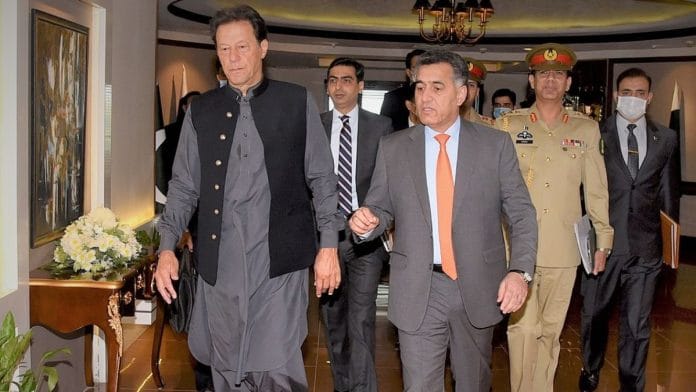



Lt Gen Faiz Hameed (retd), former Director-General of Pakistan’s Inter-Services Intelligence, was finally convicted and sentenced to 14 years rigorous imprisonment on four charges. They include “involvement in political activities, violation of the Official Secrets Act which harmed the interest of the state, misuse of his powers and government resources, and causing harm to citizens”. This verdict indeed indicates a vital turn of events, especially what it means for the political future—or lack thereof—for the incarcerated Pakistan Tehreek-e-Insaaf leader Imran Khan.
While the former DG ISI was being tried by a military court since 2024, the verdict was long-awaited, often creating the impression that he may not get punished at all. Hameed had resigned from service in December 2022, the same year that Khan was removed from the office of the prime minister through a non-confidence motion by the parliament.
His resignation paved the way for several cases to be brought against him. One such instance was the corruption case in 2023 regarding a housing scheme called Top City, where CEO Kunwar Moeez Khan accused the former DG ISI of illegally raiding his house, harassing his family, and forcing him to turn over company shares to his brother. It seems that the army did not take kindly to this instance of graft and corruption.
Cases against Hameed
It is no secret that Hameed is not the only senior general in Pakistan Army who has engaged in misuse of authority or corruption. And he is not the only one removed from service for corruption. In 2016, then army chief General Raheel Sharif tried and sentenced Lt Gen Obaidullah Khattak and Maj Gen Ejaz Shahid on corruption charges. The history of the army punishing its own among the officer cadre dates back to the 1950s.
However, this is certainly a peculiar case of a senior officer being tried and sentenced for trying to manoeuvre his own institution for his own power ambitions. Hameed also used Khan for the purpose, putting him directly in conflict with the current army chief, Field Marshal Syed Asim Munir. Both Hameed and Khan tried to use their positions to capture greater power and extend their respective stay in positions of influence.
While many may think of this case as Munir’s personal anger against both the general and the Pakistan Tehreek-e-Insaaf (PTI) leader, the fact is that the army as an institution, especially the top ranks, wasn’t pleased with Hameed’s behaviour. Even Munir’s predecessor, General Qamar Javed Bajwa (retd), was unhappy with Hameed—the latter used Khan to protect his position as the ISI head.
As prime minister, Khan had refused to relieve Hameed of his duties as DG ISI for a few months and get posted as Corps Commander Peshawar in 2021. This change was then necessary, even if Hameed was to be considered for the position of the next army chief; commanding a corps is a prerequisite. But at that time, Khan was dependent on the DG ISI’s support and ideas. This delay did not make Hameed popular among the rest of the generals.
Hameed has also been accused of conspiring against the Pakistan Democratic Movement government and the newly appointed Army Chief Asim Munir by instigating a mini–rebellion on 9 May. This case is still being pursued, as is obvious from the Inter-Services Public Relations (ISPR) press release. More sentencing could be coming, not just for Hameed but also for Khan.
Also read: Lt Samuel Kamalesan’s dismissal for religious stand shows colonial mindset. Army must end it
Munir is now unstoppable
Munir cannot seem to get over 9 May as a moment when Hameed and Khan came close to breaking the military’s institutional esprit de corps. According to sources, the Field Marshal at one point even wanted to turn the Corps Commander Lahore’s residence—that faced attack from PTI supporters—into a museum to highlight the moment of internal attack on the military.
Stories circulate on the Islamabad grapevine, one being that the delay in Munir’s notification as the Chief of Defence Forces (CDF) until 2030 was because the Sharifs insisted on Hameed’s verdict. However, it is less about what the politicians in power could extract from Munir and more about the army chief waiting to consolidate his most powerful position in the military hierarchy to drop this bombshell. Indeed, the verdict is a message to all those within the services with sympathy for Khan. They will be dealt with a heavy hand if they continue to nurse such sentiments.
Politically, the trajectory is much clearer—it means that Munir is now prepared to convict and sentence Khan as well for instigating a rebellion against the army chief, with no possibility of any reproachment or mercy. This was also obvious from the DG ISPR’s recent press conference, in which he called Khan mentally unwell and dropped clear hints of dealing with the PTI leader and his party with a heavy hand. As long as Munir is in power, Khan will remain incarcerated, and probably will be dealt with more severely than before, perhaps with as heavy a hand as Zulfiqar Ali Bhutto and Nawaz Sharif were when they were in jail.
The verdict against Hameed underscores Munir’s strength within his own institution. Even if some may not agree with the decision, which can no longer be challenged in the Supreme Court, they will keep their heads down. They are now dealing with a commander who cannot be challenged domestically and can show off his relevance globally. And US President Donald Trump’s recent bonhomie and praise for Pakistani military leaders have only bolstered Munir’s overall power and significance.
If anyone thought that Munir was going to crash and collapse due to internal resistance, they have been proven wrong. This also means that he will now feel more confident to bring more changes politically without any fear of another meaningful political rebellion.
Ayesha Siddiqa is a senior fellow at the Department of War Studies at King’s College, London. She tweets @iamthedrifter. Views are personal.
(Edited by Prasanna Bachchhav)