






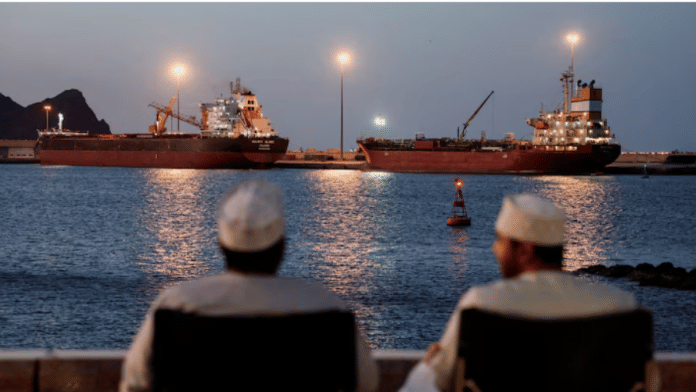



The closure of the Strait of Hormuz has intensified anxieties across global energy markets, over supply chain disruptions and risks to maritime trade. On the Chinese internet, the crisis has generated sustained attention, with discussions highlighting the structural vulnerability of this critical chokepoint.
Commentators described the situation as the most severe disruption since the Iran-Iraq War (1980-1988), while the Weibo hashtag “no ships passing through the Strait of Hormuz” has been all over Chinese social media handles.
A Global Times article suggests that while a prolonged, total closure of the Strait remains unlikely, elevated tensions are expected to persist, injecting volatility into global energy flows and economic activity.
Wang Xu, an expert on the Middle East at Beijing Foreign Studies University, argues that a sustained blockade would impose high economic and political costs on Iran, thereby constraining its long-term feasibility. This logic, he notes, helps explain why the Strait has historically never been fully and permanently closed.
Chinese online discourse also situates the crisis within a broader geopolitical context, particularly the hesitancy of US allies to support Washington. Widely circulated Weibo posts point to the risks already incurred by allied naval forces in escort missions against Houthi attacks in Yemen, suggesting that further commitments in the Strait would entail disproportionate costs.
Some commentators interpret this reluctance as indicative of a shifting international order, characterised by a more cautious and interest-driven approach among US partners. A viral Weibo post claimed: “The era of America’s absolute authority is over. These so-called allies are vocal before a war, but when trouble comes, they retreat faster than anyone else.”
At the same time, a prominent strand of commentary portrays China as comparatively well-positioned to absorb potential shocks. Among major Asian oil importers, China is framed as possessing relatively strong systemic resilience, with a lower likelihood of acute short-term supply disruptions.
From China’s vulnerability to resilience
The crisis has also intersected with the US-China tensions. Chinese social media users reacted sharply to reports that US President Donald Trump threatened to cancel a planned visit to China if Beijing declined to assist in managing the situation. The remark was widely dismissed online as both politically ineffective and rhetorically excessive.
A viral Weibo post mocked the statement, quipping that “Trump even threatened us: if China doesn’t send warships, I won’t visit China. Oh my, that scared us to death!”, while another described the comment more bluntly as “shameless.”
Chinese discourse frames the crisis as a stark reminder of the country’s enduring energy vulnerability. Heavy reliance on imported crude transiting a narrow maritime corridor is widely viewed as a structural weakness, with the 2026 Iranian blockade and the resulting surge in global oil prices cited as evidence of fragile external supply chains. This has sharpened debates over China’s energy security.
While China’s rapid expansion of wind and solar is acknowledged, these sources are seen as insufficient for meeting the high-temperature demands of heavy industry. Nuclear power, by contrast, is increasingly framed as a strategic solution. Commentaries highlight China’s accelerated nuclear buildout and advances in next-generation technologies, contrasting this momentum with regulatory and political constraints in the US. Within this framing, nuclear energy is positioned as a pillar of domestic energy security and as a means for China to shape future global standards.
Victor Gao, Chair Professor at Soochow University and Deputy Director of the Center for China and Globalization, highlights that coal remains China’s most abundant energy resource. He argues that even under extreme conditions, such as a complete disruption of foreign crude supplies, China would retain the capacity to sustain economic activity by relying on domestic coal reserves.
Chinese commentary further highlights a broader strategy of energy diversification. China now sources crude oil from a wide range of suppliers, while overland pipelines with Russia, Kazakhstan, and Myanmar reduce dependence on maritime transport routes. Major infrastructure projects, including the China-Russia East Route gas pipeline and the planned Power of Siberia 2, are central to this approach.
In addition, Arctic shipping routes are increasingly discussed as a means of bypassing traditional chokepoints and mitigating exposure to geopolitical risks in the Middle East. Diversification is thus framed as a hedge against supply disruptions and a mechanism to enhance strategic autonomy and bargaining power.
Chinese commentary also calls for a more proactive role in maritime governance and emphasises the importance of reducing reliance on any single supplier. Russia, which has emerged as China’s largest crude provider, supplies a significant share of oil through pipelines that circumvent maritime chokepoints, thereby enhancing supply security.
Also read: The West’s real crisis isn’t war. It is the weakness within
India’s structural vulnerabilities
India is widely perceived in Chinese discourse as one of the most vulnerable actors in this scenario. An observer remarked, with its global energy lifelines under threat, India, reliant on the Middle East for roughly two-thirds of its liquefied natural gas, appears to be “in a state of panic.” Another commentary suggested that India long assumed its energy purchases would grant it leverage in global markets. The current crisis, however, upends that assumption, with Iran turning the Strait into a strategic bargaining chip.
This “choking” reportedly forced New Delhi to abandon ‘arrogance’ and adopt an unusually low-profile stance towards Tehran.
Dong Ximao, deputy director of the Shanghai Finance and Development Laboratory, argues that India faces among the highest risks of supply disruption in Asia. The country imports roughly 85 per cent of its oil, with nearly half passing through the Strait of Hormuz. Limited strategic reserves and refineries tailored for high-sulfur Middle Eastern crude constrain its ability to diversify quickly.
Even easing US sanctions on Russian oil would offer little immediate relief, and measures such as suspending fuel exports have only marginally mitigated these structural vulnerabilities.
A commentator highlighted what is perceived as a dilemma for the Indian government: it must sustain alignment with Washington’s Indo-Pacific strategy while simultaneously increasing oil imports from Russia to support domestic needs. This tension, in turn, is seen as reshaping New Delhi’s diplomatic priorities.
Another dimension of the discussion concerns India’s security role. A Zhihu post noted that although Trump did not explicitly mention India, New Delhi responded proactively to US calls for multilateral cooperation by deploying naval vessels to escort its oil tankers. Some commentators suggest that if additional countries adopt similar measures, Iran’s capacity to enforce an effective blockade of the Strait could be significantly diminished.
In Chinese discourse, the Strait of Hormuz crisis highlights both the fragility of global energy dependence and the limits of US influence, as allies hesitate and India faces acute vulnerabilities. Beijing is depicted as seizing the moment to bolster resilience through diversification, nuclear expansion, and alternative routes, while New Delhi appears constrained by its energy reliance and strategic trade-offs.
In an era of contested chokepoints and unreliable alliances, energy security is once again taking centre stage in shaping the regional balance of power.
Sana Hashmi is a fellow at the Taiwan Asia Exchange Foundation. She tweets @sanahahsmi1. Views are personal.
(Edited by Saptak Datta)
WHEN CHINESE MESSAGING GETS AN INDIAN BYLINE
This article takes Beijing’s preferred story about India and hands it to readers whole — no questions asked, no context provided, nothing pushed back on. That story goes like this: Bharat is panicked, weak, confused and scrambling while China sits above it all, calm and in control. Every paragraph repeats this. At no point does the article stop to ask whether any of it holds up.
THE REAL STORY IS WHAT’S LEFT OUT
China is Iran’s biggest trading partner and has more economic pull over Tehran than any other country on earth. China buys over 90% of Iran’s oil exports — roughly 1.4 million barrels a day. That is not a bystander relationship. That is a lifeline. A blocked Strait hurts the West, strains US alliances, and puts countries like India in difficult corners. The question the article never bothers to ask is the obvious one: who does this crisis actually benefit? And why does an article about Chinese strategic thinking not find that worth a single line of scrutiny?
What readers get instead is a string of Weibo posts mocking Trump and congratulating China on its foresight.
THE ‘VULNERABLE INDIA’ STORY DOESN’T HOLD UP
Japan sources 75% of its oil from the Middle East. South Korea sources 70%. Both countries hold only two to four weeks of LNG reserves. Neither has pipelines, alternative routes, or meaningful domestic production to fall back on.
In 2025, 78% of all Middle Eastern crude exported to China, Japan, South Korea and Taiwan flowed through the Strait. India is not an outlier. It is one of many.
Where are the Weibo posts about Japan’s panic? Where is the mockery of South Korea abandoning its arrogance?
Nowhere. Because this is not really about energy dependence. It is about singling India out — getting Indians to believe that Bharat alone is exposed, helpless and out of options. A country that starts believing that about itself pulls back, treads carefully, stops throwing its weight around. That is the effect of this kind of messaging.
THE ‘DILEMMA’ CHINA MADE UP
This article presents India’s position — balancing Washington’s Indo-Pacific goals against buying Russian oil — as though India backed into it by accident.
India built this position on purpose. Since 2022, India has been buying Russian crude cheaply, keeping Washington close, refusing to join Western sanctions, and keeping both sides engaged. That is not stumbling around. That is deliberate strategic positioning — answerable to no one, useful to everyone.
The article calls this a dilemma because calling it a strategy would mean admitting that India is not confused at all. That is not a conclusion Beijing’s messaging welcomes.
WHAT THIS ARTICLE SHOULD HAVE BEEN
Readers deserved an article that read Chinese discourse and then questioned it — not one that simply wrote it down. They deserved someone asking who actually benefits from a blocked Strait and whether Chinese silence is strategic convenience rather than helplessness. They deserved a reality check on whether China’s much-talked-about pipelines and energy alternatives are actually working at the scale being claimed. They deserved to be told plainly: this is Chinese messaging, and Chinese messaging is not without purpose.
Instead they got the messaging itself, dressed up as analysis.
The most effective attack on any nation is not the one that destroys its capabilities. It is the one that convinces the nation its capabilities don’t exist. That is what this article does to Bharat.