






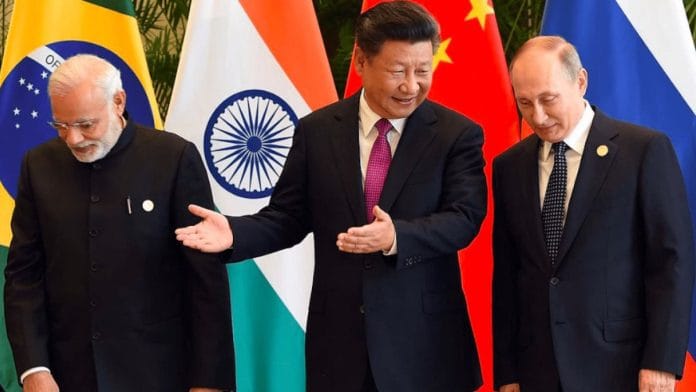



After a four-year hiatus, Russian President Vladimir Putin is visiting India for the 23rd Russia-India Annual Summit on 4-5 December. In Chinese online discourse, the visit is framed as consequential. It is seen as less of a diplomatic gesture and more of a transactional move focused on three core areas: energy deals, weapons sales, and nuclear cooperation.
On Weibo, hashtags ‘Putin to visit India’ and ‘India continues purchasing defence equipment from both Russia and the United States’ are attracting thousands of views. One Weibo user captured the prevailing Chinese anxiety.
“India already has 200 Russian aircraft and multiple S-400s. Now Putin brings Su-57s and S-500s. Given China-India and India-Pakistan dynamics, what game is he playing?” he wrote.
Russia under pressure
Chinese commentators frame Putin’s visit as a means to ease Russia’s financial strain after years of Western sanctions and the enormous costs of post-war reconstruction. Battlefield gains, a commentator notes, have not eased pressure on the Kremlin; they have only highlighted growing fiscal burdens. And now, Russia looks toward India, is the narrative.
The accompanying cooperation agenda, including technology transfers and joint research and development, is interpreted as a sign that Russia aims not only to continue selling weapons but also to deepen long-term military ties. Joint research and development helps Russia secure revenue while maintaining a stable arms export market. Beijing sees this as a move to stabilise a “special and priority strategic partnership”, enabling Moscow to better withstand Western pressure.
Chinese analysis also emphasises regional implications. The visit is also about projecting influence across the Asia-Pacific. Both India and Russia, as core BRICS members, share common interests and a broad consensus on regional issues.
Also read: That one sentence from US central bank changed gold prices
Arms race in Indian subcontinent
Chinese analyses highlight India’s defence procurement as a technical hedge against China. The headline acquisitions—Su-57E stealth fighter, R-37M air-to-air missile, Zircon hypersonic missile, S-500 surface-to-air system, and anti-stealth radar—are being described as five “killing weapons” against the People’s Liberation Army. They’re seen as an integrated “air supremacy plus air defence plus anti-stealth” network. Beijing interprets this as India bolstering its position against both China and Pakistan.
In Chinese commentary, the potential Su-57 sale is viewed as particularly momentous. Analysts note that the aircraft has stealth limitations: its radar cross-section is reportedly 0.1 sq m, larger than the J-20’s 0.05. However, it is still considered superior to the Rafale, capable of super cruise at Mach 1.3 and equipped with R-77 missiles with a 110 km range.
Chinese observers stress that India’s domestic defence industry is too weak to reverse-engineer the platform, making a full transfer a “blood transfusion” for the Indian Air Force through the Russian deals.
Commentators also suggest that such developments demonstrate Russia’s balancing act and could challenge China’s calculations vis-à-vis the regional military balance.
Also read: Why China targets Arunachal citizens — and how Nehru, Patel and Khathing saw it coming
India’s balancing act
Wang Shida, deputy director and researcher at the Institute of South Asian Studies, China Academy of Contemporary International Relations, noted that India and Russia will not abandon their long-standing strategic partnership. Covering military and strategic cooperation, this relationship is rooted in mutual strategic needs and historical Cold War ties, he added.
Chinese discourse largely admires India’s careful balancing act. Modi is praised for exercising strategic autonomy: ties with Russia compel the US to offer better terms, while engagement with the US pressures Russia to retain India as a partner. This “art of wall-riding”, a commentator wrote on Baijiahao, reflects sophisticated diplomacy, leveraging great power competition to India’s advantage.
Beijing-based South Asian Studies newsletter argues that India’s high-profile invitation to Putin, despite the International Criminal Court’s arrest warrant, is part of a strategy to strengthen India-US relations while also deepening ties with Russia.
“The US may be angry about Putin visiting India. But is Modi afraid? If he were, there would be no meeting. Time we stop labelling India as simply ‘pro-American’ or ‘pro-Russian’. Modi is working for India’s interests,” added a Baijiahao commentator.
One commentary sums up the prevailing sentiment regarding New Delhi. According to the author, India is neither constrained by Russia’s “friendship” nor swayed by American “smears”, and is following its own “India First” rhythm. Drawing on 5,000 years of civilisation and focusing on domestic development, India will not become anyone’s pawn, the commentator wrote.
For Beijing, the central questions are around Moscow’s motives, Washington’s response, and India’s navigation between international expectations and sovereign choice.
Commentators emphasise India’s evolving role in a multipolar world, noting that the summit could influence New Delhi’s relations with the West, test its strategic autonomy, and shift regional balances, especially as Moscow appears to be reaching out to a strong alternative partner.
This re-engagement is prompting China to reassess its own influence and strategic calculations in a shifting regional landscape.
Sana Hashmi is a fellow at the Taiwan-Asia Exchange Foundation. She tweets @sanahashmi1. Views are personal.
(Edited by Prasanna Bachchhav)