






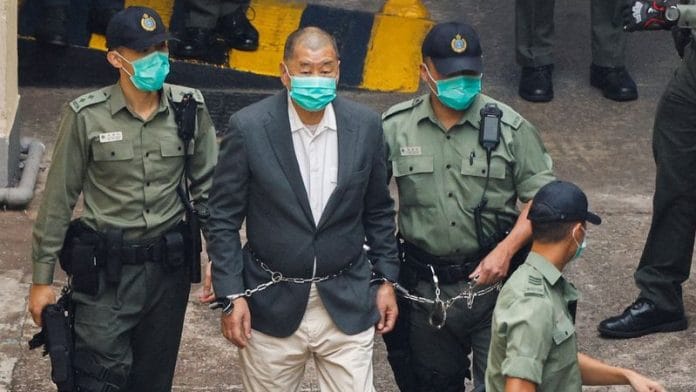



Jimmy Lai, a media tycoon from Hong Kong, has been convicted on national security charges, bringing a five-year legal saga to a close. Once celebrated at home and abroad as a beacon of Hong Kong’s democracy, he is now portrayed by Chinese media and online commentary as a threat to national security.
On 15 December, Hong Kong’s High Court convicted Lai on two counts of conspiring to collude with foreign forces and one count of conspiring to publish seditious materials.
The case unfolded under Hong Kong’s National Security Law (NSL). Imposed by Beijing in 2020, the NSL redefined the rules on dissent, media activity, and foreign engagement, creating a framework through which political behaviour came to be judged and controlled by the state.
In Lai’s trial, the law—the basis of his arrest and charges—shaped both the verdict and the surrounding narrative by creating scope to convict individuals on vaguely defined national security grounds. It shows how legal frameworks and media discourse combine to define the limits of acceptable politics in Hong Kong.
Across Chinese online platforms, reporting follows highly standardised language. Lai is described as “the mastermind behind the Hong Kong version of the colour revolution” and “an instigator of anti-China riots in Hong Kong”. Repeated phrases such as “anti-China” and “colluding with foreign forces” narrow the interpretive space available, establishing clear moral and political boundaries.
No space for democratic symbols
In Chinese digital discourse, Lai’s conviction is presented as self-evidently justified. He is consistently characterised as “anti-Hong Kong”, a leader synonymous with “chaos and social disorder”. His democratic ideals are actively dismantled. His media empire is portrayed as a vehicle for political manipulation while its stance on press freedom is hardly referenced.
The language echoes categories embedded in the NSL, particularly those surrounding ‘collusion with foreign forces’ and ‘subversion of state power’. Online commentary frames the law’s logic as natural and uncontestable. In this narrative, Lai isn’t seen as a journalist. He is instead presented as a political broker operating behind a facade of media work, serving foreign interests while undermining the “one country, two systems” framework.
Historical and ideological references used by Chinese social media users further reinforce this image. A BiliBili vlogger likened Lai to a member of the Mao Zedong-era Gang of Four, portraying him as opposing the government in a similar style in Hong Kong. Another commentator wrote that Lai influenced some Hong Kongers to leave for the United Kingdom, where they discovered that they were not British and could no longer return to China. Such narratives emphasise betrayal, misguidance, and the personal cost Hong Kongers had to pay for aligning with foreign forces.
Chinese discourse also stresses a strict separation between freedom of expression and opposition to the state. One comment contended that while expression can be diverse, behaviour must remain within the law. The commentator added that criticism of the government is permissible, but collusion with external forces and subversion of social order will not be tolerated.
Also read: Epstein files and what they mean for the American anger against elites
American chess piece
External interference is central to Lai’s portrayal in China. He is embedded in what is described as the “Chongguang team”, a supposed cross-border political network linking foreign foundations, local actors, media amplification, and street mobilisation. Hong Kong’s unrest is framed as a coordinated operation orchestrated from abroad. This narrative reinforces the claim that national security enforcement under the NSL is both justified and unavoidable.
Yao Chun, a Guancha columnist, wrote that during the Cold War, the US often advanced foreign propaganda and influence projects through “committees, foundations, broadcasts,” and other relatively non-governmental channels. The Jimmy Lai case, Yao notes, is one such node. Western concern over Lai’s conviction is framed as anxiety over the dismantling of this proxy system. Lai is cast as an American chess piece in Hong Kong, and his conviction is seen as proof of China’s success in countering foreign influence.
At the time of Lai’s arrest, Hu Xijin, former editor-in-chief of the Global Times, stated that Hong Kong’s future lies with China and not Washington. Following foreign interests, Hu argued, is no longer an option; upholding stability protects the law, supports China, and serves the people’s fundamental interests.
A ‘rock-solid’ state response
Chinese online commentary consistently depicts the state’s response as firm and uncompromising. Commentators argue that Hong Kong has fundamentally changed and, despite sustained international pressure, China’s position remains rock solid. The High Court judgment is presented as evidence-based and immune to external interference, including the presence of representatives from a number of countries at the trial and calls from Donald Trump to “save people”. China did not yield; the court proceeded with the conviction.
Other commentators place the case within a broader strategic context. Lai’s prosecution is described as merely the “fuse”, with China itself identified as the true target of foreign forces. Lai’s conviction is framed as the lawful dismantling of this channel and the failure of efforts to influence Hong Kong through local intermediaries.
A Zhihu post described the verdict as setting a benchmark for Hong Kong’s national security enforcement. “No matter who the individual is or who supports them, crossing the red line of national security will inevitably lead to punishment under the law,” the post read.
This discourse reflects a visible surge in nationalist sentiments within China. While dissenting views remain rare due to both self-censorship and state censorship, the dominance of the Lai narrative cannot be explained by suppression alone. China’s framing of its actions as necessary to safeguard national security appears to resonate with domestic audiences.
By redefining dissent, media activity, and foreign engagement through a security-centric lens, Beijing is normalising the persecution of individuals and organisations in the name of national security. Convictions such as Lai’s become the primary measure for evaluating both legal outcomes and public discourse.
Sana Hashmi is a fellow at the Taiwan-Asia Exchange Foundation. She tweets @sanahashmi1. Views are personal.
(Edited by Prasanna Bachchhav)