






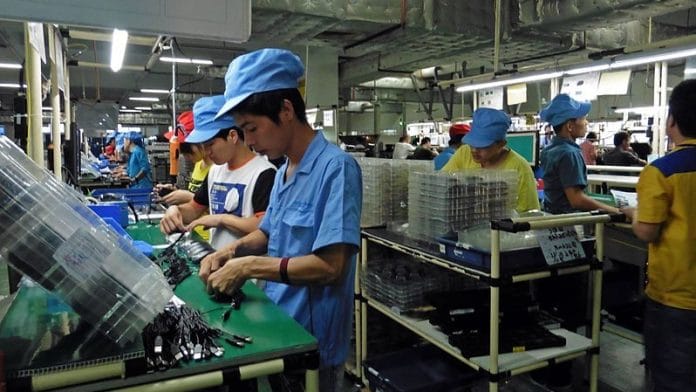



Chinese Vice Premier He Lifeng, speaking at the World Economic Forum in Davos, declared that China aims to become the “world’s market”, not only the “world’s factory.” His remarks reflect ongoing debates, both internationally and within China, about the country’s role in global manufacturing amid large trade surpluses, supply chain dependencies, and mounting geopolitical pressures.
Several major economies have responded through derisking and protectionist measures. Apple’s decision to shift part of its production to India is cited, with the share of “Made in China” iPhones in the US market projected to fall from 70 per cent to 25 per cent by 2025.
Domestic indicators and discourse, however, point to resilience in China’s manufacturing sector. According to the National Bureau of Statistics (NBS), China’s manufacturing Purchasing Managers’ Index (PMI) reached 50.1 in December 2025, returning to expansion for the first time since April. New orders in higher-value sectors, including agricultural processing and high-end equipment, exceeded 56 per cent. Although the PMI dipped slightly to 49.3 in January 2026, NBS forecasts suggest that China will remain the world’s largest manufacturing leader for a 16th consecutive year.
Chinese commentary frames this performance and projections as moderate expansion supported by structural upgrading, signalling a shift from “scale expansion” toward “value creation”.
Structural shifts and industrial strategy
Chinese analysts describe the manufacturing sector as mixed yet structurally resilient. Large and medium-sized enterprises continue to expand, while smaller firms face tighter margins, reflecting a transition toward more technologically advanced and efficient production.
Li Daokui, professor of economics at Tsinghua University, emphasises that manufacturing remains central to China’s economic model. He echoes that the country is moving away from large-scale, low-value production toward higher-value, technologically integrated output, supported by coordinated development across traditional and emerging sectors. During the 14th Five-Year Plan period, according to Li, China maintained global leadership in manufacturing value, with rapid growth in new energy vehicles, shipbuilding, high-end equipment, and digital integration enabled by 5G and the industrial internet. CCTV commentator Jiang Wei highlights the parallel shift toward intelligent, green, and high-tech manufacturing, noting that China hosts nearly half of the world’s “lighthouse factories”.
The US mobile phone market and its tilt toward India illustrates both a challenge and an opportunity within Chinese discourse. While “Made in India” products have gained short-term advantages, analysts stress that long-term competitiveness depends on industrial upgrading, research and development, intelligent manufacturing, and enhanced product value. Market diversification is also viewed as a buffer against external trade shocks.
Domestic commentary reinforces this perceived trajectory. One Weibo post summarised it as: “The road to upgrading Made in China: first cars, now ships, soon machines; first domestic substitution, then international expansion.” Commentators highlight gains in intelligent manufacturing, driven by 5G and the industrial internet, which have improved efficiency, expanded smart factories, and drawn small and medium-sized enterprises into digital transformation. Green manufacturing is presented as both a necessity and a growth driver, supported by rising green consumption, low-carbon technologies, and renewable energy integration. Views like these translate policy goals into industrial practice, framing 2025 as a year of accumulation and breakthrough that strengthened the resilience, competitiveness, and global standing of China’s manufacturing system.
Also read: Xi’s military purges are less about China’s strategic goals, more about party control
Micro indicators and macro strategy
Within Chinese discourse, the January 2026 PMI decline is treated as a micro-level signal of current economic conditions rather than a transient shock. A commentator noted weak demand, pressure on SMEs, and uneven performance in non-manufacturing sectors, while highlighting resilient areas such as high-tech manufacturing and modern services. Investors are advised to focus on structurally strong sectors and monitor policy support, with monthly PMI fluctuations serving as tools to assess short-term dynamics within the broader structural context.
At the macro level, Made in China 2025 is framed as a transformative initiative guiding long-term industrial strategy. Launched in 2015, it is considered to have met key targets, including progress in electric vehicles, smart factories, 5G deployment, the C919 aircraft programme, and shipbuilding, laying the foundation for the 2024-launched “New Quality Productivity” initiative. Zang Jiyuan, a manufacturing strategy scholar at the Chinese Academy of Engineering, notes that external pressures, including Western technological containment, have accelerated domestic technological self-reliance and shaped debates on balancing global competition with internal structural development.
These developments are situated within a broader strategic framework that addresses persistent constraints, including Western trade restrictions, reshoring by advanced economies, lagging consumption, and slow commercialisation of frontier technologies. Policy measures, expanding domestic consumption, boosting industrial investment, supporting R&D, and promoting overseas operations are presented as key levers to convert innovation into scalable production and sustainable growth.
Within Chinese discourse, manufacturing is portrayed as facing real but manageable challenges. Perceived short-term fluctuations, such as the January PMI decline, are treated as signals for adjustment rather than signs of structural weakness, while achievements of initiatives such as Made in China are highlighted and celebrated. Narratives acknowledge pressures from weak demand, external restrictions, and competitiveness, yet emphasise resilience, continuity, and long-term planning. Policy support and industrial upgrading are presented as reinforcing the sector’s trajectory, reflecting a prevailing trust in manufacturing as the anchor of economic stability in a new avatar and the broader economy’s resilience in China.
Sana Hashmi is a fellow at the Taiwan-Asia Exchange Foundation. She tweets @sanahashmi1. Views are personal.
(Edited by Aamaan Alam Khan)
Meanwhile, India is busy with freebies, subsidies, reservations, and loan waivers.