






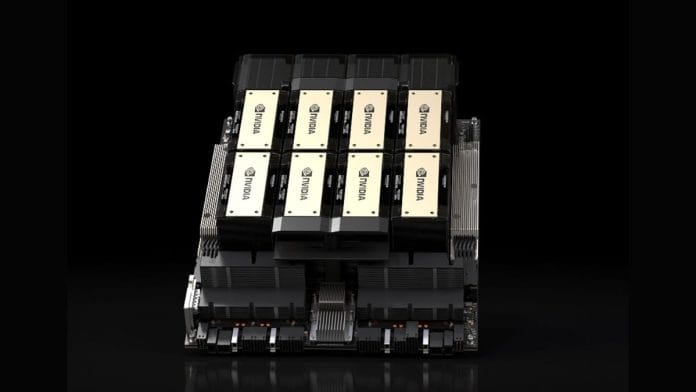



US President Donald Trump’s recent announcement permitting the sale of Nvidia’s H200 AI chip to China has elicited a lukewarm response from the country. Far from signalling a major policy shift, the move has been interpreted through a lens of longstanding distrust toward US export controls and perceived unpredictability under the Trump administration. Additionally, Chinese reactions suggest that Trump’s decision is driven less by strategic confidence and more by American anxiety.
Limited appeal
A Baijiahao commentator argued Trump misread China’s priorities and interests, expecting a warm reception but encountering a cool and measured response. This indifference is widely interpreted as confidence grounded in China’s growing technological self-reliance, with US export controls and the AI competition seen as accelerating, rather than constraining, China’s drive for independent AI chips.
Chinese analysis characterised the H200 sale as “wishful thinking,” arguing that, like its predecessor H100, the chip is unlikely to see broad adoption. The easing of restrictions is attributed more to Nvidia’s inventory and revenue pressures than to geopolitical intent. With newer, more power-efficient Blackwell chips supplanting older models, domestic US demand has weakened, making China a convenient outlet for dumping surplus H200 stockpiles.
Nvidia CEO Jensen Huang’s lobbying for relaxed export restrictions, citing economic costs and the company’s shrinking presence in China, is well documented. According to a widely circulated Weibo post, Nvidia’s share of China-related revenue has fallen to 5.2 per cent, while domestic chip penetration has risen to 30 per cent. Security vulnerabilities and monopoly concerns surrounding the H100 and H200 continue to attract scrutiny. Meanwhile, Chinese firms are rapidly localising their AI ecosystems. Examples include: Huawei unveiling a three-year roadmap for its Ascend AI chips, while Alibaba, Tencent, Baidu, and ByteDance ramping up investment in chip research and design.
Hu Xijin, former editor-in-chief of the Global Times, contended that Trump’s decision reflects two pressures. First, China’s rapid progress in independent chip technology has weakened the effectiveness of US export controls, leaving advanced chips as one of Washington’s last levers to slow China’s technological rise. Second, concerns over rare-earth supply stability have prompted the US to ease restrictions to reduce China’s leverage over upstream materials. According to Hu, this move is motivated by pressure rather than goodwill, allowing partial reliance on American chips, while withholding cutting-edge Blackwell and Rubin technologies to blunt incentives for full self-sufficiency. In essence, the Chinese view is that the US is willing to sell “sub-par” products, while keeping next-generation technology firmly under American control.
Within Chinese discourse, the H200 is seen as useful for short-term AI training but limited in strategic value. US chips are regarded as unreliable, reinforcing China’s focus on building a self-reliant AI ecosystem. Economically, the H200 offers limited cost advantages and does not directly compete with domestic GPUs, which dominate inference workloads. Policy direction, market demand, and capital allocation are considered far more decisive than the availability of any single chip.
Also read: NSS to NDAA—the gap between Trump’s MAGA worldview and US actions is impossible to ignore
Seen as a transitional product
A post on Zhihu noted, from Washington’s perspective, the decision balances commercial and national security interests. It allows Nvidia to reduce inventory and stabilise revenues, while offering China only incremental AI capabilities. But, Chinese analysts express deep skepticism toward Trump’s decision. Some commentaries describe the sale as a subtle “poison pill,” a trap, or even a US conspiracy. Across Chinese online platforms, sentiments such as “China refused to buy H200,” “the US plan was obvious,” and “Trump is disappointed” reflect this skepticism even in the absence of official confirmation.
Yet, some recognise limited potential benefits. They argue that China’s cautious stance is technically sound, given the H200’s performance cuts and high price, and as domestic GPUs already satisfy most inference needs. Still, the H200 provides meaningful improvements in memory and bandwidth, helping address China’s shortage of high-end training compute, albeit remaining inferior to Blackwell chips in certain scenarios.
However, the consensus on the Chinese internet is largely against the H200. For many large manufacturers already holding substantial numbers of H100s, upgrading to the H200, with its limited performance improvements, offers little incentive; waiting for the B200, which promises greater gains, is seen as the smarter choice. Consequently, the H200 has been “strategically skipped” by many customers in China. It is widely regarded as a transitional product, at best.
The prevailing view in Chinese discourse is that US technology remains unreliable, susceptible to abrupt policy shifts, and potentially insecure, with concerns about possible backdoors in foreign chips. Against this backdrop, the narrative emphasises continued selective purchases of US chips, while avoiding overdependence, alongside a determined push toward AI chip self-sufficiency.
Sana Hashmi is a fellow at the Taiwan-Asia Exchange Foundation. She tweets @sanahashmi1. Views are personal.
(Edited by Theres Sudeep)