







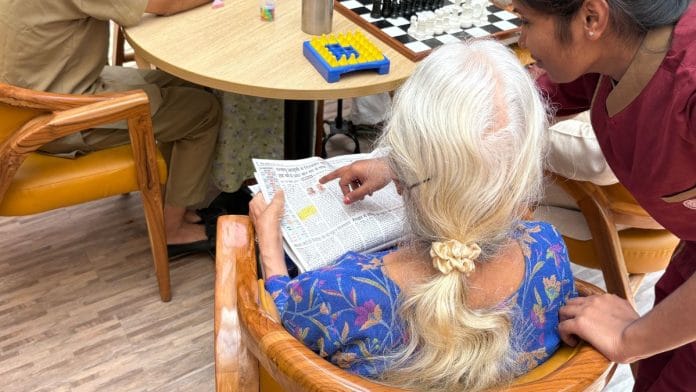



At 101 and 92, the two sisters lived alone in a senior citizen housing complex in Pune, a bustling city. Former freedom fighters and fiercely independent, they were determined to retain control over their daily lives for as long as possible. The only close relative — the elder sister’s only son — was himself close to 80, single, and increasingly unable to care for his mother as her mobility and health needs intensified.
When managing on their own became impossible, the sisters were moved from the housing complex into an assisted care home — a solution that exists more by exception than by design in India. The younger sister died there. The elder, who was later moved to another facility with her son, passed away late last year at the age of 104.
This true story, deeply unsettling in its own right, involves elderly who could afford at least some support, unlike many other elderly in India without adequate financial resources. It underscores a national challenge unfolding silently: millions of elderly Indians are ageing without reliable support.
As we wait for the upcoming Union Budget, policymakers must grapple with not just headline issues such as investment climate, fiscal prudence, and job creation, but also a demographic shift affecting over 150 million Indians aged 60 and above, a figure expected to reach 230 million by 2036 and nearly 350 million by 2050. The Union Budget 2026 offers a critical opportunity to reimagine elderly care as essential demographic infrastructure.
Old and alone
While most older adults live with families, a significant minority are ageing alone or living with another older adult, usually a spouse. According to estimates based on the latest Periodic Labour Force Survey (2023-24), which covers the demographic details of each household member, around 20 per cent of the elderly population lives alone or with another elderly household member. This translates to an alarming 30 million elderly people living all by themselves. There is a slightly higher prevalence in urban areas, at 21.6 per cent, as compared with 18.3 per cent in rural areas, highlighting shifts in traditional living arrangements, with women disproportionately represented among the elderly living alone.
Despite this reality, formal institutional care remains scarce. According to recent government data, as of 2025, there are 696 senior citizen homes across India, providing shelter, nutrition, medical care, and recreation, with 84 new homes approved in the current financial year. Even so, they serve a very small fraction of the elderly.
India has a framework of policies and programmes aimed at supporting older persons, but these are under-utilised and under-resourced relative to the scale of need. The National Policy on Older Persons (1999) articulates goals for financial security, healthcare, and shelter, but lacks clear budget lines and measurable outcomes.
Broader social security programmes provide some financial cushioning: pension-targeted savings schemes like the Senior Citizens Savings Scheme and Pradhan Mantri Vaya Vandana Yojana offer income support for eligible seniors, while flagship schemes like Ayushman Bharat extend health insurance that can reduce hospitalisation costs, albeit without elder-specific long-term care coverage. As of December 2024, more than 1 million senior citizens aged 70 years and above had enrolled for Ayushman Vay Vandana Card, enabling them to access free healthcare benefits under the AB PM-JAY.
All these measures are demand-side interventions that improve the affordability of care for the elderly, but they do little to expand the overall supply of healthcare facilities in India, and even less so for elder-specific care. Health initiatives such as the National Programme for Health Care of the Elderly (NPHCE) aim to integrate preventive and curative geriatric care into public health infrastructure, but coverage and specialist capacity remain limited, with uneven implementation across states.
Also read: Dementia wave is hitting Indian homes. Families are exhausted, healthcare unprepared
A budgetary realignment
The human consequences of this gap are stark. Older adults living alone or with limited family support face a higher prevalence of loneliness, mental health challenges, and unmet daily care needs, even as chronic diseases become more common with age. In one survey, conducted across communities in India, more than half of older adults reported feelings of loneliness, and a third said they experienced social isolation — conditions that directly affect well-being.
The Maintenance and Welfare of Parents and Senior Citizens Act, 2007 and the subsequently amended Maintenance and Welfare of Parents and Senior Citizens (Amendment) Act, 2019 legally obligate children and heirs to provide maintenance to parents. Yet it remains under-invoked and difficult to enforce for several reasons, including a lack of awareness and social stigma.
Elderly care requires dedicated financial support to expand geriatric healthcare, including training specialists, establishing more geriatric wards and outpatient services, and financing community- and home-based care networks that can support seniors ageing in place. Subsidised assisted living and scaling up of senior citizens’ homes must be part of a broader continuum of care, with priority given to low-income and rural seniors who lack family support.
Social security systems should be strengthened and indexed to inflation to ensure income adequacy for basic needs and healthcare. Additionally, investing in robust data systems to monitor living arrangements, service utilisation, and policy outcomes will improve planning and accountability.
Without such a budgetary realignment, the limited care the Pune sisters accessed and self-funded will remain unattainable for most elderly Indians, and even those who can afford it will find options scarce, allowing precarious ageing to become the norm rather than the exception in a rapidly ageing country.
Vidya Mahambare @mahambare_vidya is a Professor of Economics at the Great Lakes Institute of Management, Chennai. Palash Baruah @DrPalashBaruah is a fellow and Poonam Munjal @poonam_munjal is a professor at the National Council of Applied Economic Research (NCAER), Delhi. Views are personal.
(Edited by Aamaan Alam Khan)
Date: 26th January 2026
To,
Respected Smt. Nirmala Sitharaman ji
Hon’ble Minister of Finance
Government of India
New Delhi
*Subject: Representation of Key Policy and Budgetary Demands of Senior Citizens of India – Budget 2026 2027*
Respected Madam,
On behalf of The Joint Action Committee (JAC) of Senior Citizens’ Organisations, Maharashtra—a collective of 28 organisations working since 2012 in the field of senior citizens’ welfare, including NGOs, researchers, academicians, and practitioners—we respectfully submit this representation highlighting the most pressing concerns and demands of senior citizens across India.
India is undergoing a rapid demographic transition. Senior citizens (60+) constitute a growing segment of the population, many of whom face financial vulnerability, rising healthcare and caregiving costs, social isolation, and legal insecurity. Despite their lifelong contribution to the nation, older persons continue to remain under-prioritised in policy and budgetary frameworks.
*In this context, we humbly place before you the following major demands for urgent consideration:*
1. *Full restoration of Indian Railways concession for senior citizens to the pre-COVID level,* recognising mobility as a basic need for healthcare, social inclusion, and dignity.
2. *Withdrawal of 18% GST on Elder Care Services, specifically:*
Sub-Group No. 999322 – Residential Care Services for the Elderly & Persons with Disabilities
Sub-Group No. 999349 – Other social services without accommodation for the elderly & disabled
Elder care is a necessity, not a luxury, and taxing it places undue burden on vulnerable families.
3. *Inclusion of all citizens aged 60 years and above under Ayushman Bharat* – Pradhan Mantri Jan Arogya Yojana (AB-PMJAY), irrespective of income, given the universality of age-related health risks.
4. *Universal Old Age Pension of Rs. 3,000 per month for all senior citizens aged 60+* who are non-income-tax payers, with periodic inflation-linked revision.
5. *Formulation and notification of a National Dementia Policy and a National Elder Mental Health Policy*, addressing prevention, early diagnosis, care services, caregiver support, and community-based interventions.
6. *Increase in budgetary allocation for senior citizens to a minimum of 10% of the Ministry of Social Justice & Empowerment (MSJE) budget, along with effective implementation of the National Policy on Senior Citizens.*
7. *Withdrawal of GST on Adult Diapers, Wheel Chairs, Walking Sticks* which are an essential healthcare requirement for many older persons and persons with disabilities.
8. *Passage of the Maintenance and Welfare of Parents and Senior Citizens (Amendment) Bill, 2019* in both Lok Sabha and Rajya Sabha, to strengthen legal safeguards and enforcement mechanisms.
9. *Inclusion of Adult Vaccination under India’s Universal Immunisation Programme (UIP),* covering vaccines critical for older adults such as influenza, pneumococcal, shingles, and others.
10. *Increase in the Basic Income-Tax Exemption Limit for:*
Senior Citizens (60+) and
Super Senior Citizens (80+)
Considering inflation, healthcare expenses, and declining post-retirement income.
11. *Legislation for Adult Guardianship provisions and simplification of Living Will execution*, making it citizen-friendly and reducing the present medical and bureaucratic complexities.
Madam, these demands are rooted in constitutional values, inter-generational equity, and social justice. Addressing them will not only ensure dignity, security, and wellbeing for senior citizens, but will also prepare India for the realities of an ageing society.
We respectfully seek an opportunity to present these issues in greater detail through a consultation or meeting at your convenience. We remain hopeful of your empathetic and visionary leadership in advancing the cause of senior citizens of India.
Yours sincerely,
Sailesh Mishra – Coordinator
For the Joint Action Committee (JAC) of Senior Citizens’ Organisations, Maharashtra (Collective of 28 Organisations since 2012)
CC:
1) PMO
2) MOSJE
3) Railway Minister
4) NITI Aayog
5) Shri Bhartruhari Mahtab MP Lok Sabha
6) Raghav Chadha, MP Rajya Sabha
7) Supriya Sule, MP Lok Sabha
8) Priyanka Gandhi Vadra, MP Lok Sabha
—
On Behalf of
Joint Action Committee of Senior Citizens Organizations