









In April 2022, the Taliban imposed a nationwide ban on poppy cultivation. Unlike the previous bans in 2000-2001, this ban was aggressively enforced, resulting in the collapse of Afghanistan’s opium poppy cultivation. As of 2021, Afghanistan produced more than 90 per cent of the world’s heroin. With this massive shock to supply chains across the world, the global market needed replacement immediately.
In 2021, the Myanmar coup d’etat saw the military junta take control. A fragmented resistance emerged to counter the Tatmadaw. These ethnic armed organisations (EAOs) needed revenue and encouraged poppy cultivation. The existing “Golden Triangle”—which constitutes northeastern Myanmar, northern Thailand and northern Laos, centered on the confluence of Ruak and Mekong rivers—has historically been one of the largest opium producing areas in the world. The ready infrastructure of the Golden Triangle and the conducive environment of a post-coup Myanmar resulted in quick scaling and the historic shift of the heroin supply chain to India’s backyard.
But that was not the only market that gained traction through the unrelated political changes in Afghanistan and Myanmar. The methamphetamine market that has existed since the 1980s in the Golden Triangle also expanded into becoming the largest in the world. When Thailand intensified anti-drug crackdowns in the 1990s and 2000s, syndicates shifted their operations into Myanmar’s dysfunctional Shan State. Armed groups such as the United Wa State Army, long active in the heroin economy, quickly added synthetic drugs to their portfolio. Additionally, production of synthetic drugs did not require farm land, could be produced around the year and was more profitable.
However, after the 2021 military coup, meth production escalated sharply. The collapse of government, widespread corruption and the financial needs of EAOs created ideal conditions for illicit manufacturing. It was during this instability that Myanmar emerged as the world’s dominant hub for methamphetamine production. In the years following the coup in Myanmar, production reached record highs and there were record seizures across Asia. The United Nations Office on Drugs and Crime (UNODC) labelled Myanmar the “global epicentre of methamphetamine”. Production sites were no longer little dingy holes in the wall but highly sophisticated mega-labs.
Also read: Haryana has no patience for woke narrative on drug abuse and trade. It’s a war
Spillover into India’s Northeast
While there is no published research or official statistics quantifying how much meth or heroin produced in Myanmar lands up in India, it is evident by the record seizures, which are a fraction of what slips through, that India’s Northeast borders have become an important transit and destination point.
Drugs are frequently smuggled to the Northeast, primarily through Champhai district in Mizoram. UNODC reports state that year-on-year seizures of amphetamine-type stimulants (ATS), which were mostly believed to be methamphetamines, have increased significantly over the past five years. In 2024, law enforcement authorities recorded a nearly 500 per cent increase compared to 2020, of Amphetamine type stimulants (ATS).
Methamphetamines enter India’s Northeast in two major forms: Crystal meth and Yaba, which literally translates to “crazy pill” in the Thai language. The brightly coloured “party pill” seized across the northeast region in 2025 reveal the scale of the crisis. Mizoram alone intercepted 5,27,900 meth tablets in April and another 2,625,890 in May, alongside heroin consignments. Assam’s five largest hauls together exceeded 5,00,000 tablets. Manipur saw 1,00,000 Yaba pills seized, while a joint operation recovered over 7.7 kg of heroin and 6.7 kg of opium. Tripura reported more than 1,71,000 tablets, and Nagaland seized nearly 58,000 in 2024.
However, this is only a fraction of what actually slips through. Most reported incidents are high profile cases. With the lack of consolidated data and reporting split into pill counts and kilograms, accurate data even on seizures let alone production is impossible.
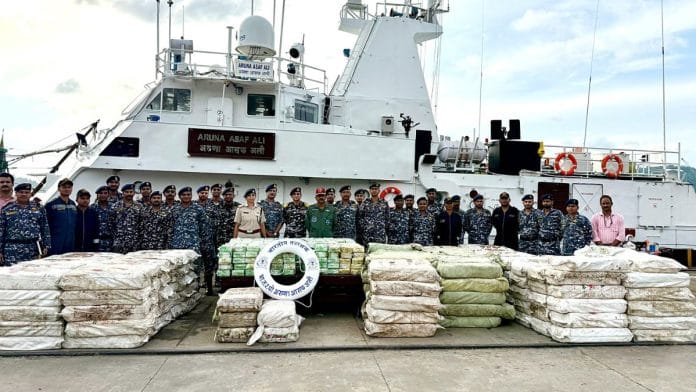
But with the largest seizure made by the Indian Coast Guards—6000 tonnes of methamphetamine valued at Rs 36,000 crores from a Myanmarese manned trawler in Andaman and Nicobar Islands in November 2024—it is only clear that the quantities are alarming.
Also read: God’s own country is high on MDMA. Kerala school, college students flood rehabs
A threat to national security
The increasing inflow of heroin, methamphetamines and Yaba tablets landing from Myanmar into India is not a mere law and order problem. It is a national security threat with long term consequences.
Mizoram has the highest HIV prevalence in India at around 2.7 per cent far above the national average of 0.2 per cent, Nagaland and Manipur come next. The primary cause being injection drug use and sharing of needles for heroin and other synthetic drugs. For the youth in Northeast India, this is not just a health crisis but a developmental and social crisis. But it’s not limited to the Northeast. Each pill sells for anywhere between Rs 1,500 to Rs 5,000 depending on location and purity. A price not entirely unaffordable to the average youth across India.
For local insurgent groups and transnational militia groups, drugs have become a revenue stream to prolong instability across borders and help with procurement of weapons and ammunition, payment of stipends to cadres, funding of training camps and sustaining long term underground operations.
In a region where employment opportunities may be limited, drug-financed groups can attract youth.
It is important to note that drugs coming into India are not just controlled by EAOs in Myanmar, but also Chinese syndicates. These networks are operating dangerously close to India’s porous borders fuelling not just non-state actors but also corrupt state actors encouraging parallel systems of power that envision competition with the Indian state. Furthermore, there are also Bangladeshi cartels, especially Rohingya groups that are responsible for moving Yaba towards Assam and Tripura.
India must realise that it can no longer afford to treat drug trafficking merely as a criminal law and order issue. It must treat it as a national security threat. Since 2021, New Delhi has walked a tightrope when dealing with Myanmar. It has kept channels of communication open with all stakeholders, keeping India’s national interest in mind. This balancing act has garnered criticism from Ethnic Armed Organisations who expect overt political and strategic support from India. However, it is time for New Delhi to raise its expectations and ask a tough question to the EAOs: Are they prepared to cooperate with India in its war against drugs?
Rami Niranjan Desai is a scholar of India’s Northeast region and the neighbourhood. She is a columnist and author and presently Distinguished Fellow at India Foundation, New Delhi. Views are personal.
(Edited by Theres Sudeep)