






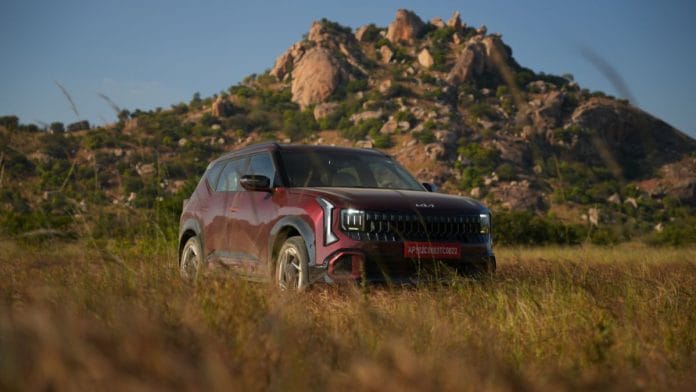



As you drive north of Bengaluru, you can’t help but notice some of the most amazing hills and rock formations. These are among the oldest rocks on the Indian subcontinent, estimated to be as much as 3.5 billion years old. And the car I happened to bring here was one of the latest products to hit the Indian roads: the second-generation Kia Seltos. As the company’s modern design philosophy goes, it was ‘opposites united’.
Having skipped the launch, I had not seen the new Kia Seltos until the media drive. And in photographs and videos, it looked odd with the daytime running lights on the front three-quarters and tail lights that looked like a thin French beard.
It was only when I saw the new Seltos in real life that I could appreciate the three-dimensionality of the design.
What’s new in the Kia Seltos
While the first–generation Seltos looked smart, it looked typical. The new one stands out with its unique head and tail light patterns. On the higher variants, the integrated turn indicators into the daytime-running lights, which themselves merge seamlessly into the front grille, give the car a smart, technologically advanced look. Even the lower variants feature multi-faceted reflector LED headlights. The Seltos comes in over 10 colour options, and the car I drove was in the new ‘Morning Haze’ blueish-grey colour.
Given the increasing competition in the market, the Seltos must stand out. The Maruti-Suzuki Victoris just won the Indian Car Of The Year. The amount of online buzz generated by the upcoming Tata Sierra is unprecedented, and the vehicle garnered 70,000 bookings on the first day. And there are a whole host of people waiting for the upcoming Renault Duster.
On the inside, the Seltos cabin is not only comfortable, but also larger. The new Seltos sits on a brand-new K3 platform (the previous one was on the K2 platform), which makes the new iteration 95 mm longer and 30 mm wider. That sense of space is quite evident: The car offers more rear legroom, more shoulder room, a larger boot, and a comfortable seating position. The digital displays on the higher versions of the Seltos are taken from its stablemate Syros, and that includes the new Kia operating system. An interesting feature is a small digital controller for the air conditioning, but the Seltos thankfully has enough physical buttons as well.
A couple of those buttons operate a feature I truly appreciate: seat position memory. My wife is a bit shorter than I am, and we often share vehicles. This means that a considerable amount of time is wasted adjusting the seats and mirrors to our ideal positions. It’s not a problem with luxury cars, but most CSUVs don’t offer the feature. The Seltos has seat position memory for two positions with mirror adjustment. The seats remain ventilated, but the two-tone black and white seats certainly look unique. And the BOSE audio system remains a standard fit on the Seltos.
But how does this all come together in the driving?
Also read: I’ve been driving an EV for 2 years—Indian roads are ready to switch to electric
A strong contender
The new Seltos retains the engine options of the outgoing model: 1.5–litre naturally aspirated petrol with 115PS, a 1.5–litre turbodiesel with 116PS, and a turbopetrol with 160PS. A new, strong hybrid variant is on the cards, but that won’t be on the roads until the latter half of 2026. So, in terms of acceleration, not very different.
The change comes in two other areas, though. The cabin is a whole lot quieter. I drove the diesel automatic, and minor changes to insulation and even the shape of the outside rear-view mirrors made the cabin feel very quiet indeed. Changes to the steering system and suspension improved handling characteristics considerably, and the ride quality also felt better. In fact, the motor-driven power steering is also one of the elements of the vehicle that can be modified by ‘Over The Air’ software updates. However, I’m not wholly onboard with the ability to transform driving dynamics through software.
The Seltos will be a strong contender in the Indian market. The first-generation vehicle sold over 7,00,000 units. But things have changed since the car first came into the market in August 2019. The competition has caught up and the CSUV market has become India’s dominant segment, with over 30 different players. The new vehicle can certainly build on the brand credentials of the previous generation and the fact that it is among the larger vehicles in terms of size and cabin space. However, much will be determined by the price, which should be announced soon, and when Kia India can get the hybrid into the market.
Kushan Mitra is an automotive journalist based in New Delhi. He tweets @kushanmitra. Views are personal.
(Edited by Prasanna Bachchhav)