






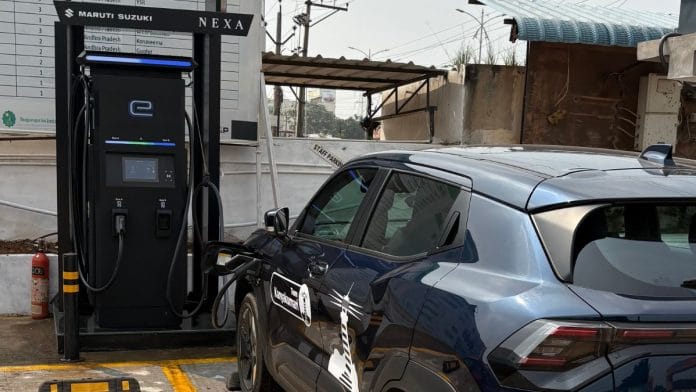



A couple of weeks ago, I reviewed the Maruti-Suzuki e-VITARA, the first electric vehicle from India’s largest carmaker. While the car was quite alright, the challenge I saw was with India’s electric vehicle charging infrastructure.
So when Maruti-Suzuki invited me to participate in a drive to showcase the vehicle and improvements in charging infrastructure, I accepted. I found myself in Hyderabad this past week, and as I drove through the capital of Telangana to Vijayawada in Andhra Pradesh and onwards down the coast to Chennai, I was extremely surprised by the number of vehicles with green number plates.
Manufacturer honchos such as Ather Energy’s Tarun Mehta and Mercedes-Benz India’s Santosh Iyer had told me that the Telugu-speaking states are leading the way in electric vehicles, but it was only when I drove past a petrol pump that I realised why. Petrol prices are the highest in the Telugu states. With Karnataka, Kerala and Tamil Nadu not far behind.
Coming from Delhi, where I pay under Rs 95 a litre, seeing prices ranging from Rs 105-110 a litre was shocking to say the least. And it isn’t just in these states where petrol prices are frighteningly high—Madhya Pradesh, Bihar and Rajasthan are equally bad. States need to line their coffers, and the motoring public is paying the price.
It is one reason why the southern states are still a major stronghold for diesel locomotion. But as prices of electric vehicles have come down—thanks to battery prices reducing, and increased production, consumers are seeing economic value in electric vehicles.
Also read: Mahindra aims for premium EV status with the XEV9s. Will it work?
Real-life practicality
Over the past month, I’ve been driving a Kia Carens Clavis electric in Delhi. The cost of running it is just so good that I do not see the need to drive any of the other vehicles. It is the perfect vehicle for school carpools, three kids, their nannies or parents, all fit. And in these days of GRAP-IV norms, a green number plate is just beautiful.
And as IndiGo underwent its meltdown a couple of weeks ago, I decided to take this vehicle to Chandigarh. Like most mid-range electric vehicles today, it had enough range to easily make the drive. There were also more than enough charging facilities on the old Delhi-Chandigarh highway via Karnal.
I charged the vehicle at a Chandigarh mall and topped it up once on my way back. I have been using the Statiq charging app, which aggregates many charging point operators. Other than one Hyundai dealership guard in Karnal telling me that the charger didn’t work, it was smooth sailing.
And that was a similar experience that I had on the journey with Maruti-Suzuki down south. Lots of chargers on the highways. I also tried out Maruti’s new ‘e for Me’ app, which integrates not only Maruti-Suzuki’s own network of chargers but also most major charging point operators. This includes both Jio-BP Pulse and Tata Power, which are not listed on many other charging aggregator applications.
But there is still one more problem to tackle in terms of charging.
While some really fast chargers are being set up, most chargers are still rated at just 60 kilowatts. And with two charging guns, the average charging rate is halved. Yes, there are faster chargers being established, but not enough right now to deal with a new crop of cars.
I used a single-gun 75-kilowatt (kW) charger at the Chandigarh mall, and Mahindra’s new chargers, such as the ones in Murthal, are rated at 180 kilowatts. But they’re the exception, not the rule. The Kia Carens Clavis electric can accept up to a 100-kilowatt charger, and at higher speeds, like at the Chandigarh Mall, I’m topped up in less than half an hour, barely enough time to navigate up and down from the coffee outlet.
While charging even the Kia at 30 kilowatts, I don’t get all that much juice. It was a similar story at Suryapet, where I charged the e-VITARA. There were multiple chargers, but at lunchtime, we were lucky to find a free gun. That said, almost everyone charged and cleared the charging spot. But all chargers shared two guns, and at 30 kilowatts, the charging was quite slow.
Also read: Rahul Gandhi loves the EV ‘decentralised’ power analogy. Too bad it’s wrong
The future of EVs
My experience on highways in the north and south is very gratifying for the future of electric vehicles in India.
But I still feel that unless you have a charger at home, even with competitive pricing, buying an electric vehicle might not be for you. The heaviest used commercial chargers always have a line, and unfortunately, might be too slow, although that is changing.
Commercial charging prices could be reduced on a per-unit basis, but a time charge might also be applied, like Tesla India is already doing at their Supercharger outlets.
And as the EV fleet grows, I wonder what the central and state governments that use fuel taxation as a major revenue tool will do? Will they follow Karnataka and impose a surcharge on EVs priced over Rs 25 lakh, or will the centre borrow a really bad idea from the United Kingdom, where Chancellor Rachel Reeves is imposing a three-pence-per-kilometre charge for electric vehicles?
This is an evolving space; my own journeys with electric vehicles on highways over the past 24 months have illustrated that change.
Driving an electric vehicle for months on end, the Hyundai IONIQ5, BMW iX and now the Kia Carens Clavis electric, has convinced me of the viability of EVs for city and mid-range commutes. There are some challenges still, but things are improving, and I will not be surprised if EVs hit as much as 15-20 per cent of monthly passenger vehicle sales by this time next year.
Kushan Mitra is an automotive journalist based in New Delhi. He tweets @kushanmitra. Views are personal.
(Edited by Theres Sudeep)