









The Indian automotive industry has some great hopes from 2026, considering the sales momentum of the past few months after tax rates were rationalised. I have already driven some of the vehicles that will be launched this year — the Tata Sierra, Kia Seltos, Maruti e VITARA, and Mahindra XEV 9S. I foresee trends in the coming year, both looking at features and the types of vehicles.
The question everyone asks is whether this is ‘the year’ for electrics. My stance is simple, if you have a home charger and do a lot of city commuting, it is a no-brainer right now to bring home an electric vehicle. The prices of EVs are at par or even lower than normal internal combustion engine vehicles, as battery prices have crashed.
Choices are only increasing with more and more body types and body styles. With Maruti Suzuki putting heft into the electric game, many infrastructural issues will be dealt with as well, so long-distance highway journeys are not going to pose a problem. I am hoping that higher-capacity fast chargers start rolling out rapidly, and I believe that will happen in the coming months. The lower GST rate on EVs is not going to last forever as governments will have to offset falling petroleum tax income. So frankly, it has never been a better time to buy an EV.
Tech, tech everywhere
All the newer vehicles I have driven recently have come with features that I think will become increasingly standardised, like the Advanced Driver Assistance Systems (ADAS). And not just the simple vision camera-based ADAS systems but systems running with multiple ultrasonic sensors. I have been driving the Maruti Suzuki Victoris and the Kia Carens Clavis EV recently, and both have these systems. In foggy conditions, I am happy to report that they work well and can sense vehicles around you better than your eyes.
And there are some other aspects to these active safety systems. In global markets, including China, systems such as Automatic Emergency Braking are mandatory if you want a high safety rating in crash tests. As a result, ADAS functionality will be offered on lower variants as well — something I noticed on the Mahindra XEV 9S and expect on the upcoming XUV 7XO as well. It could be just a simple vision camera-based system like the ones seen on Honda cars, but that would be sufficient.
ADAS can be extremely irritating, although I really like the blindspot warning system. In accidents like the one where an overloaded truck overturned onto a Bolero in Rampur, a blindspot detector would have warned the SUV driver not to turn. And while on most media drives we are told to switch off collision avoidance and warnings, I have actually started using them when driving long-term vehicles. ADAS systems are getting better tuned to India’s more chaotic driving conditions. These systems will also become mandatory for crash test ratings in India sooner rather than later. And the price of such systems will keep falling as the feature sets improve. Just look at flat-screen televisions, for example, they’re cheaper and better today than they’ve ever been.
The increasing automation of cars will also drive the concept of a ‘software-defined vehicle’ further. One interesting fact I learned about the second-generation Kia Seltos is that it has a motor-driven power steering, and that motor can be given software updates. So technically, new steering modes could be downloaded later on. And when you couple that with engine performance updates and suspension updates going forward, a vehicle could transform into a very different beast a couple of years after purchase. I’m not sure if I am extremely comfortable with the fact that I could just ‘update’ my vehicle like I do my smartphone, because I don’t know where it will end — considering the inherent information security issues and, of course, the possibility of government intervention.
Also read: What to expect from cars and carmakers in 2026—strong hybrids, flex fuel
Connectivity, and the sunroof question
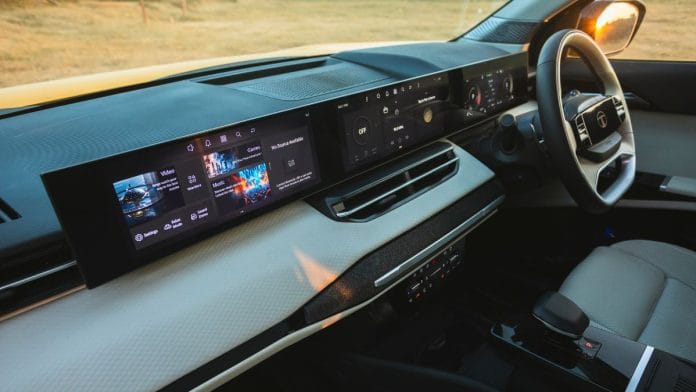
Talking of flat-panel TVs, the invasion of screens all across the car will continue into 2026. Already ‘coast-to-coast’ screens have become a feature on new Mahindra and Tata vehicles. But given what I saw at some stands at the IAA Mobility show in Munich last September, more screens inside cars are only a matter of time. Curved ‘waterfall’ screens on the central console, more screens on the dashboard, drop-down screens on the ceiling or even screens built-in for rear-seat passengers are expected to be introduced, with all of these having 5G connectivity. Again, I’m not necessarily a fan of digital screens given their potential to distract the driver, an issue that will have to be addressed by regulatory authorities soon.
On a positive note, I have mentioned in the past that I’ve never been a fan of sunroofs and most vehicles in the very popular compact-SUV segment (aka the Creta segment) these days have panoramic sunroofs. Sure, with the cold and gloomy weather in Delhi right now, I do keep the sunroof open to let in some extra light, especially when the sun is out. But for six-eight months of every year, much of India remains very hot due to the harsh sun. And there are, of course, idiots (sorry, but that is the only appropriate word here) who poke their own heads out of the sunroof and even allow their children to do the same. Please don’t do that, enough people — both children and adults — have died in the past few years.
The fact is that panoramic sunroofs let a lot of solar radiation in and while vehicles do have curtains, they are not as effective as proper insulation. On some vehicles like the new Sierra, sunroofs can be integral to the design, but on others, they are just another feature and customers should be given the opportunity to not opt for it. Most higher-specification variants do not give that option, so if you want the variant with ADAS and Dolby Atmos audio, you have to take the variant with a sunroof, usually a panoramic sunroof. Ergo, I’m glad Maruti Suzuki has started offering higher-specification variants of the Victoris without a sunroof. And this is one trend I hope other manufacturers also pick up in the coming year.
Kushan Mitra is an automotive journalist based in New Delhi. He tweets @kushanmitra. Views are personal.
(Edited by Aamaan Alam Khan)