






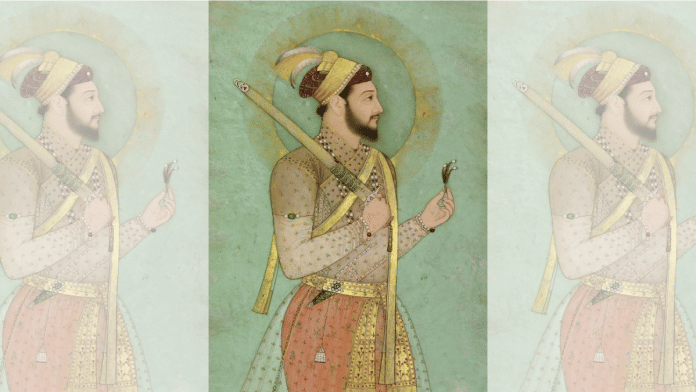



Dara Shukoh had a dream. He dreamt of Bhagwan Shri Ram, who appeared to him alongside his teacher, Rishi Vashistha. The vision came while he was immersed in the study of the Indic philosophical text, Yoga Vashishtha. The experience inspired him to undertake a new Persian translation of the book.
In the introduction to that translation, Jug Basisht, Dara’s vision is described in vivid detail:
“In the year 1066 Hijri (1655-56 CE) while the world lay in slumber, I was granted a vision that would forever alter the compass of my soul. I found myself in the presence of the sage Vashistha and the prince Ramchandra.
Vashistha, with a countenance of ancient peace, looked upon me with great affection. He turned to Ramchandra and said, ‘O Rama, here is an earnest seeker of knowledge; he is your brother in the true search for Reality. Embrace him.’ At those words, Ramchandra drew me into a warmth so profound it felt as though the very boundaries of my being had dissolved. He held me close, and in that silence, Vashistha handed him sweets. Ramchandra then fed me with his own hand. Upon waking, the sweetness remained—not upon my tongue, but within my heart — and the desire to translate the wisdom of their dialogue became an unquenchable fire.”
In both the Abrahamic and the Indic traditions, dreams carry profound spiritual significance. It takes little expertise in oneirology to decipher the import of this vision. Dara, the heir apparent to the Mughal throne, sought to be a king like Raja Ram, and to model his rule on Ram Raj.
The dream remained unfulfilled. It was cut short by the forces of bigotry led by his brother Aurangzeb, who had him executed in 1659. Dara thus became what Avik Chanda’s biography called the “undisputed Emperor of inchoate dreams”, and Indian history’s most enduring subject of counterfactual speculation — the biggest “What If” of our past, his historiography forever steeped in the melancholy of lost possibilities. This is evident in the wistful titles of two recent books about him: The Man Who Would Be King (Avik Chanda, 2019), and The Emperor Who Never Was (Supriya Gandhi, 2020).
Today, on Dara Shikoh’s 411th birth anniversary, the loss of this dream continues to haunt India, for certain counterfactuals can be posited without fear of contradiction.
Also Read: Indian Muslims must stop being delusional about the Global Ummah
The India that could have been
If Dara had ascended the Peacock Throne, there wouldn’t have been a renewed regime of subjugation and humiliation of Hindus, the most demeaning expressions of it being the reimposition of jizya and large-scale demolition of temples. The latter would have spared us the fraught legacy of a Gyanvapi ‘mosque’ here in Kashi, and an Idgah ‘mosque’ there in Mathura.
Neither would there have been a war without end in the Deccan, which bled the country dry of its resources, both men and material. Nor would religious animus have dictated the predatory taxation and heartless exploitation that broke the back of the peasantry and contributed to the decline of the empire. Furthermore, the simmering Hindu resentment wouldn’t have erupted in open revolt across the country. Above all, if Dara had the chance to bring about a semblance of Ram Raj, Hindus would have had no reason to fight for Swaraj, as the Marathas did.
A reign like Dara’s might have given the oppressed Hindu society a breathing space, and, in all likelihood, afforded it an opportunity for regeneration — the renaissance it had to wait for till the beginning of the 19th century.
Such an India would never have fallen prey to British conquest, sparing us the intergenerational trauma of colonialism, post-colonialism, and now the arduous process of decolonisation.
Hindus and Muslims might never have become two separate communities. A regime that facilitated the assimilation of the Muslim ruling class into Indian culture, and discouraged the breaking away of the overwhelming majority of converts from it, would have fostered the indigenisation of Islam. This would have insulated Muslims from the decay and degeneration that resulted in the anti-Indianism of Shah Waliullah’s school, which bore the bitter fruit of two nation theory, identity politics, and the many partitions that we have been condemned to live with.
This hypothetical narrative, the wishful retrospective conjecture, has been the constant refrain in the alternative imagination of India, free from unending Hindu-Muslim strife.
Urdu writer Qazi Abdus Sattar ends his novel Dara Shukoh on this mournful note: “He set out to revive a culture and civilisation, but destiny snatched the pen from his hand, and history spilled ink on his script.”

The foundation of an Indic Mughal empire
Dara’s dream of Ram was the culmination of processes that had been maturing for generations. By the 1650s, Muslim rule in India had been several centuries old, and the Mughal empire itself had completed a hundred years. Historian Supriya Gandhi says, “Dara’s spiritual journey was integrally linked to his role as ruler”. It was time for Muslim rule to evolve into an Indian one.
It was time for Muslim rule in India to evolve. While the limitations of Islamic political theory made it difficult to find the right idiom to articulate this need, the longevity of the empire depended on a fundamental shift. It had to discard its foreign, religious, and militaristic nature to embody a truly Indian national and civilisational character.
Earlier, Akbar had attempted this evolution by integrating the Indian elite — primarily the Rajputs — into the government. He sought to build an ideological foundation for the state through the policy of Sulh-i-kul (universal peace), while removing the blatant humiliations of the jizya and pilgrim taxes. However, he lacked the intellectual wherewithal to develop an alternative political theory that could firmly ground the empire in its Indian foundations.
On a personal level, Dara Shukoh, the mystic-minded prince, had reached full maturity in his spiritual growth. Having already authored biographical dictionaries (tazkira) and hagiographies of Sufi saints, such as Safinat-ul-Auliya and Sakinat-ul-Auliya, he turned to Sufi esoterica in works like Risala-i-Haq Numā. By then, he had attained the stature of a Sufi master, an erudite scholar, and a philosopher, a vantage point from which he could finally ascend to the study of Indic spiritual and philosophical texts, which he soon did on the suggestion of his mystic guide, Mulla Shah Badakhshi.
In tandem with this spiritual evolution, Dara had reached the acme of his princely career. With the grandiloquent title of Shah-e Buland Iqbal, and the highest ever Mansab, he had been anointed crown prince and elevated to the status of virtual co-emperor alongside his father, Shah Jahan.
These parallel processes coalesced to make the philosopher prince work on transforming the Mughal empire into a truly Indian state.
A new ideal of kingship
In a remarkably prolific two-year period between 1655 and 1657, Dara authored the Majma-ul-Bahrain (The Confluence of the Two Oceans), oversaw the translation of the Yoga Vashishtha, and rendered 52 Upanishads into Persian under the title Sirr-i-Akbar (The Great Secret).
This project was a much-delayed leap from the translation of a few Indic texts such as the Mahabharata and Ramayana under Akbar. Much delayed because though Jahangir and Shah Jahan didn’t reverse Akbar’s policy, they didn’t advance it either. In fact, there were some serious deviations from it. And, a leap because what Akbar did was a tentative overture, but what Dara set out to do was the formulation of a new ideal of kingship, different from the one enunciated in the Perso-Islamic akhlaq literature, which derived from the Greco-Hellenic traditions. His hero was neither his namesake Dara (Darius), nor Sikandar, nor Afrasiyab, but Raja Ram, the epitome of the saint-king.
In Majma-ul-Bahrain, which was rendered into Sanskrit as Samudra Sangam for his Hindu audience, Dara sought to reconcile the superficial contradictions between Hinduism and Islam. Drawing upon the metaphor of the Confluence of Two Oceans from the allegory of Moses and Khizr in the Quran (18:60), he attempted to uncover the essential unity of these two distinct traditions of knowledge.
In this pursuit, he was guided by the Vedantic concept of Advaita (non-dualism), in which he saw a profound reflection of the Islamic doctrine of Tawhid. He found the Indic concept echoed in the Islamic declaration Wahdahu La Sharika Lahu (“He is One, without partner”), recognising in both a shared realisation of Divine Oneness.
Sirr-i-Akbar contains the Persian translation of 52 Upanishads, the work through which Europe first became acquainted with the highest expression of Indic philosophy. A French Indologist, Anquetil-Duperron, translated Sirr-i-Akbar into Latin, which was published in 1801. In 1814, the work came to the attention of German philosopher Arthur Schopenhauer, who later wrote: “It has been the solace of my life, it will be the solace of my death.”
Dara Shukoh regarded the Veda as the earliest celestial book, revealed to the first and pure (Safi) human, Adam, whose original home was India. The Upanishads, being the distillation of the Veda, contained the ancient secrets of mystical knowledge, which he identified as the Kitab al-Maknun (The Hidden or Protected Book) mentioned in the Quran 56:77–78, the same as the Lauh-e Mahfooz or the Preserved Tablet (85:21–22), and Umm al-Kitab or the Mother Book (13:39, 43:4). He effectively canonised the Upanishads as the original Islamic text, and held that it was the duty of every faithful Muslim to read them, as they were the fountainhead of the Quran.
Historian Muzaffar Alam is emphatic that Dara’s engagement with Indic texts was an exercise in political theory. He was building a new moral and ideological foundation for the polity he was set to preside over. “When we evaluate Dara primarily as a failed statesman, we overlook his contribution to ideas of Mughal kingship,” writes Supriya Gandhi.
By anchoring political morality in the Indic tradition, he not only surpassed Akbar’s Sulh-i-kul, or even Ashoka’s Dhamma, but also harked back to the civilisational subconscious of India, the longing for Ram Raj.
Conquest vs civilisational power
While Aurangzeb was further entrenching the military character of the empire, Dara was building a moral and ideological foundation for it.
Those who dismiss Dara as a political amateur or a novice in war miss the larger historical imperative: the Mughal empire had reached its zenith and its limits of expansion. If the state could not transition from an Islamic war-machine into an Indian civilisational power, its internal contradictions would inevitably become unmanageable.
Regarding his policy toward Hindus, Shah Jahan was no Akbar; indeed, his reign saw several unconscionable deviations from his grandfather’s pluralistic path. Nor were Dara’s radical religious and philosophical predilections hidden from him. Yet, when the time came to select a successor, the emperor’s choice fell upon the son who wore a ring inscribed with the Sanskrit name for God, Prabhu, in Devanagari script. The statesman in Shah Jahan recognised the gravity of the hour: the Indianisation of the Mughal state had become an inexorable historical imperative, and only Dara, with his deeply cultivated Indic sensitivity, was equal to the task.
Dara has long been a victim of ridicule at the hands of pro-Aurangzeb historians for failing to match his brother’s military astuteness. Yet seventeenth-century India did not need a warlord for an emperor; the Mughal empire had already reached the limits of its viable expansion. As history would prove, the weight of further conquest would only cause the state to implode — a collapse triggered by Aurangzeb’s relentless warmongering in the Deccan.
Shah Jahan seems to have been instinctively aware of this danger. This awareness, rather than any supposed machination by Dara, explains why the emperor repeatedly restrained Aurangzeb from the total annexation of the Shia Sultanates. History has since delivered a clear verdict on the consequences of the “astute” military commander’s exploits.
Also Read: Muslims never held Akbar in high regard. Hindus made him ‘Great’
The Muslim antipathy to Dara
Hindus and Muslims view Dara differently, the reverse of how they view Aurangzeb. Several Muslim historians’ eulogy, or apology, for Aurangzeb has also served as censure for Dara. Almost all the books on Dara, both historical and literary — from Kalika Ranjan Qanungo’s 1935 biography, and Bikramjit Hasrat’s Dara Shikoh: Life and Works (1953) to the ones mentioned in the beginning — have been authored by Hindus. Manager Pandey, in his Hindi book on Dara, gives a long list of Hindi literary works on him. In Urdu, and by a Muslim, there is only one in that list: a historical novel by Qazi Abdus Sattar.
Why have Muslims been so antipathetic to Dara? Well, he tried to change the character of the Mughal state from Islamic to Indian, and laid the ideological foundation for it. He claimed that the truth Muslims consider exclusive to Islam had been part of Hinduism long before Islam. He wasn’t constrained by the Muslim understanding of Hinduism as polytheistic paganism. Monotheism and polytheism are elementary Abrahamic binaries that don’t fit well with the complex, multifaceted contemplation of the Divine in the Indic tradition.
The worst violence that Muslim rulers inflicted on Hinduism was to equate it with the primitive paganism of pre-Islamic Arabia, on the fallacious analogy that both cultures worshipped idols. Blinded by prejudice, they equated the uncivilised Arabs of Jahiliyya (ignorance), who couldn’t even sculpt the stone they worshipped into a statue, with an advanced civilisation which, to name just a few, had created the Vedas and Vedanta, produced the Buddha and Mahavir, developed the Six Systems of Philosophy, invented zero, found the precise value of 𝜋 (pi), and measured the circumference of the earth. There was a difference in what they worshipped: Indians bowed before God, whether in formless abstraction or in tangible anthropomorphism, while the Arabs worshipped (non)entities beside God (Min Dunillah).
Despite ruling the subcontinent for centuries, the Muslim political and clerical establishment made little effort to study or understand the land they lorded over. For the most part, India’s religion and culture were viewed with a mix of hostility and indifference. To them, Hinduism was not a philosophically grounded way of life, but simply mumbo jumbo.
In the last thousand years, except for Kitab-ul-Hind by Al Biruni (1030), and barring some stray translations, there has been no serious scholarly endeavour by Muslims to understand India. Dara has been the solitary exception. He broke ranks with Muslim orthodoxy by undertaking a sincere effort to understand it on its own terms. He paid for this intellectual courage with his life.
His favourable disposition towards Hinduism was taken as apostasy from Islam. In the four centuries since his execution, there has been no comparable effort from the Muslim side to try to understand Hinduism. The paths that diverged on the battlefield of Samugarh continue to diverge today, leaving Dara’s “Confluence of Two Oceans” a dream deferred.
Ibn Khaldun Bharati is a student of Islam, and looks at Islamic history from an Indian perspective. He tweets @IbnKhaldunIndic. He can be reached by email at ibn.khaldun.bharati@gmail.com. Views are personal.
Editor’s note: We know the writer well and only allow pseudonyms when we do so.
(Edited by Asavari Singh)
This showcases that when Mr. Ibn Khaldun Bharati tries his hand at counterfactual history, few can rival the quality of his thinking, the quality of his imagination, the quality of his writing. His understanding of the grandeur of Indic civilization is awesome, and this essay is glowing with his deep affinity for this great civilization. One can also sense his profound sense of loss regarding Dara Shukoh. What if Dara had not lost to Aurangzeb!
The wise will find it hard to miss how any vision of a ‘unified’ Bharata, ancient, medieval (‘Mughal’), or modern, is inevitably one infused with Sanatana values, ethics, and philosophy.
While this particular speculation on ‘what-if’ is more accurately ‘an exception that proves the rule’ (as Skanda’s comment below mine argues), it is high time that the Bharatiya public, left, right, centre, progressive or conservative, realised that the constructive way forward can only be Ramrajya.
This piece is essentially a mourning letter dressed as history. Every paragraph is calibrated to make you feel the loss of what could have been, rather than interrogate what actually was.
It never asks the more important question — why, in 1500 years, has the Dara template been repeatedly executed by its own people, while the Aurangzeb template gets mosques, textbooks, and street names? The answer makes this entire ‘What If’ exercise redundant.
This ‘What If Dara’ fantasy is the intellectual equivalent of citing one gentle wolf to defend the pack. The pack’s track record speaks louder.
Dara isn’t proof that Islam can reform. Dara is proof of what happens to Islam when it tries