








Excavations at Harappan sites in the early 1920s yielded a corpus of artefacts that came to define our understanding of one of the earliest societies in the Indian subcontinent. These objects, recovered from sites such as Harappa and Mohenjo-Daro, were not merely documented but were also used in understanding the society they belonged to. And so, contemporary society became the yardstick through which the past was understood, allowing these interpretations to stand the test of time for over a hundred years.
Among the most celebrated of these finds is the steatite figurine of a bearded man, adorned with an intricately trefoil-patterned garment, with a composed, almost meditative expression. Popularly known as the “Priest King”, this figure has, for nearly a century, been taken to represent a statesman or a religious head, shaping broader assumptions about the political and social structure of the Harappan society. The name was heavily influenced by the role of religious heads in ancient societies, such as in Egypt, where monumental architecture, burials, and inscriptions substantiated the role of the pharaohs. The existence of such a figure in the Harappan context, however, remains unverified. The title persists, even as its foundation remains uncertain. It was named as per a colonial-gendered gaze, and a century later, it is still misinterpreted.
While this demands a separate discussion, it is worth noting that a similar interpretative approach was applied to another artefact — one that has perhaps been even more enduring in its mischaracterisation.
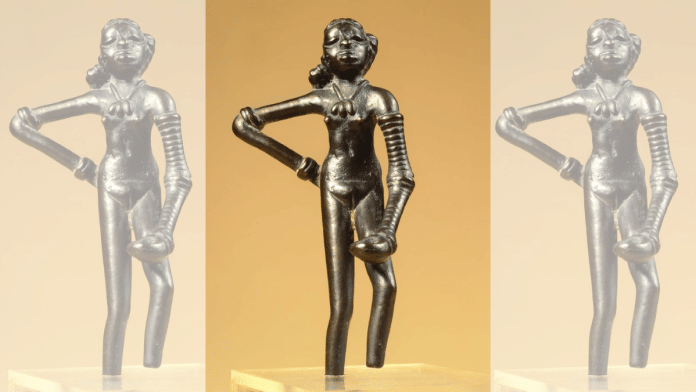
A small bronze statuette of a young girl, measuring just over eleven centimetres, is standing with one hand resting on her hips and another loosely hanging on the side, called the “Dancing Girl”. She is completely nude but is adorned with a series of bangles and a necklace. For over a century, the name was her identity. Despite the absence of clear evidence to support this claim, the name has remained unquestioned. We still have not dared to go beyond this title, to make an honest attempt to answer the simple questions of who she is and why she continues to occupy such a contested place in our understanding of the past, and whether she really is dancing.
This is not an attempt to provide a definitive answer, but rather a necessary act of re-examination — a course correction, if not a conclusion.
The Dancing Girl of Mohenjo-Daro
Cast using the Lost-Wax technique, the Dancing Girl was excavated from the HR (Hargreaves) area of Mohenjo-Daro during the winter of 1926 by British archaeologist Ernest Mackay. The statuette was discovered in a housing complex of Black 7 (Kennedy et al, 2012) and is assigned to the mature period of the Harappan Civilisation (c.2600-1900 BCE).
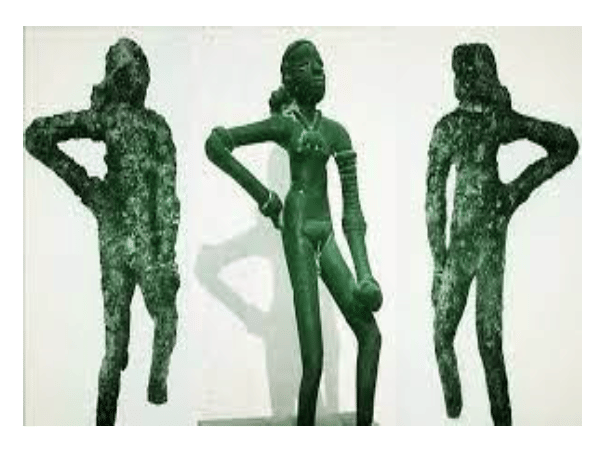
The figure is a free-standing, realistic sculpture of a naked girl with small breasts, narrow hips, elongated legs and arms and a short torso. Her left arm bears a stack of 24 bangles, while the right arm bears 4 bangles. On her neck, she wears a necklace with three pendants, and her hair is neatly tied in a bun, twisted in a spiral fashion. Her right arm is bent at the elbow, resting on her hip, while the left hand is hanging on the side. Her head is slightly tilted backwards, and her legs are bent at the knees. It was this posture that led early scholars to identify her as a young girl sculpted in a dancing position.
The interpretation of this bronze statuette was shaped by the colonial officers who viewed the past through the lens of their own assumptions about Indian society and the role of women. Also dubbed as a “Nautch Girl” by John Marshal, who oversaw the excavations of Harappa and Mohenjo-Daro, the figure was interpreted in ways that were deeply imperialistic in nature. In the absence of a deciphered script and of a complete context of the excavation (where it was found and in what context), early investigators turned to the familiar framework of misinterpretation, while imposing a false sense of uniformity onto a complex society. Their interpretations were shaped by a strong gendered and colonial gaze.
This resulted in a reductive division amongst women who, according to the colonial officers in the 1920s and 30s, were seen either as idealised and refined, usually behind the purdah or gungath (head cover), largely treated as Sanskari (traditional), or belonging to marginalised communities, associated with performance, sexuality and lower social status. The bronze figure from Mohenjo-Daro, therefore, was placed firmly in the latter category, probably due to her lack of clothing.
Labels such as “Dancing Girl” or “Nautch Girl” are not neutral descriptions. They carry specific social meanings, associations of which are not supported by any clear archaeological evidence.
While the “Dancing Girl” was linked to the Devadasi tradition, male sculptural representations from the same context are treated with far more objectivity. Male figurines are typically elevated as a symbol of authority and divinity, as in the case of the “Priest King” or the “Horned Yogi”. In contrast, the female figure is read through a more conservative lens. Since her discovery, her nudity has been called into question and described as “provocative”, whereas male nude statues or artefacts are treated as customary and socially accepted. Such differences expose a distinctly gendered framework of interpretation that is prevalent to this day.
Unlike the colonial and Eurocentric interpretation
Also Read: Aravallis shaped early human history. They’re Delhi’s forgotten archaeological frontier
Is she dancing?
To identify the figure as a “dancing girl” requires clear evidence of movement — but such certainty is difficult to sustain. In the absence of textual records or a complete understanding of the Harappan society, the purpose and the meaning of the statuette remain unknown. Any interpretation, therefore, rests on inference rather than evidence.
Some scholars have linked her posture — bent knee, tilted head, and curved stance — to later Indian sculptural traditions and classical dance forms. However, these comparisons are separated by significant temporal and cultural distance. The evolution of forms such as Bharatanatyam belongs to a much later period, making such parallels speculative at best. More importantly, where movement is clearly intended in Harappan art, it is rendered explicitly. Other figures from the same context display dynamic poses and unmistakable action, for instance, the figurine of the “Dancing Man”. In contrast, the bronze girl suggests stillness rather than motion. Her posture may be poised, even expressive, but is not necessarily performative.
Also Read: We celebrate Harappa excavation—and dismiss Keeladi, Sinauli archaeological digs as politics
The other Dancing Girls…
If she is not a dancing girl, then who is she? A mother goddess, as some have suggested or simply an ordinary young girl?
The idea of the Mother Goddess itself is not without problems. It draws from earlier, Eurocentric
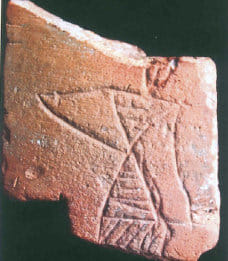
The excavations at Mohenjo-Daro have yielded at least three similar bronze statuettes of the “Dancing Girl”. One from HR area and two from DK (Dikshit) area of the site. Beyond this, from the site of Bhirrana in Haryana, a potsherd with a graffiti resembling the same form is found. Such repetitions suggest that the figure held a significance beyond the ordinary. While the true identity remains unclear, what is certain is that she is neither a dancing girl nor a nautch girl.
Disha Ahluwalia is an archaeologist and research fellow at the Indian Council Of Historical Research. Views are personal. She tweets @ahluwaliadisha.
(Edited by Insha Jalil Waziri)