





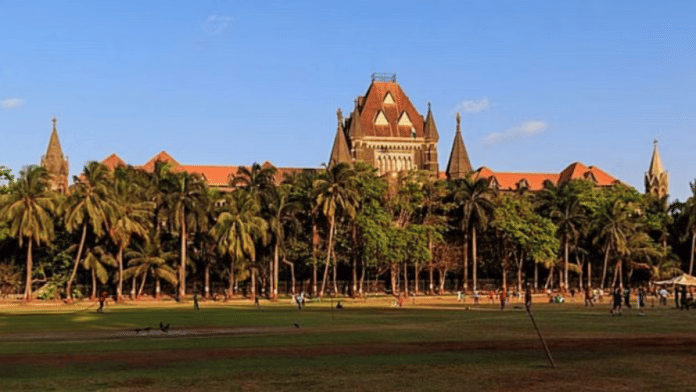



She is a 14-year-old girl from a remote village in Maharashtra. A POCSO survivor, she had stayed silent about the repeated assaults against her. It was barely a month ago that a medical examination confirmed her pregnancy. Already past the 24-week statutory window for a legal termination, she found every door shut. The medical board didn’t allow it, citing a lack of authority. The Maharashtra government opposed termination outright, pushing instead for delivery and adoption. With nowhere left to turn, she walked to the doors of the Bombay High Court.
The judge wasted no time. He listed her matter as “First on Board,” held hearings on consecutive days, and met with her in private. In unequivocal recognition of her pain, the court allowed her to terminate her pregnancy. The court also ordered that if the procedure failed and a child was born, neonatal care would be provided at the government’s expense, with the state government stepping in for adoption.
Funds from the Manodhairya scheme were directed toward her welfare, and follow-up hearings were scheduled to track her safety and recovery. Given the failures commonly attributed to Indian courts, this minor’s case seems to stand out as an outlier. A vulnerable person approaches the court and gets timely relief. But, in fact, it’s not. Our analysis of similar cases handled by the Bombay High Court shows that when it comes to medical termination of pregnancy, the court almost always provides timely relief to the litigant. While such cases are far and few, it is apt to highlight this silver lining of the Indian justice system this International Women’s Day.
Bodily autonomy
India’s Medical Termination of Pregnancy Act was enacted in 1971. In its original form, the Act permitted termination of pregnancies up to 12 weeks on a single doctor’s approval, extendable to 20 weeks only to preserve the life of the mother. An amendment in 2021 significantly broadened this framework. Termination up to 20 weeks now requires only one registered medical practitioner’s approval. Between 20 and 24 weeks, two practitioners must concur — but the window is available only to specific categories of women. They are survivors of sexual assault, rape, or incest; minors; women with significant disabilities or mental illness and others in similarly vulnerable circumstances.
Beyond 24 weeks, the Act permits termination only upon approval of a Medical Board, and strictly on the ground of substantial foetal abnormality. When the Board declines or does not respond, the woman has only one path left—to file a writ petition before a High Court or the Supreme Court.
Over the years, courts have done more than merely adjudicate these petitions. In landmark decisions such as Suchita Srivastava v. Chandigarh Administration, the Supreme Court read reproductive autonomy into the fundamental right to personal liberty under Article 21 — making India, at least on paper, more progressive than many developed countries. Yet not all assessments of India’s framework are celebratory.
Some scholars argue that the MTP Act was never conceived as a feminist instrument — that its roots lie not in women’s autonomy but in post-Independence population control policy, and that the 2021 amendments, however welcome, do not fundamentally alter that character. Irrespective of legislative intent, the reality for the most desperate cases is clear: when the statute offers no refuge, women are left to pray that a court will uphold what the law does not guarantee. So, how do these desperate cases play out in court?
Within TheProfesseer’s dataset, we identified 232 MTP cases filed before the Bombay High Court between June 2021 and December 2025. We set out to understand just how courts respond when women have nowhere else to go. Seventy-one per cent of these cases arrive beyond the 24-week statutory limit, and 33 per cent are minors.
Timely relief
In regular litigation, there is rarely a normatively “appropriate” case duration. In contrast, MTP cases operate on a biological clock. Every day spent in legal limbo is a day the petitioner loses to decide her own future. In matters surrounding MTP, the judiciary appears acutely responsive to this closing window. We find that the median time to dispose of these cases is four days. That is, 50 per cent of the cases get resolved within four days, and 85 per cent of these cases get disposed of within a week. Longer ones are rare, where the court keeps the case open through the gestation period to facilitate urgent intervention, if situations so demand.
Among cases in TheProfesseer’s database that were adjudicated on, 87 per cent were allowed. In most of these cases, the court grants relief to the pregnant person because of a “substantial foetal abnormality”. Rape or sexual assault, grave injury to mental or physical health, and the pregnant woman being a minor are other common, overlapping grounds, as seen in Figure 1 below.
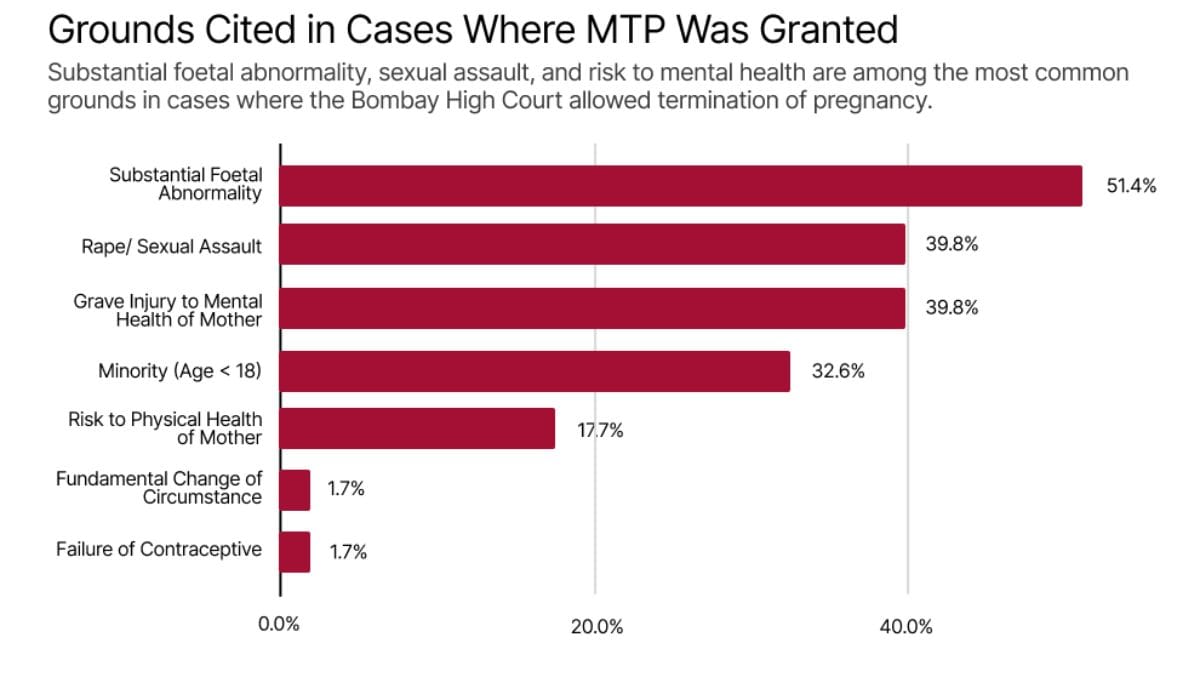
The court consistently looks beyond the 24-week limit to grant extra-statutory relief on the grounds over and beyond the MTP Act, sensitive to the vulnerabilities and unique positions of the women. This trend is consistent across the different benches of the Bombay High Court and reflects, in many ways, the positive downstream effects of strong pro-abortion jurisprudence by the Supreme Court.
Additionally, in cases where a financial hardship of the woman is involved, the court goes beyond the order itself — arranging shelter homes and ensuring neonatal care at the State’s expense, should the MTP procedure fail. In cases involving sexual assault or rape, it further directs the State to extend support to the survivor through the Manodhairya scheme.
Also read: Winners’ remorse in Indian litigation—2 ways to resolve execution delays
When is relief denied
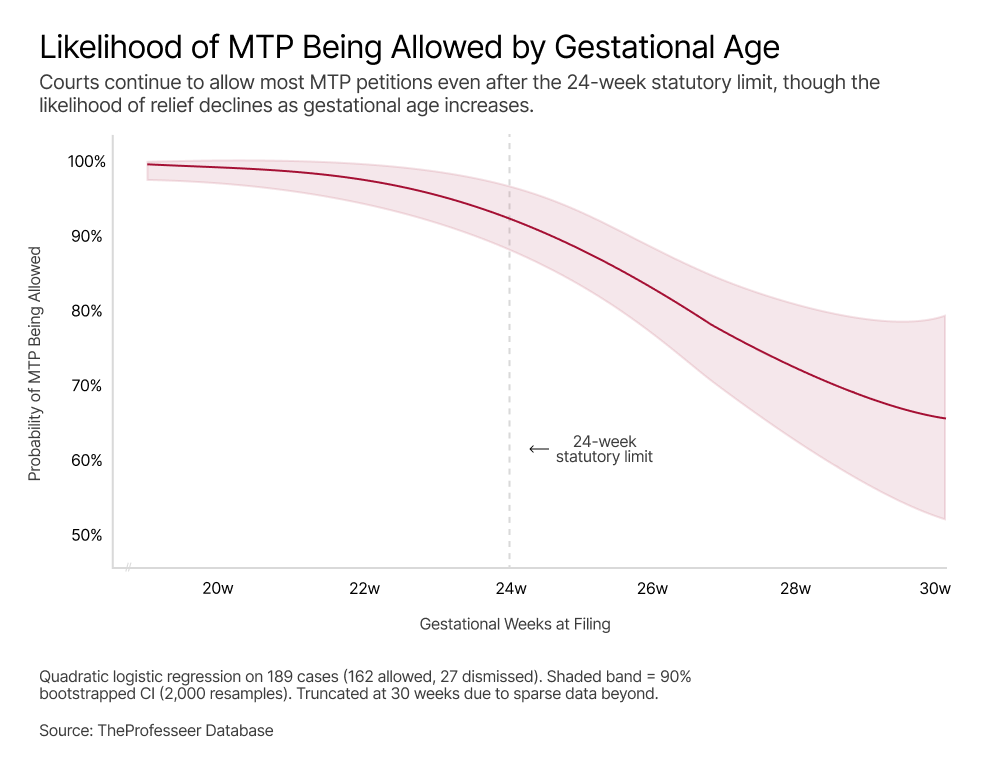
In 13 per cent of adjudicated cases where relief was denied, the primary reasons were either risk to the mother’s life or the likelihood of a failed procedure resulting in the birth of a live foetus with significant morbidities or physical and mental damage. These dismissals arise from careful judicial discernment, with cases becoming less likely to succeed as the pregnancy progresses, as demonstrated in Figure 2.
There are, however, a handful of instances where the court backtracked on its own jurisprudence. In an order from August 2023, the court held that the presence of a foetal heartbeat, coupled with no medical determination of risk to the mother, meant that, with due respect to the rights of the unborn child, natural delivery ought to be completed. While the court did arrange shelter and prolonged medical care for the petitioner, it glossed over a critical fact – that she was just 13 years old and a survivor of penetrative sexual assault.
The court cited its own precedents, cherry-picking instances where termination was denied — while, as Figure 1 shows, such denials are very much the exception. A similar case, by the name X v. State of Maharashtra, 2024, went on appeal to the Supreme Court against dismissal by the Bombay HC. The apex court reversed the decision and allowed for abortion while also holding that the opinion of pregnant minors carries superior weight to that of their parents in matters of termination of pregnancy.
Though a minority of instances, these cases are unfortunate nevertheless. In eight cases within the dataset examined, the court even diverged from its usual deference to the Medical Board’s wisdom. While the Board seemed to approve of and make suggestions in favor of MTP, the court, claiming foetal viability, ruled otherwise. These cases are in sharp contrast with the established position of law.
A bright spot
The data, on balance, tells a reassuring story. Nine in ten women who knock on the Bombay High Court’s doors in search of reproductive justice are heard, and heard quickly. Yet for one in ten, the outcome may turn out to be inconsistent with constitutional promises they’re entitled to.
That said, the broader arc of this jurisprudence is undeniably a bright spot — not just for India, but in global terms. This analysis is limited to the Bombay High Court, but if this data trend holds across High Courts nationally, it carries two important lessons.
First, a strong and healthy pro-abortion jurisprudence is quietly taking shape through India’s Constitutional courts. Second, this evidence must feed back into legislative reform. For every woman who finds her way to a High Court, there are likely several others for whom the Medical Board’s refusal is where hope ends — who lack the resources, the awareness, or the time to file a writ petition before a higher court. Taking a cue from the precedent set by the higher courts, litigants could be given a statutory right of appeal before the District Courts, bringing relief closer to where it is needed most.
There is much to be proud of in how far Indian law has come in championing reproductive autonomy. But justice without uniformity is not yet justice as a guarantee. That remains the work ahead.
Srikanth is a Developer and Data Scientist at TheProfesseer. He tweets @SonOfRajkumar. Gokul is a Legal Associate at TheProfesseer. He tweets @GokulSunoj. Views are personal.
(Edited by Ratan Priya)