





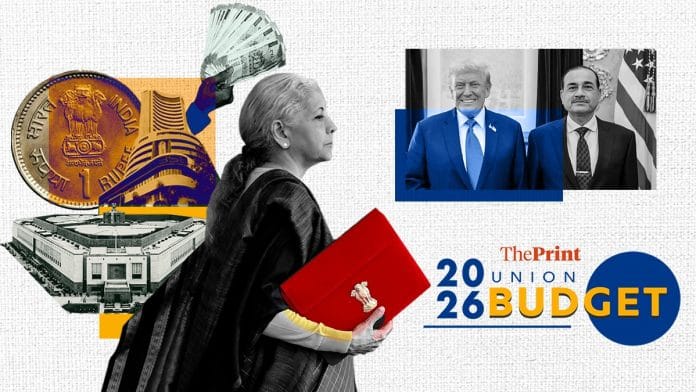



Of Nirmala Sitharaman’s nine Budgets so far this shows the least political anxiety. Yet, it is a Budget designed for geopolitically anxious times. Here’s how we square these contradictions.
There was much demand and advice from corporates, investors and establishment-friendly economists to risk loosening up, take advantage of super-low inflation and drive nominal growth.
Print more money, sell some assets, cut capital gains taxes to assuage estranged Foreign Portfolio Investors, they said. Mostly, the contrary has been done. The Securities Transaction Tax (STT) has been raised by up to 150 percent to cool the markets instead of firing them up.
This is political as well as ideological and philosophical. The political part first.
The reason we call this politically the least anxious Budget is that it has no new giveaways, tax cuts or exemptions for the middle classes. Allocation to the states, if anything, has been curtailed marginally.
There are no favours done to any allies or to ‘own’ states whatsoever. This absence of electoral anxiety shows in nothing being on offer for the states going for elections this year.
This is political confidence. The government has shaken its post-2024 jitters. It knows its vote bank is intact. Of the four major states going to the polls it believes it has one in its pocket (Assam), is marginal in two (Tamil Nadu and Kerala), while West Bengal will be fought on polarisation. And even if any Kolkata rich are hurt by the Budget, they’d vote for the BJP anyway.
Also Read: Union Budget 2026-27: What it really says about India’s economy
The Budget has indeed woken up the sleeping markets, just not the way the government’s fans would have expected. The tough F&O action and subsequent finance ministry statement that this was done to curb speculation is what we call both ideological and philosophical. Ideologically, the RSS has had a paternalistic and patronising view of the middle classes.
Since they’re hard-working and talented but not always the smartest in the markets, they’d need to be protected. Sometimes from themselves. Philosophically, there are questions over algorithmic trading where losers are simple millions and the winners often distant hedge funds with smart guys in $200 Hermes ties who game the algos. This was the Jane Street phenomenon.
One hedge fund based overseas apparently had a company in India that would allegedly drive up prices of a stock with small buys in the morning and the overseas parent would short it in the afternoon. SEBI has provisionally stopped it but the ‘system’ only woke up when its profit was approaching the $10 billion-mark. How many lakhs of under-employed, retirees, even housewives would have to lose their hard-earned tens of thousands each to add up to these billions?
The government didn’t like it, and said so explicitly today. But it saw the downside in stopping F&O altogether because this is, after all, a globally accepted market practice and route to price discovery. Hiking STT on each transaction 3X is simply a case of throwing sand in the wheels. If it will infuriate the FPIs, the Modi government won’t bother. They’d rather the FPIs return as patient investors in the India story. This distinction between pure trading and investment is the philosophical point. Let’s call this the Jane Street Amendment.
This will however hurt this government’s favourites, the middle classes. Over two years as the FPIs cashed out and net FDI turned negative the slack was picked up by domestic individual investors. The finance minister has spoken with pride about these millions of brave Indians investing in SIPs unmindful. By December 2025 they owned more of NSE stocks than FPIs. Will they take this fresh setback on the chins? This is a political risk.
Also Read: Union Budget: Cancer drugs & solar panels set to get cheaper; seafood exporters to benefit
The government is confident, calm, and strapped up for the long term. The metaphor strapped up is deliberate as we switch to our second point: this being a Budget also for great geopolitical anxiety. A bit like the captain asking passengers to keep seatbelts fastened as through turbulence.
Nobody knows what Donald Trump’s next Truth Social post would say, if war with Iran will resume or there will be a truce. Will there be a settlement in Ukraine or hardening of postures? The future of tariffs? Oil prices? What to make of the purges in Chinese military brass? Who’ll be in power in Bangladesh after the elections? When will Asim Munir become insecure and be back at our throats again?
This is a lot of global and neighbourhood anxieties listed in just one paragraph. All of these provide good enough justification to play safe for now, to retain the fiscal headroom, build export competitiveness to take advantage of markets the new FTAs will open up.
That’s why the most welcome—if expected—shift is in defence budgeting. After 11 years of remaining frozen at around 1.9 percent of GDP, the Budget has gone up to 2 percent. I’ve been writing consistently that India needs to increase the defence share of GDP each year by 10 basis points until we get to 2.5 percent. This year’s increase is exactly that: 10 basis points. Even better, this is the first time in 11 years that the armed forces have spent their entire capital Budget—Rs 1.8 trillion (revised) to 1.86 trillion. In each of the preceding years they’ve been returning money unspent. For FY 2024-25 it was Rs 16,000 crore or about $2 billion. Those spending shackles, or absorptive capacity constraints (the expression current defence secretary Rajesh Kumar Singh has used) have been shaken off. This is the Operation Sindoor shock therapy.
This Budget is a politically confident government’s super-cautious move for turbulent times. You find it boring? Weren’t we told that the boring bankers were the best?
Also Read: Budget 2026: Push for India’s bond market needs the foundations fixed first