






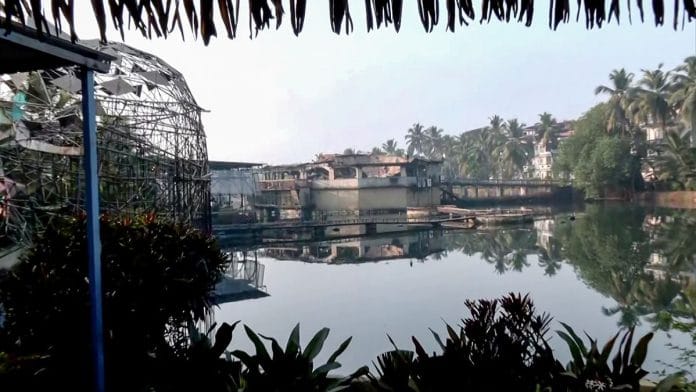



You can see the moment the fire started at Birch by Romeo Lane in a widely circulated viral video. A Kazakh performer danced to “Mehbooba O Mehbooba”, as fireworks went off all around her, pyrotechnics for the Saturday night crew. A bright burst of sparks catches what appears to be a thatched roof above the DJ booth, causing the orchestra and the dancer to scramble. An inebriated patron wisecracks at the dancer: “Aapne toh aag laga di!” (You’ve set fire to the stage.)
The mood must have been decidedly less cheerful two levels below. Nineteen-year-old Binod Mahto isn’t in the video; neither is his brother Pradeep (24) nor Mohit Munda (18). The three men—from the same Jharkhand village—were in the establishment’s basement kitchen with no fire exits, along with 17 other kitchen workers. The men had migrated from Uttarakhand, Assam, and Nepal, to scrape together a living by cooking in a barely legal nightclub, built on a salt pan, enabled by a system that ought to surprise no one. They are all dead now.
Birch by Romeo Lane is a prime example of how Delhi’s audacity—combined with muscle, money, and entrepreneurial powers—succeeds in Goa. You cannot drive from Panaji to Mandrem, or visit a North Goa neighbourhood, without encountering a hoarding advertising the nightclub. Earlier this year, it won the Iconic Concept Bar award at the Times Hospitality Icons. Romeo Lane’s chairman Saurabh Luthra, a “gold medalist engineer turned into a promising and fastest-growing restaurateur”, had racked up a Forbes India feature. Multiple institutions and nodal authorities had to fail to ensure that Birch could continue functioning, despite a demolition order, which was subsequently stayed, against it. And they did, spectacularly.
A land grab
Let’s start with the land itself. According to the Regional Plan 2021, the area of the Birch site is zoned as a salt pan, classified as ECO-1, and is clearly marked as a No Development Zone. This is khazan land, a centuries-old engineered ecosystem featuring an intricate network of bunds, sluice gates, and fields that manage the tidal flow of saline water. However, a structure mysteriously appears and, even worse, is then permitted to run commercially at the same location, said Solano Da Silva, researcher, educator, and author of The Great Goa Land Grab.
The land has also been mired in litigation, at least since 2005, with complaints against the current owner, Surinder Kumar Khosla. Yet, over the years, what started as a small pavilion rented out for weddings and small get-togethers, metastasized into a full-scale nightclub. Birch was constructed using wood, palm thatch, and other highly flammable materials, most likely to present itself as a “temporary structure”. Kaustubh Naik, a Goa writer and doctoral candidate at the University of Pennsylvania, pointed to the coastline’s ubiquitous shacks: “They create a certain aesthetic of rusticness and antiquity. But they’re also used to legally flout some of the structural requirements of the buildings themselves.”
The fire safety incident report notes that Birch was functioning without a valid No Objection Certificate from the Fire Department. The report, which was compiled after the tragedy, catalogues what the department would have found, had they ever been asked to inspect: “High fuel load density in restaurant and bar areas. Presence of flammable furnishings and plastics. Highly combustible interior finishes including wooden panels, partitions, and décor. Basement with inadequate ventilation and obstructed means of egress.”
What Birch did have was a trade license and a consent to operate from the Goa State Pollution Control Board. “A nightclub needs to have sound control,” said Tahir Noronha, architect and urban planner. “It has only two narrow bridges to enter and exit. How could they have been given consent to operate? The buck might stop at the panchayat and pollution control board. But the planning department should have stepped in. A 1.5-metre bridge is not fire safe.”
Also read: Goa’s digital nomads get a reality check—working from paradise needs more than just good vibes
‘Politically managed illegalities’
The more we get to know about Birch, the more it becomes clear that it was operating in the gaps between jurisdictions. Two weeks before the fire, the Goa Coastal Zone Management Authority gave the nightclub a clean chit. The body concluded that the structure was “entirely legal” since it “purportedly fell outside the Coastal Regulation Zone, thereby eliminating any alleged CRZ violations.” It relied on a 1996 NOC issued by the Arpora-Nagoa Panchayat for the construction of a restaurant, staff quarters, compound wall and retaining wall. “There is no environmental cause, as there has been a civil litigation between the owners of the club and the complainant since 2005,” it said.
This circular logic, as with most things in Goa’s development story, lies in what Da Silva calls “politically managed illegalities.” “The well-connected demonstrate their power in terms of their ability to set the government’s agenda,” he told me. “Or when faced with scrutiny, the powerful demonstrate the capacity to ensure non-decision-making; i.e. endless delays, condonements, inconclusive inquiries where nothing gets resolved, and violators persist in their businesses. All this is possible because this regime has parcelled out policy making and enforcement in little fiefdoms that keep a coalition cobbled by defectors intact.”
It wasn’t always like this. Da Silva said that Goa once had some of the most impressive land use regulations in India. In the 1980s and 90s, the state implemented a Regional Plan with statutory zoning for every parcel of land, protecting Non-Development Slopes and Khazans. These were mechanisms explicitly designed to “limit where the market could go” and keep certain spaces off-limits to commodification. It was the articulation of a society saying, “There are things (lands/ecological systems) that are not up for sale”. Unlike cities such as Delhi, which developed master plans only after they were already built out, Goa had the foresight to plan before the onset of rapid urbanisation.
Goa’s “extremely progressive land laws,” Da Silva explained, once ensured an urban fabric that preserved the state’s natural appeal. However, more recently, a slew of amendments have been enacted, including 17(2), 39A, FAR relaxation, and expansions of ODPs, which permit case-by-case exemptions from conforming to the Regional Plan. “Such is the appetite for land conversion among the political class in Goa that from October 2024 to November 2025, using Sec 39A, more than 12,76,000 square meters of ecologically sensitive land has been provisionally approved for conversion.” These regulations were once a defence against unchecked development—now, they act as a hall pass.
Da Silva said that, irrespective of our social position, we are all supposed to be equal before the law, and in a sense, the law and all its processes are meant to protect the weakest, most vulnerable, and those who are voiceless in society. “However, in Goa there is a ‘political fix’ available for the monied and well connected to circumvent regulations and get violations condoned. The cost is borne by the most vulnerable in society, like the labourers who paid with their lives on account of a political-bureaucratic culture of corruption and gross negligence…. And of course the cost is also borne by Goa’s ecology systems, the silent victim in the schemes and machinations of this government.”
The Arpora-Nagoa Panchayat did try to stop this, by ordering the demolition of illegal structures at the site. The owner, however, appealed to the Additional Director of Panchayats, which eventually granted the nightclub a stay. Senior advocate Arun Braz de Sa had also seen this coming. In a legal notice dated 4 November, a month before the fire, he had warned government authorities of “imminent risk of catastrophic failure and potential mass casualties” if operations at Birch continued unchecked.
Also read: Goans are turning their anger toward migrants now
A feature of the system
This culture of impunity extends well beyond Birch. Noronha notes that Nazri resort, associated with Calangute MLA Michael Lobo, is still taking bookings despite a demolition order issued seven years ago. “When there are these major concerns about stability, access and egress, and building within CRZ area, the first response of the government should be to seal the property,” he said. “This innocent-until-proven-guilty principle for commercial buildings should not be upheld.”
But it is upheld all the time. Naik said that the system is designed to produce irregularities from which people can benefit. “This is not a bug—it is a feature of the system.”
The PM, the President, as well as several leaders across the political spectrum have issued statements expressing deep sadness over the loss of life. Both the PM and CM, Pramod Sawant, have announced compensation packages for the deceased. What’s notable, Da Silva points out, is what they didn’t say. “Why has the PM not demanded accountability from every Minister and Governmental department?” he asked. “It is very easy to use taxpayers’ money to provide compensation. However, if this government has any moral stamina, it would expose every minister, MLA, and bureaucrat involved in condoning these collective illegalities and extract compensation from each of them.”
Meanwhile, a flurry of activity has ensued in the last two days. Four managers have been arrested, and three mid-level bureaucrats have been suspended. A police team has been dispatched to Delhi to arrest the owners. “I’m sure somebody will be scapegoated,” Naik told me, “but eventually these things will die out in a news cycle.” Just the way the May 2025 Shirgaon stampede has faded from sight. Next week, the tourists will return for the Rs 3000 cover charges. And we can all pretend this was just a temporary setback to the high season.
This article is part of the Goa Life series, which explores the new and the old of Goan culture.
Karanjeet Kaur is a journalist, former editor of Arré, and a partner at TWO Design. She tweets @Kaju_Katri. Views are personal.
(Edited by Theres Sudeep)
I would like to congratulate the author on how well assimilated she is to Goan culture! This is because, after reading this article twice, the two brothers who own the club are the only Delhi folk mentioned here…but they’re just one party to this sordid affair, literally everyone else involved – right from the village panchayay to the fire department are all local Goans, yet Ms. Kaur couldn’t help but drag Delhi into this!! Clearly she’s internalized the classic Goan response to all valid criticism – “they’re not locals, they’re outsiders”!
The columnist had covered the issue of Goa’s taxi mafia very well some time back. A jewel, which could rival the South Of France. Or at least comparable destinations in south east Asia. How can such abysmal governance, coupled with rent seeking, be condoned or accepted. Ahmednagar district in Maharashtra is four and a half times the area of Goa.