









In pre-election Bangladesh, accurately measuring public sentiment through reliable surveys has become vital for understanding the country’s trajectory.
Trustworthy polling institutions are limited, and the public’s skepticism toward data, understandably heightened after years of manipulated statistics during Sheikh Hasina’s tenure, has eroded confidence in traditional sources.
This pattern was first disrupted by Innovision’s People’s Election Pulse Survey (PEPS). Its two published phases offered citizens a rare, trusted foundation for making informed, data-driven judgements about a decision as consequential as a national election.
Then on Monday, the US-based think tank International Republican Institute (IRI) released its own pre-election assessment of Bangladesh, and its findings produced a set of striking insights that merit careful consideration from analysts and observers at home and abroad.
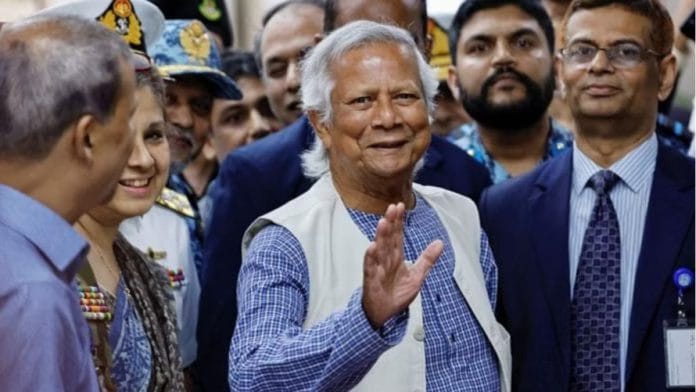
The most notable result from IRI is that seventy per cent of Bangladeshis now approve of the interim government’s performance—a dramatic shift that upends assumptions about the country’s political direction following last year’s uprising.
Crucially, it also dismantles the Awami League’s narrative that the movement was merely a “foreign-inspired conspiracy.”
The IRI data allows no space for such claims. It captures a genuine shift in sentiment driven by ordinary citizens, not external orchestration, signaling a clear realignment of political legitimacy—one rising organically from the population rather than descending from opaque, external forces.
Also read: Is Bangladesh ready for ‘developed country’ status? It’s all optics for Sheikh Hasina
Three contenders
The numbers hit with rather unmistakable clarity. If an election were held today, 33 per cent would cast their vote for BNP and 29 per cent for Jamaat. In contrast, support for the Awami League has evaporated: Only 11 per cent express strong backing, and a thin 14 per cent offer even a tentative endorsement.
This is no longer the old binary contest between BNP and the Awami League. The political arena now has three contenders—and the Awami League is visibly diminished, the weakest of the three.
BNP and Jamaat have absorbed the popular energy that the AL allowed to dissipate, and the once-formidable machinery of the Awami League has fractured beyond recognition.
Yet the current mood is more than a rejection of the past; it carries a cautious sense of renewal.
A full 53 per cent now believe the country is “performing well,” reversing the bleak mood that settled after 2020. Their optimism is grounded in tangible changes that include improvements in household finances and more reliable access to basic needs.
An overwhelming 80 per cent remain hopeful about Bangladesh’s future. Many feel the country is finally emerging from years of suppression and political fatigue. Seventy-two per cent now describe the state of democracy as “good”—the highest level recorded in eight years.
This public mood dismantles the notion of a hijacked revolution or a power shift engineered from abroad; it underscores that the uprising cleared the way for something organic—a sentiment that had been simmering in Bangladesh’s civic consciousness long before it burst into the open. The country’s hierarchy of institutional trust reinforces this point.
At the top stands the military, followed by the student movement and the media—institutions seen as bulwarks against chaos and political deceit. At the bottom lie the police, the Election Commission, Hefazat-e-Islam, and Hizb-ut-Tahrir, all burdened with deep reputational deficits.
The military is viewed as a stabilising force rather than an authoritarian lever. The student movement is remembered as the moral catalyst that rekindled civic resistance to autocratic governance.
Also read: India has to move on now. Engage with ‘Nooton Bangladesh’
Corruption looms large
The overall climate is far from celebratory though. The same surveys reveal corruption, insecurity, political volatility, price shocks, and joblessness as the central fears of Bangladeshis. These are not episodic irritants—they are long-festering grievances that eventually drove the country into collision with the entrenched order.
Equally significant is the urgency: 72 per cent now call for a national election without delay, and 41 per cent demand that it happen immediately. This is not a hesitant electorate—it is a nation impatient to reassert democratic will.
As BNP and Jamaat advance, the interim government remains, for now, the beneficiary of public patience. But that patience is conditional: Eliminate corruption and implement real structural reform—not just reshuffle political faces, while preserving the same power architecture.
Demands for transparent elections, forceful anti-corruption action, and transformational reform are fundamental requirements from a population that has endured years of political inertia followed by the rupture of mass revolt, the survey found out.
The IRI survey essentially proves that if Awami League continues cocooning itself in the comforting myth that last year’s uprising was staged or manipulated, it will ignore the plain truth. That Bangladeshis asked for accountability and genuine electoral competition—and they have not retreated from those demands.
The rise of Jamaat as a real contender beside BNP signals that voters have broken free from the old AL–BNP binary, and the revived democratic confidence shows that Bangladeshis intend to rebuild their political order.
Taken together, the IRI results depict a Bangladesh in the middle of a genuine civic reconfiguration—propelled by unmistakable public intent.
Those who recognise it may adapt and endure. But those who cling to denial—as the Awami League continues to do—will soon discover that history has already moved on without them.
Faisal Mahmud is the Minister (Press) of Bangladesh High Commission in New Delhi. Views are personal.
(Edited by Theres Sudeep)
I can go to Bangladesh and get 100 people in my sample. I will chose in such a manner that 90 out of those 100 would say that they love Sheikh Hasina and would want Bangladesh to get rid of the interim government. I can then publish the results under some obscure and shady think tank or whatever and get people with agenda like Mr Mahmud to share it. Some people would buy it and some would not.
Bangladesh is more than welcome to become the outpost of an actual hegemon who wants to use it as a base for their own strategic interests. But when the chicken would come home to roost, I am sure people like the author can spin and twist it to blame India. Judging by the attacks and intimidation of bauls, liberation war veterans and religious minority leaders, I am grateful as an Indian Bengali to people like Mr Mahmud to showcase how Bangladeshis are not Bengalis and how 1971 was a civil war between the Islamists and moderate Pakistanis who were understandably disgusted at Operation Searchlight.
It is more pertinent for Bengalis in West Bengal to protect the culture and the language. And all the more important to kick out the closeted Islamists who use the language to destroy it and its accompanying culture.
Mr Faisal is trying too hard. His words should be directed at the “interim government” to call for elections next week itself since it is so popular. Or did the student leaders succumb to the intellectual fallacy of democratic systems run by surveys conducted by another sovereign situated thousand of miles away ? It is laughable that the author is relying on surveys. It is also seems to paint a sorry picture where citizens are being made to read reasons to accept validity of interim non democractically elected governments. Conduct elections before lest crutching on straws is the new normal.