









Those who are expecting the results of the next national elections, slated for 12 February, to pull Bangladesh back from the abyss may have to wait a little longer. A whole lot longer if the largest Islamist political party in Bangladesh, the Bangladesh Jamaat-e-Islami, has its way.
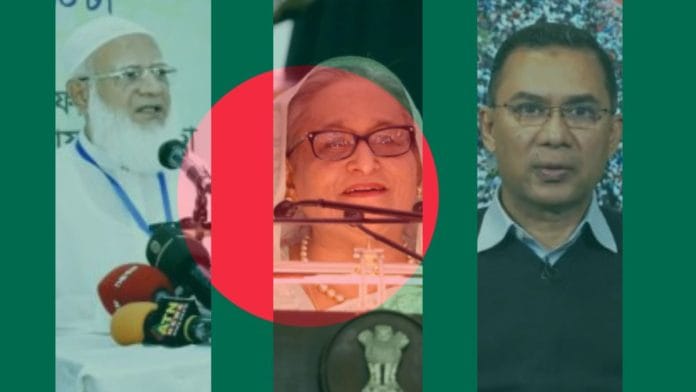
The Bangladesh press reported on 31 December that Bangladesh Jamaat-e-Islami ameer Dr Shafiqur Rahman is considering forming a unity government after the next national election. He also held a meeting with an Indian diplomat. Rahman reportedly said the Indian diplomat asked him to keep the meeting secret, which is why it was not disclosed earlier. Rahman’s statement has cast doubt over the impact of the upcoming polls on Bangladesh’s political future. Political observers note that irrespective of which party comes to power on 12 February, it will be a Jamaat government by another name.
Unity among whom?
In an interview with Reuters on 2 January, Shafiqur Rahman said: “We want to see a stable nation for at least five years. If the parties come together, we’ll run the government together.” Rahman also said the prime minister will come from the party winning the most seats in the 12 February election. If Jamaat wins the most seats, the party will decide whether he himself would be a candidate, he added.
Many Dhaka watchers are reading Rahman’s statement as an indication of things to come. The Jamaat-e-Islami has already tied up with the students’ party—the National Citizen Party—which was formed after the July uprising of 2024. But the Bangladesh Nationalist Party (BNP), the largest political party in Bangladesh after Sheikh Hasina’s Awami League, a former ally of the Jamaat, is standing against it this election season.
“What is the point of talking about a unity government before the polls take place? Most opinion polls still suggest that the BNP will win the February election in the absence of the Awami League. Why will the BNP agree to a unity government then? This is a not-so-subtle warning by the Jamaat to the BNP that no future government can be run without taking it along,” Bangladeshi political journalist Sahidul Hasan Khokon told ThePrint.
“The BNP and the Jamaat are former allies who are now against each other, sharing similar ideological moorings. The next government would be two sides of the same coin,” Bangladeshi actress and journalist Deepanwita Roy Martin told ThePrint.
She added that the July revolutionaries’ saying they killed policemen to bring Jamaat to power only strengthens this possible outcome. “Do you think after all this, the Jamaat will let anyone deny it a place in the next government?” Martin said.
The plan for a Unity Government, though, is not a fresh development. In August 2024, soon after the fall of the Sheikh Hasina Government, Jamaat leaders held a meeting with the top Qawmi scholars of the country, where participants had voiced optimism about establishing a country based on Islamic rules under the leadership of Shafiqur Rahman.
Interestingly, at the meeting, Shariat Mufti Abu Zafar Qasemi, ameer of another Islamist party, the Bangladesh Khilafat Andolan, had said: “We must be united regardless of party opinion. We should forget all our past differences and should not give any political party a chance.”
According to Bangladeshi-Australian political commentator Faiyaz Hossain, those in Bangladesh waiting for a return of electoral democracy after 12 February are in for a rude shock. “There is some support for the BNP after the demise of the former prime minister, Khaleda Zia. In the absence of the Awami League, it is the BNP alone that can win polls. But that would foil the Jamaat’s plan of a nation ruled by Sharia. Hence, the talk of a Unity Government,” Hossain told The Print.
The Yunus administration has promised to hold free and fair elections this February. “The nation is eagerly waiting to exercise their voting rights, which were stolen by the autocratic regime,” Yunus reportedly told US envoy Sergio Gor during a phone call in December as mad violence gripped the country after the assassination of young political leader Osman Hadi.
The fear is that the very purpose of such an election would be defeated if the Jamaat manages to bring in a unity government.
Deep Halder is an author and a contributing editor at ThePrint. He tweets @deepscribble. Views are personal.
(Edited by Theres Sudeep)