






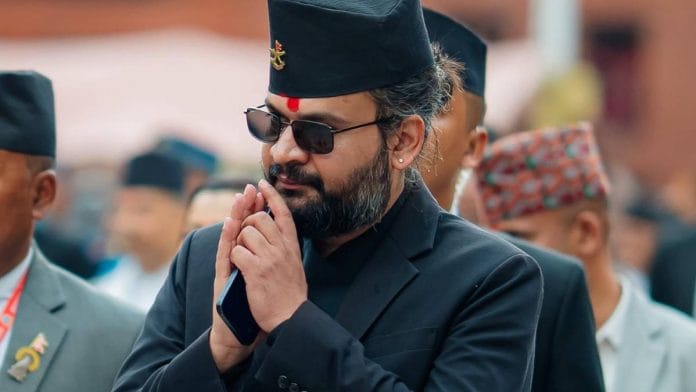



The Balen wave has swept the fifth general election in Nepal, bringing the newbie Rastriya Swatantra Party a historical victory. Never in the country’s 17-year democratic history has any party won such a large mandate, not even the Maoists, who led a decade-long fight against the monarchy and helped lay the foundation of democracy in 2008.
The RSP has won a total of 183 out of 275 seats in the lower house—125 under the first-past-the-post, plus 58 through proportional representation. In the lower house of 275 members, 138 seats are required for a majority, and 184 for a two-thirds majority, and RSP may have just achieved the latter.
So far, elections in Nepal have reflected a clear regional and ethnic divide, with voters often taking the Pahadi (hills) versus Madhesh (plains) split into account while casting their votes. This would be the first election where the agenda seems to have mattered more than such divides. This will also be the first time that someone like Balendra Shah with Madhesi and Maithili roots will be the Prime Minister. Nepal has seen a few deputy prime ministers from the plains in the past, but never someone like Shah at the top—making this an election of many firsts. A few milestones have emerged from the election results.
The milestones
For Nepal watchers, Balen was a serious figure who entered a serious race for the top office. Riding the Gen Z movement and its agenda, he brought a majority of this scale to a party he had joined two months before the elections. During the campaign, however, most observers still believed that traditional parties like the Nepali Congress, the Communist Party of Nepal (UML) (CPN-UML), and the Nepali Communist Party (NCP) would once again form a coalition, as had been the case in the past.
Quite the opposite: RSP may have close to a two-thirds majority of its own, and the numbers for these traditional parties are so meagre that they will have to stand united while being in the parliament. Additionally, breaking from strategic electoral calculus, the RSP and Balen Shah were just three-year-olds in Nepalese politics, who defied the odds of a traditional cadre base.
Leading up to the elections, there were parallels drawn between RSP and Bangladesh’s National Citizens Party, both of which had youth-centric leadership and distaste for the old guard of their respective politics—Sheikh Hasina in Bangladesh and KP Sharma Oli in Nepal. In all probability, there was a strong belief that, since the NCP in Bangladesh failed due to its own follies and ambitions, the RSP might experience the same.
Contrary to popular belief, Balen not only captured national sentiment but also proved a strong force against stalwarts such as KP Oli, whom he defeated in Jhapa 05 by almost 50,000 votes. This proves that the Gen Z movement was a serious wave that RSP and Balen together managed to capture—the first milestone reflecting the relevance of issues-based politics.
Second, the Balen wave ends the vicious cycle of coalition government and political instability. In Nepal’s political history, this election would be remembered as a boon to democracy: it ends the power contest between different coalition partners, and the element of ‘compulsion of coalition’ across the sectors. Such instability had often slowed major decisions—drafting of the constitution, a national security policy, deciding on the direction of foreign policy, passing of social security bills or economic development of the country.
It will be the first time the parliament has a ruling party with a clear majority and the capacity to bring about changes quickly.
Third, the results have also brought about the ‘second coming’ of democracy in Nepal, especially in the multiparty system. When Nepal became a full-fledged democracy in 2008, though it abolished the monarchy, parties were still from the royal era. The only change was that, instead of the monarch having the sole say in the country’s affairs, political parties now held the magical chairs of power, keeping the country hostage to political instability for 17 years, where no prime minister or coalition stayed in power for 5 years. Political instability would end now unless Balen Shah and the top leadership, such as RSP’s convener Rabi Lamichhane, are at odds and decide to split.
Also read: Balen Shah’s victory signals the fall of Nepal’s old establishment. India will have to adapt
The challenges
Besides the milestone, the new government’s key challenge would be delivering on the mandate they have promised to the public. For a four-year-old party and a leader with four years of experience as the Mayor of Kathmandu, delivering on the key issues of employment, good governance, transparency in governance and finances, safety of Nepalese abroad—conflict in West Asia, and educational reforms.
If traditional parties had 17 years to work on these issues, the mandate given to the RSP would require much speed. The youth who gave the party with the mandate will be the proven opposition on the streets; the opposition in the parliament would be pale. There would be less patience among the youth.
On the other hand, Nepalese politics would now be a witness to the populist mode of governance. In the theoretical framework, populists often bend the rules, redefine the law, disregard opposition in parliament, and, for every action, reach out to the masses to justify it.
If Balen’s record as a mayor is taken into account, he was allegedly disruptive, whether it was freeing the roadside pavements or addressing the issues of unruly hawkers in the city. However, in his new role as the first-ever youngest Prime Minister of Nepal, his biggest challenge would be to be patient rather than be impulsive.
To conclude, it is the people of Nepal who need to be congratulated for the way they have evolved through different systems, from Absolute Monarchy in the 1950s, party-less Panchayat System in the 1960s, and Constitutional Monarchy in the 1990s, and finally Democracy in 2008. The outcomes of the Gen Z movement and the 2026 election results must be seen as a second coming in Nepal’s democratic evolution, which has just gotten rid of the old guard and shown faith in the new aspiration order.
Rishi Gupta is a Commentator on Global Strategic Affairs. Views Personal.
(Edited by Ratan Priya)