






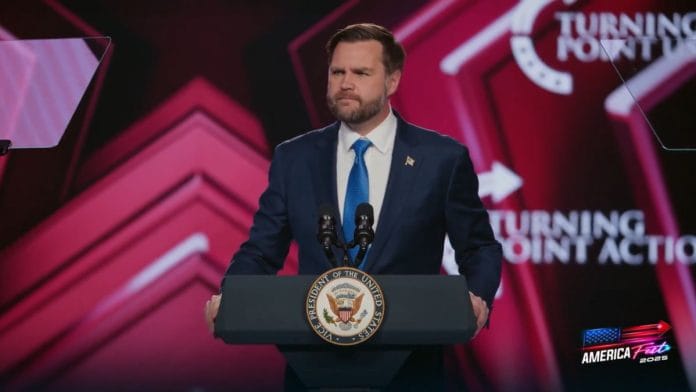



Right-wing nonprofit organisation Turning Point USA is at the centre of a major infighting within the Make America Great Again movement. The organisation advocates conservative politics among American high schools, colleges, and university campuses. It was co-founded by Charlie Kirk in 2012 and supported by Bill Montgomery, a prominent figure in the Tea Party movement. After Kirk’s assassination earlier this year, his wife Erika Kirk has led the organisation, which has caught global attention with its AmericaFest conference in Arizona. The conference has turned into a gladiatorial colosseum for a growing rift among conservative politicians and influencers.
This transpires as the campaign heat picks up before the mid-term elections in 2026, which will test the staying power of President Donald Trump’s agenda and the trifecta hold of the Republican Party over the White House and the two houses of the US Congress. The right side of the political spectrum in the United States, which has held its tent under the Trump presidency, does not look all that formidable anymore.
Rifts are showing over both domestic and foreign policy issues, including Israel, Jeffrey Epstein, and immigration. TPUSA’s AmericaFest has also propped up Vice President JD Vance as the most likely Republican candidate for the presidency in 2028. As the Republican Party and the broader conservative base look for a post-Trump future, will Vance prove to be the man to hold the base together?
Rift in the Right
Right-wing coalition MAGA took shape with the rise of Trump’s political fortunes and his domineering influence on the nation’s politics, even during his four-year hiatus, when Joe Biden was in power. The undercurrents of MAGA’s rise could be traced all the way back to the financial crisis of 2008 that left the American industrial heartland gutted, as well as the imperial overstretch of the “forever wars” in Afghanistan and Iraq. However, Trump’s politics embodied the true MAGA wave.
The same coalition is now showing unmistakable signs of cracks, which Vance and Erika Kirk are trying hard to display as symbols of American democracy and free speech.
“I know some of you are discouraged by the infighting over any number of issues. Don’t be discouraged… Wouldn’t you rather lead a movement of free thinkers who sometimes disagree than a bunch of drones who take their orders from George Soros,” Vance said at AmericaFest. Erika Kirk echoed the line.
“You won’t agree with everyone on this stage this weekend. And that’s okay. Welcome to America,” she said.
However, differences among the American Right over immigration, Israel, anti-Semitism, race, and the Epstein files have moved from the peripheries to the centre. Former White House chief strategist Steve Bannon openly and repeatedly called for the ouster of Speaker of the House of Representatives Mike Johnson. Prominent conservative commentator Ben Shapiro tore into fellow commentators, calling Candace Owens, Tucker Carlson, Megyn Kelly and Steve Bannon “frauds and grifters”. Contending that “the conservative movement was in serious danger,” Shapiro said the danger came not just from the Left but “from charlatans who claim to speak in the name of principle but actually traffic in conspiracism and dishonesty”.
Also read: 2025 was good for Turkey’s defence industry. Indian analysts don’t see the threat
Campaign 2028 has started
The rift in the Right also reflects growing anxiety as the Republican Party stares at a future beyond Trump. This is particularly so as culture wars grow bitter in the midst of a major struggle within the Democratic Party, with the rise of progressive figures such as Zohran Mamdani. Mamdani rose to a mayoral win on issues such as economic inequality, public services, American pluralism, and a welfare-oriented role of government, infusing new energy in the American left, or what the conservative movement would broadly dismiss as “woke” politics. The culture wars in America’s ballot politics are being waged and won not on specific policies, but on grand narratives of what America and the American Dream mean and who is and isn’t an American.
Even as Mamdani’s win re-ignited the progressives’ popularity in urban spaces, Erika Kirk claimed major conservative inroads at AmericaFest. She claimed that 80 per cent of the attendees were first-timers to AmericaFest, that one-third of them were students, and “54 per cent were females.” Since her husband’s death, Erika Kirk claimed that the membership of TPUSA had risen to “over 1 million people across 4,000 chapters at high schools and colleges.”
As the MAGA base looks for continuity without chaos in a post-Trump era, Erika Kirk came out publicly endorsing Vance as the rightful heir to Trump. Although the American vice president is yet to publicly announce his intention, signals are hard to miss. Vance used the AmericaFest conference to double down on his views on race and religion.
“In the United States of America, you don’t have to apologise for being White anymore… Over the last 50 years, there has been a singular focus, a war that has been waged on Christians and Christianity in the United States of America. And let me say, of all the wars that Donald Trump has ended, that is the one we’re proudest of,” he said.
Vance’s clearer ideological affinity to the conservative movement is starkly different from Trump, who is ideologically unhinged. This makes Trump’s politics simpler for a large number of Americans to feel without calculating, and to absorb without ideological complexities. Vance is more outrightly a restrainer on foreign interventions and more outrightly conservative on the frontlines of America’s culture wars. In case he takes up the presidential race seriously, how he will balance the libertarians, national security hawks, evangelicals, general disrupters, and establishment Republicans will have to be seen.
American electoral politics and debates over governance have always been shaped by competing visions of what the US is, what it should be, and who truly belongs in it. What is different today is the intensity and consequences of how these differences are expressed. Even as former presidential hopeful and 2026 Ohio Gubernatorial candidate Vivek Ramaswamy harped on at AmericaFest on the exceptionalism of the American Dream, the future of who that dream belongs to is at the very heart of the culture wars in the US. What it means to be an American in 2026 and beyond will be at the very heart of the future of America’s social contract.
What emerges out of this slugfest in the American Right will be germane to the shape of things to come, not just in the US but also in terms of its engagements with the world.
Monish Tourangbam is a Fellow at the Chintan Research Foundation, New Delhi. Views are personal.
(Edited by Prasanna Bachchhav)