









The upcoming 2026 delimitation exercise raises concern about the North-South divide. Those in the south are concerned that they will receive fewer seats in the next redistribution under the population-based parliamentary seats distribution. Under Article 82- Delimitation for the Lok Sabha and under Article 170- Delimitation for the state legislative assemblies Constitution of India provides legal authority to readjust the seats after every census.
If the Delimitation Commission revised the delimitation exercise on a per-population basis, then the number of seats would increase from 543 to 848, with a proportionate increase among various states. Southern states, smaller states like Punjab, Himachal Pradesh, and Uttarakhand, as well as the Northeastern states, would be at a disadvantage compared to the larger northern states. This will undermine the concept of federalism.
Northern states, such as Uttar Pradesh, Bihar, Madhya Pradesh, and Rajasthan, have experienced significant population growth, whereas southern states, including Kerala, Tamil Nadu, Karnataka, Telangana and Andhra Pradesh, have managed to control their growth through effective policies. There are worries in the South that they will lose seats in the upcoming redistribution despite contributing more to the GDP than the North.
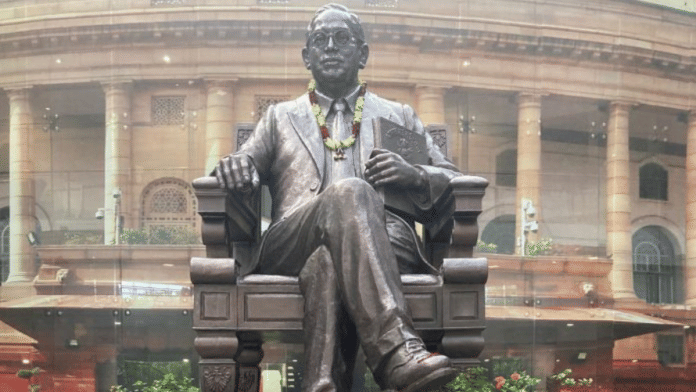
This article attempts to understand federalism through the lens of BR Ambedkar.
Also read: Ambedkar’s fight wasn’t just against caste. Scholars have overlooked his labour activism
Birth and growth of Indian federations
Ambedkar was the constitutional architect and moral philosopher of Indian federalism. He argued that Indian federalism did not arise in the same way as the United States and Australia, where different states form a union voluntarily through negotiations and a treaty. Indian Federalism was shaped by British colonial rule. Indian federations were not negotiated by pre-existing sovereign states; instead, they were created by the Constitution to hold together different states under one constitutional rule.
Federalism is a modern political system. At the time India became independent, only a few countries had successfully adopted it—USA, Switzerland, Imperial Germany, Canada and Australia. The US constitution is the oldest written federal constitution (1787). Switzerland shifted from independent states to a federal union in 1848. The German Empire (1871-1918) was a federal monarchy. Canada’s Constitution Act of 1867 created a quasi-federal system to unite its provinces under British dominion. India and Canada have similar types of federal systems, both of which are quasi-federal; they both draw their constitutional heritage from British constitutionalism. The Australian Federation of 1901 unified six colonies under the Commonwealth Constitution, blending British parliamentary traditions with American federalism. Similarly, Ambedkar sought to create the All India Federation, embodying Holding Together Federalism, where a diverse and large territory is governed by a single constitutional framework.
Ambedkar compared Indian federalism to that of other federal countries based on geographical size, population, and administrative position. Each Indian state reflects a unique set of languages, cultures, and politics, highlighting India’s remarkable diversity compared to the more homogeneous social composition of the US. This diversity is unmatched by any other federation in the world.
Union of States
Ambedkar wanted the phrase “Union of States” to be used instead of “Federation of States” or “United States of India.” Ambedkar deliberately chose the term “Union of States” to denote that Indian federalism is distinct and stronger and that states in India do not have the right to secede.
Ambedkar said that India is very far from becoming the United States of India, even morally and mentally. Because in the USA, all states enjoy equal federal power, but in India, every state has different political weightage. In India, there is a consolidation of the North and Balkanisation of South and this creates an asymmetric federation.
According to Ambedkar, India’s federation is both Unitary and Federal. Ambedkar wanted a constitution that ensured National Unity, but also allowed states to maintain their own autonomy in normal conditions. Ambedkar made it clear that the Indian President can exercise the special power by approving both houses of the Indian Parliament during a war to make the country unitary.
Ambedkar admitted that Indian Federalism is rigid, like the US Senate, and not completely unitary, like the United Kingdom’s House of Lords. Our Federalism is flexible; it is Quasi-Federal.
Also read: Ambedkar made human rights Indian ideals in fight against caste—before they became global slogans
Balance among the states
Ambedkar, in Thoughts on Linguistics States, argued that federations only function effectively when there is a proper balance among the states. Suppose some states become dominant population-wise, economically, and politically, it will create an imbalance among the federal units, which could pose a danger to the unity and stability of the federation. A smaller state will feel marginalised, and that will lead to resentment and distrust among the federal character. According to Ambedkar, successful federations of the world recognised the risks, so they designed a constitutional mechanism that can limit the political dominance of the larger states. In the United States, the Lower House (House of Representatives) has more representatives based on population, but in the Upper House (Senate), every state has an equal number of representatives, two, despite differences in population. So, the US Bicameral structure adopted both democratic rule of the people and balanced federalism. Ambedkar envisioned a similar type of federalism in India, where every state has the same number of Rajya Sabha seats, but the Lok Sabha has a population-based number of seats.
According to Ambedkar, regional equilibrium is necessary to maintain a balance between the centre and the state. His concern was that if the Hindi belt became dominant in national politics, then the South would become marginalised and feel alienated, and ultimately this would lead to disunity, undermining national integrity. The political dominance of any region could erode federal cooperation and lead to a separatist movement. Other states should not feel like they are being ruled by someone else, but rather like equal partners in the federal structure. Each state, regardless of size, population, or resources, has equal constitutional status and the domination of any region leads to policy bias and distrust.
North India has a language that most local people can understand, but the southern states have different languages in every state, so they cannot unite like North India. This unified North and a fragmented South can create an asymmetric power balance. This imbalance not only affects the southern Indian states but also the East and North West. Compared to Uttar Pradesh, West Bengal, and Punjab have fewer seats.
After Independence, North India emerged as the heartland of national parties, such as the Bharatiya Janata Party (BJP) and the Indian National Congress (INC), which have led the central government. This is why Ambedkar talked about the pro-federal balance. In a federal country, population-based representation is legitimate in the Lower House; however, in the Upper House, to maintain federal balance, each state must provide equal representation. Otherwise, it will lead to majoritarian politics instead of pluralist politics.
Ambedkar on Northern-Southern states
Ambedkar also analysed the sociological differences between the south and the north. According to him, the South is educationally advanced, whereas the North is educationally backward. The culture of the South is modern, whereas the culture of the North is ancient. The north is numerically superior but culturally conservative, whereas the south is progressive. The North is superstitious, while the South is rational. Then how can the South tolerate the rule of the North?
Ambedkar also didn’t want to divide southern states on linguistic lines because, according to him, it would break their unity and they could not fight against the larger states of north India. He wanted to preserve the southern states’ political significance by forming larger states. If the southern states were to become smaller in terms of population, they would lose their relevance in national politics compared to the North. According to Ambedkar, this fragmentation is not only harmful for the south but also weakens India as a whole.
Ambedkar, by providing examples, aimed to demonstrate that a similar civil war, such as the American Civil War (1861-1865), between the North and South, could also occur in the future in India.
Division of the north states
Ambedkar argued that the problem of the federal balance arises due to the size of the states, which are often defined on linguistic or regional lines, resulting in an excessive imbalance in state sizes. According to him, to create a state, there should be standard, uniform rules for determining the size of states. Northern states such as UP, Bihar and MP should be divided, with each new state having a population of approximately 2 crore (at the time of writing in 1955). This, he said, will strengthen the federalism balance and protect regional and linguistic identities.
Ambedkar proposed dividing UP into three parts: West UP, Central UP, and Eastern UP. Maharashtra was suggested to be split into four regions: Bombay city state, Vidarbha, Marathwada, and Western Maharashtra (Konkan Desh). Bihar and Madhya Pradesh were to be divided into two parts each: Northern Bihar and Southern Bihar, and Northern Madhya Pradesh and Southern Madhya Pradesh.
Most southern states at that time fell below the ideal two-crore population size. To maintain ideal size, states had to be enlarged with neighbouring regions of other states, which would result in mixed states. This would disrupt linguistic homogeneity. Southern states have distinct linguistic and cultural unity; they would lose their value. Enlarging them also violates the principle of linguistic states, which Ambedkar accepted as legitimate. Ambedkar suggested that only the larger states of the Northern belt should be broken up instead of enlarging the southern states.
Also read: How Ambedkar was both ‘Dalitised’ and ‘Brahminised’ by Indian ruling class to own history
Federations vs freedom
According to Ambedkar, the federal government is the middle path of governance. A unitary government is totally centralised, A confederation is a loose alliance of the states, but a federal government is the middle path between the two extremes. Nationalism can exist in both unitary and federal forms of government. Federalism does not weaken national unity.
Ambedkar’s concerns were not only institutional but also ethical in nature. He believed that federalism should be based on the principle of equality of power. According to him, true unity only comes about when states have mutual respect; if small states feel excluded, it would pose a danger to Indian democracy. He wanted a nation based on cultural balance and cooperation. He envisioned an inclusive democracy, not a numerically dominated state. Ambedkar’s warning remains relevant in today’s context, as evident in cases such as the delimitation, the language war, language-based state demands, as well as debates over fiscal federalism.
Krishna Mohan Lal is a PhD research scholar at Tata Institute of Social Sciences, Mumbai. He tweets @Maitreya_G. Views are personal.
(Edited by Theres Sudeep)