









Did the gatekeepers at the India AI Summit decide that they needed to be Gateskeepers? Was Bill Gates quietly told that he would not be welcome at a Summit that is already reeling from controversy after controversy?
It does look like that. Even before the event, government ‘sources’ were quoted as saying there had been a change of plan and that Gates would not be speaking. But the Gates Foundation insisted that he would address the Summit as scheduled.
The last-minute cancellation, announced when Gates was already in India, suggests that nobody in authority wanted another day of negative publicity, with the actual substance of the Summit being ignored while Gates and the ghost of Jeffrey Epstein dominated the conversation.
It’s been that kind of Summit. And while its defenders argue, with some justification, that the controversies should not be allowed to distract us, the truth is that few people in Delhi will remember this Summit with any great affection.
Partly, this is because the controversies did give us an insight into how India functions these days.
Also Read: India-US trade deal is just like Union Budget. Sycophants are forced to praise both
An embarrassing dog and pony show
I don’t think anyone, including the organisers themselves, disputes that there were too many screw-ups on the first day. Social media was filled with complaints about thievery at the venue (at least in one case the thieves were identified, arrested, and the loot recovered); about poor organisation; the quality of the WiFi; and claims that vendors were refusing to accept UPI and insisting that customers buy coupons and then make their purchases with those. So much for being a great IT superpower!
Things improved by the second day. Or they would have, if not for the Galgotias dog.
Some background: Galgotias is an educational enterprise based in UP whose institutions do not receive much respect from many serious educationalists, though of course that may just be down to snobbery.
Certainly, this does not bother Galgotias University, which spares no effort in promoting itself. On the day after the controversy broke out, an unfortunately timed paid advertorial supplement in which Galgotias lavishly praised itself appeared in one of India’s top newspapers.
The ‘university’ openly seeks to ingratiate itself with the political establishment, using hyper-nationalism as another form of advertising supplement. Sycophancy 101 would probably be the only course it could legitimately offer if ‘universities’ like Galgotias were judged on the basis of expertise.
But in today’s India, this sort of shabby, low-IQ, high-rent approach works, and Galgotias is able to make crores from students whose gullible parents are impressed by the hype and pictures of the ‘university’ receiving ‘awards’ from powerful ministers.
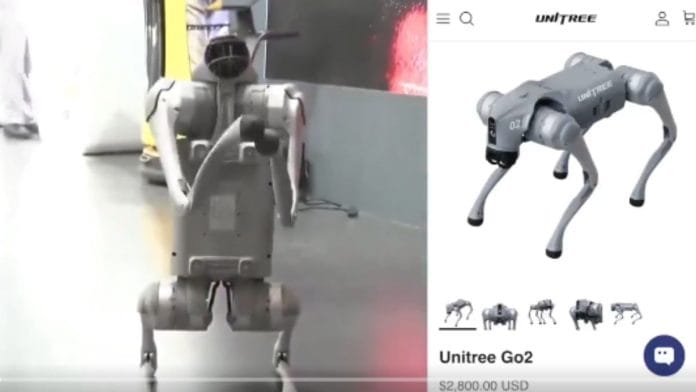
Given its proximity to the powers that be, it is not surprising that Galgotias was allowed to showcase its AI ‘triumphs’ at the Summit. One of these so-called achievements consisted of a robot dog allegedly developed by the Galgotias geniuses.
It was entirely in keeping with the nature of this kind of ‘educational establishment’ that the genius of the Galgotias faculty was revealed to lie not in science but in shopping. The robot dog was Chinese, and intrepid reporters soon discovered that you could buy it on the internet for around Rs 2 lakh.
Worried that the Summit was running into a second day of controversy, the organisers asked the dog-loving Galgotias team to leave. When this did not happen, they reportedly cut the power to the Galgotias stall.
Undeterred, Galgotias sent its faculty out to tell the media that it was all a misunderstanding. This offered an insight into the institution’s IQ. One woman, Neha Singh, described as a member of the Communications faculty, said that the whole problem was caused because she had been unable to “communicate it properly”. Nobody at Galgotias saw the irony in this.
When all this failed, Galgotias issued a press release blaming the fiasco on faculty members, as though this somehow exonerated the fat-cat bosses who profit from the ‘education’ offered by these faculty members.
The Summit’s defenders, who were then despatched in force to flood social media once it became clear that the event was turning into an international embarrassment, argued that we should not focus disproportionately on the fiascos and lies about our robot development skills.
They may have been right, but it was too late. The Galgotias dog made it to media around the world. The Chinese, in particular, treated our enthusiasm in passing off their work as ours as a metaphor for India’s claims about scientific and technological progress.
Also Read: How China sees Delhi AI Summit—India’s attempt at visibility, not a breakthrough
Intelligence deficit on display
All of this was embarrassing enough, but the reason so many of Delhi’s citizens were so fed up was that it rapidly became clear that the administration did not have the intelligence (artificial or natural) to organise the Artificial Intelligence Summit. Delegates complained that taxis were not allowed anywhere near the Summit and that they had to walk for miles to find any kind of transport. Obviously, nobody had factored in the interests of ordinary delegates while planning the Summit.
The focus was solely on VIPs and foreign leaders. The idea was to use the Summit to showcase our AI capabilities, robot dogs and all, to important foreigners. So ordinary citizens, even those with no interest in AI, were harassed. Roads were arbitrarily shut down and car journeys that would normally take 30 minutes took up to five hours.
Nobody disputes that VIP security is important, but any administration has to balance security requirements with the interests of ordinary citizens. People are always annoyed about being made to stop their cars for five to ten minutes to let a VIP pass. They get over it. However, when traffic is stopped for 40 minutes each time a VIP passes (and there were lots of VIPs at the Summit) it causes a spiral of traffic chaos that brings the entire city, not just the area around the Summit, to a halt. What was once a matter of inconvenience turns into an issue of police incompetence.
There are no good explanations for the poor management by the organisers of the Summit and the administration, which caused so much chaos in Delhi. Yes, there were many VIPs in town, but many capitals around the world have hosted far more heads of state at a time without making life hell for ordinary citizens.
This is hardly the world’s first Summit or high-level conference. Other cities handle security better because they are run by competent people. In Delhi, a mixture of incompetence, VIP-worship, and a callous disregard for ordinary citizens demonstrates how India does things these days.
In many ways, the Summit offered a snapshot of today’s India: a great technological mindset, gifted and enthusiastic citizens, both of which spur global interest. But also: incompetent administrators and policemen; no regard for citizens; and the rise to wealth and fame of dodgy institutions, educational and otherwise, that get rich on sycophancy, jugaad, and the fleecing of gullible people.
Are you surprised that they did not let Bill Gates speak? That would have been the last straw.
Vir Sanghvi is a print and television journalist and talk show host. He tweets @virsanghvi. Views are personal.
(Edited by Asavari Singh)