



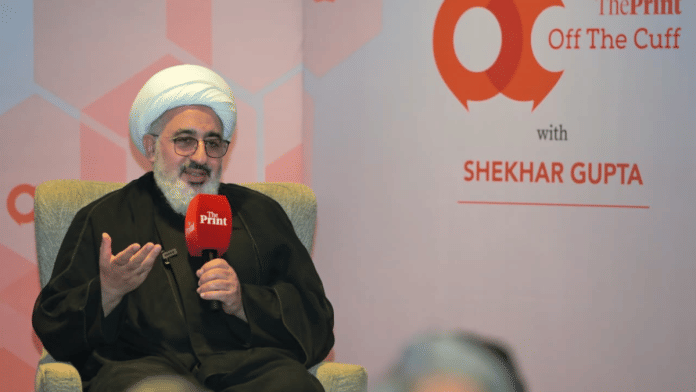
Gurugram: Pakistan is only a messenger between Iran and the US, and one of the “more active” countries in the region to do so, Abdul Majid Hakeem Ilahi, the representative of Iran’s Supreme Leader to India, has said.
“As you know, we didn’t call anyone to be a mediator between us and the United States. But some countries, they started, they initiated this mediation between Iran and the United States. One of these countries is Pakistan and started to be more active at that side. And this is just only a mediator (carrying) our message to the United States. This is their way,” Ilahi said at ThePrint’s Off The Cuff at Gurugram on Monday.
The Representative of the Iranian Supreme Leader Mojtaba Khamenei added: “Pakistan is providing opportunities and a base and field for negotiation at the first turn and also getting our messages and sending them to the United States.”
In a conversation with ThePrint’s Founder and Editor-in-Chief Shekhar Gupta at the Quorum Club in Gurugram, Ilahi did not answer whether Tehran trusts Islamabad to be an honest mediator, given its long history as a major partner of the US in the region.
Islamabad has been pushing both Tehran and Washington to find a solution to the West Asian war, and helped broker the original ceasefire on 8 April. The first round of direct negotiations between Iran and the US was held in the Pakistani capital of Islamabad on 11 and 12 April. However, both countries failed to arrive at an agreement during those talks.
A second round of negotiations failed to materialise in Islamabad last weekend, after the US pulled out of sending its delegation to the Pakistani capital, after Tehran maintained that direct talks are not possible until Washington lifted its blockade of the Iranian ports in the Strait of Hormuz.
Ilahi, acknowledged that a number of countries including Qatar, Iraq and Türkiye, along with Oman, have been pushing both sides to negotiate an agreement to end the war.
The US and Israel launched military strikes on Iran on the last day of February, kicking off a roughly 40-day war before the fragile two-week ceasefire came into force.
In its retaliatory attacks, Iran targeted its neighbours across the region and effectively shut down the Strait of Hormuz, the global waterway connecting the Persian Gulf with the Gulf of Oman. Around a fifth of global energy supplies flow through the waterway. The effective closure of the Strait has shaken the global economy.
The Representative of the Supreme Leader of Iran to India Monday made it clear that its retaliation was aimed solely at American bases in the region, while asserting that the United Arab Emirates – the country that faced the brunt of Tehran’s military retaliation – is a “very close friend”.
“We have a very good relationship with them (the UAE), and friendship with them. Even some of them, even the kings or amirs are Iranians. But they offered their land to the United States of America, and they also supported the United States of America, and they supported some other countries, and they [the US] attacked us,” said Ilahi.
He added, “We don’t want to attack. And just only we defend ourselves. I’m sure after this war, the relationship between Iran and UAE will be better.”
Ilahi made it clear that Iran wants a “conclusion” to the war as it is negatively affecting Iranians as well, but said the original negotiations conducted in Pakistan earlier in April was to be around Tehran’s 10-point peace proposal.
The Representative highlighted that while Tehran was ready to discuss the 10-point plan, which was “accepted by the US”, Washington instead made other demands during the Islamabad talks, which led to its breakdown.
The situation in West Asia remains tense. A situation of no war, no peace continues, with US President Donald Trump extending the 8 April ceasefire. Both sides are yet to engage in another round of direct negotiations.
(Edited by Ajeet Tiwari)

Also Read: ‘Don’t know if Supreme Leader lost his leg but he’s healthy’—Mojtaba Khamenei’s India representative