








In the heady days of 2006, the government and corporates joined forces to sponsor ‘India Everywhere’ as the theme for that year’s World Economic Forum (WEF). There were events, parties, music, and gifts. The economy was booming and the rise of the tech sector in India was there for all to see. Its star was seen as rising. India was indeed everywhere. This year was different. Although nine states set up their pavilions and six chief ministers and two deputy chief ministers were present, it was a contrast to 2006. Indians made no news except on their own TV channels.
This was the most low-key Davos in about two decades. I am, however, making the argument that this is the best thing for India at this juncture, laden with opportunity and yet as treacherously slippery as the hard black ice in this week of snow drought. Consider these dozen points:
● If Indians made no news it was prudent. Any chest thumping wasn’t needed when leaders of five G7 nations spoke glowingly of trade deals with India. EU’s Ursula Von der Leyen called it the “mother of all deals”. Not long ago she was an India critic over Ukraine. But nothing reflected the changed world more starkly than mention of a likely trade deal with India in the spectacular speech by Canada’s Mark Carney. His predecessor Justin Trudeau had suspended the negotiations. An aside: Trudeau was there too, mostly in the off-Forum talk and party circuit; with Katy Perry of course.
● This Davos was so overwhelmed by Donald Trump and his people like Howard Lutnick, Scott Bessent and Elon Musk that the only way to get attention was to fight with him. Carney, Emmanuel Macron and Friedrich Merz did so in varying measures. Carney pretty much proclaimed the end of the western alliance. The best place for India was to stay out of this fight. Collateral benefit came from the desperate search for new friends by traditional, rich, developed American allies now furious with Trump. Let’s call them the Trump-peedit (victims) alliance.
● Carney’s speech is being hailed as among the greatest in our era. His masterful invocation of moral force from Czech statesman Václav Havel apart, his definition of the ‘middle powers’ and their place in the Trump universe becomes an epoch-defining thought.
● See it this way. In a two-hegemon world where the US is the rude, toe-crushing bully, and China a cleverer one to turn the economic and strategic knife ever so skilfully you almost don’t feel the pain, the choice is obvious. You can become a supplicant of one. In the rarest of rare cases, which has to be Pakistan, of both. But where do you go if you are a nation with substantive power and self-respect, or whose people so value their dignity they would boot out any leader who keels over?
Also Read: Thank you Donald Trump, again. India now has reason to shed fear of trade deals and risky reform
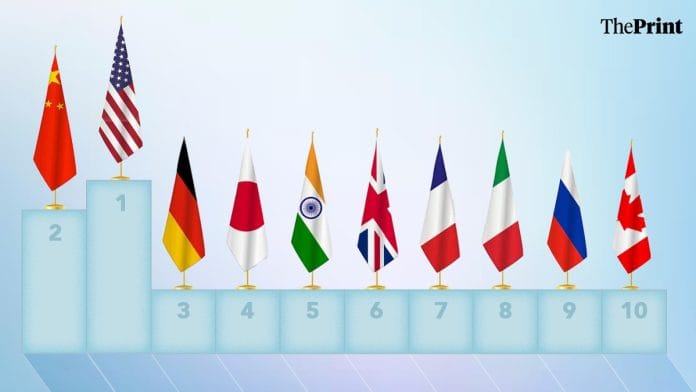
You can start the count of the top 10 economies after the two hegemons. Germany, Japan and India at 3, 4 and 5 are in that middle power category. Leave out Britain at number 6 for now, and Russia at 9, France and Italy at 7 and 8, and then Carney’s Canada at 10. You can keep counting 11 onwards: Brazil, Spain, Mexico, South Korea and so on. They are all reviewing their place in the world. Trump’s America treats all with equal contempt. They can’t go to the Chinese camp. Can they find some unity, common cause and probably even some power of collective bargaining?
● Remember the Non-Aligned Movement (NAM)? There were sound reasons why it didn’t become a true power. One, while it was theoretically non-aligned it leaned increasingly towards the Soviet Union. Second, it did not have members that could then be described as middle powers. India was the biggest, but its moral posturing was undermined by its economic and military limitations and dependencies. In the course of time India also became a treaty ally of the Soviets.
● With Germany, France, Japan, Canada, and much of Europe exploring this new world, is this time for a new NAM? Of course with new characteristics in tune with the times. Not ideological, but pragmatic. Do business with both America and China, but look for negotiating strength as a grouping. We can quote Carney again. “…If we’re not at the table, we’re on the menu.” Middle powers therefore must collaborate, find areas of common interest and look beyond legacy groupings. For example, G7, G20, NATO, even the UN are now unwieldy and ineffectual. Some of the others like BRICS and SCO are Chinese-dominated.
● By now Trump’s negotiating playbook is known to all but the delusional. He so detests dealing with any grouping. The clearest example is his contempt for NATO. He has no time for the World Health Organization (WHO), World Trade Organization (WTO), Paris Climate Accord, the UN and even the Quad. Since he doesn’t come at you with between-the-lines intrigue but in your face and in rude self-interest, it is now easier to read his mind. Any multinational institution, NATO included, treats each sovereign state as equal. The Trump view is: we are so powerful, why should we sit in any group as equals?
● Two consequences follow. One, he sees any rules-based multilateralism as undermining American power. And second, more importantly, that he will no longer negotiate with or in a group. He will talk to each country individually. And he’s way more powerful than all of them except China. That’s how he brings the Corleone principle to the negotiating table: I am offering you a deal you cannot refuse. Greenland is the latest. Ukraine is getting there. No nation other than China can negotiate one-on-one with Trump on an equal footing. That’s why the middle powers who so far formed the core of these multilateral bodies now feel orphaned and at Trump’s mercy. India was only the first middle power to be subjected to this ‘be reasonable, do as I say’ treatment. Then came Europe’s turn. Canada is leading Washington’s western allies’ fightback.
● Now that the middle powers have been shown their place, or aukaat as we say in Hindi/Urdu, where do they go? Key NATO members tried collective bargaining with Trump by lining up at the Oval Office like fawning schoolchildren before the headmaster. We know what that came to. You can be sure that he will crush any new alliance before it even takes shape. For the middle powers a space has opened up to talk, strike deals among themselves bilaterally.
Also Read: Trump’s trade wars have rewritten powerplay, but India didn’t get the memo
Many are moving away from long-held, ossified, non-negotiable, even ideological positions. India from trade protectionism, Europe from labour, carbon and other political correctness obsessions, Germany’s Merz is regretting the decommissioning of nuclear power plants, and most strikingly, Canada is repairing its ties with India by understanding that the Punjabi gangs are a mafia problem and not a sovereignty issue as Trudeau defined it. An every-man-for-himself fate brings pragmatism.
● The warp-speed trade deals are the first outcome of this new thinking. Military/defence ties are more complex though we might see some emerge informally in Europe. The most important change is that all two-trillion dollar-plus democracies are looking at each other with new respect.
● Defence will inevitably follow trade deals. Embargoes and hesitations will be lifted over who buys or sells to whom as defence spending explodes among the ‘rest’. You can see old hesitations over defence hardware joint ventures evaporating. Production capacities will move across these new friendly buyers, especially India. Of course the US will benefit too as many, particularly the Europeans, now stockpile.
● And finally, what if Trump loses his majorities in mid-terms later this year, and becomes a lame duck? In any case, he’s got only three years. You could then have an America returning to the old normal. But can you be sure? Hope, as that oldest wisdom goes, is not a plan.
Trust in America is lost. The middle power phenomenon is here to stay. Will it work? It is fitting to conclude this from Musk’s latest in Davos: “…it is actually better to err on the side of being an optimist and wrong rather than a pessimist and right.”
Also Read: That Oval Office picture for ages deserves closer Indian reading, with a geopolitical lens
Pessimist or optimist are subjective feelings. What matters more is for senior personages responsible for foreign policy and national security to be right a lot more often than wrong. Even before Trump 2.0, the need for course correction was being felt. President Trump has now made it unavoidable.
On what basis are we considering India as a middle income country? At best we are a low income country with a huge domestic market. We are a laggard on every parameter. Whether it be education or health or cleanliness or quality of life or even quality of economy, we are significantly backward. We are, at best, a strong banana republic country which is largely inward looking and divisive. On R&D front we are no better than a jugaad economy. We stifle innovation, we stifle reasoning and/or rationality and want the world to believe that our cultural values give us intellectual superiority. Guess what – Iran too is a civilization country, had a deep rooted history like ours and look where they are. We are a third world country and will continue to be so for decades to come.