





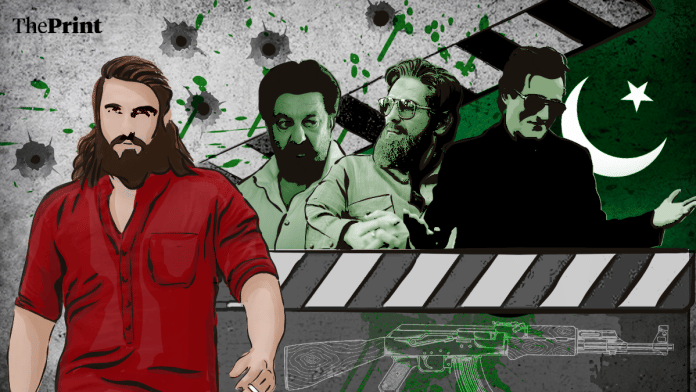



It’s a leap of faith to presume that everybody reading this has watched Aditya Dhar’s Dhurandhar and also Siddharth Anand’s Pathaan (2023). The second is probably the biggest earner among Hindi originals. The first is catching up fast. It also has a second innings coming up, a pre-announced sequel on 19 March, 2026. I take it that not everybody watches movies, but might still be familiar with the buzz, debate and controversies over both.
The one over Pathaan was confined to Deepika Padukone making her first appearance dressed in a saffron bikini to the song ‘besharam rang’ (shameless colour) in the background. The angry ones drew the connection, demanding the scene be deleted. Or maybe they did not mind the bikini, only that the colour be changed? Protests died soon.
Almost two weeks after its release, Dhurandhar is still running to full halls across the country, many repeat watchers. It has just been caught in an enormous controversy, and not just on social media. Its critics in mainstream media, serious broadsheet op-eds have widely described it as government-sponsored, BJP propaganda, war-mongering, Islamophobic. Or all of the above.
I am focusing entirely on the two films that straddle politics, nationalism and religion. A quick listing will give us an idea of why one was mostly hailed as a clean, if fantasy, entertainer, what with VFX stunts, humans good or evil chasing each other in skies riding jet-packs. Ask no questions, or as we say on holi, bura na maano (take no offence), this is just a movie.
On the three polarising issues, politics, nationalism and religion, Pathaan was a cop-out. However, the list first:
● On politics, the film, though on an India-Pakistan theme, was clinically devoid of politics. It was as if two good guys from rival spy agencies joined hands to save humanity, or at least the one-sixth of it that is Indian. You, of course, know that I use “guys” as a metaphor and I wouldn’t dare to call Deepika Padukone that. In short, there was no India-versus-Pakistan here.
● Nationalism was fully kept out. Not only was this ‘India partnering with Pakistan’ even the nationality and religion of Shah Rukh Khan’s character was kept vague. He was brought up by Afghan foster parents in a village under American bombing. The bad guys were the Americans (aren’t they always?) and everybody else was a victim. India faced a terror threat that could wipe out most of its population with a bug so destructive only Putin’s Moscow would have it in storage. So, a Pakistani and an Indian spy found common cause to join hands and protect humanity. It obviously didn’t hurt that one looked like Shah Rukh Khan and the other, Deepika Padukone. The threat to India did not come from a Pakistani or even someone from a mythical republic of Mogambo or Shakaal. It was from an Indian traitor, an agent gone rogue. The theme would pass the test of an elite school Model UN (MUN) event.
● Religion is such a no-no that to date, we don’t know what Pathaan was, or his name. Nobody in the film ever said anything rude about any faith, nor needed to. The terrorist’s motive was personal revenge. No impulse of religion, nationalism or ideology.
All three of these, combined in Pathaan, gave both the liberals and the nationalists a buffet of alibis and room to hide. Both could dismiss it as good, non-serious fun, just a movie after all, paisa vasool (value for money). Dhurandhar is the exact opposite. That is also the reason it is among the most significant political movies at scale in the history of Bollywood yet.
Also Read: Manoj ‘Bharat’ Kumar sang so Sunny Deol could yell—journey of Bollywood patriotism
Let’s put Dhurandhar to the same three-point test. On politics, its abiding theme is that there is a pre- and post-2014 history to how India has responded to terrorism, which “always comes from Pakistan”. In fact, the Sanyal (read Ajit Doval) character says that ‘any terror anywhere in the world comes from Pakistan’. Dhurandhar has an unapologetically political theme. This is a celebration of the Modi-Doval era. And because there’s a sequel coming, you ain’t seen nothin’ yet.
Next, nationalism is the strongest impulse of Dhurandhar. So strong that even convicted prisoners serving life sentences or on death row would be willing to train, infiltrate and embed the gangs working with the ISI in Pakistan. Pakistan is the enemy, India the victim and that is unqualified and perpetual. It’s just that Modi’s India has now decided not to play victim. Call it nationalism on steroids.
And third, religion. There is zero doubt that the perpetrators are all Muslim acting in the name of their faith and for a country built on that foundation. The victims whom they call cowardly, are Hindus who had, pre-Modi, been so timid. In one large state bordering Nepal, for example, fake currency mafias are from ‘one community’ and any action will bring political intervention. So, wait for a strong leader to rise. I suppose Yogi Adityanath gets a mention here.
It is these fundamental differences on three key issues that make Dhurandhar that much more controversial and polarising than Pathaan. If Khan’s film gave both conservatives and liberals room to hide, Dhurandhar extends no such courtesy. The nationalist can celebrate, the liberal can ask: What the hell has gone wrong with my cinema? Dhar ripped open that tent of hypocrisy and turned the knife. Which, by the way, is an act of violence of much lower order than you’d see in his film.
Also Read: Return of the Muslim: From Modi ‘sermon’ to Pathaan to Bharat Jodo Yatra
I am curious, however, if the ISI won’t see Dhurandhar with some disappointment. To suggest that it needs the Lyari underworld to source weapons and explosives is an insult to what isn’t just one of the world’s most sophisticated, subversive, violent and empowered spy agencies but also an agency with enough weapons in its stores to arm a hundred 26/11-sized attacks anywhere in a month.
I will take you back to the Bombay (as it was then called) blasts of 1993. Veteran anti-terror cop M.N. Singh keeps reminding me that in the post-bombings raids, they recovered 71 AK-47s (not counting the ones destroyed by Sanjay Dutt’s ‘friend’ Kersi Adajania in his foundry). Add to this, 3.5 tonnes of RDX, enough to blow up every skyscraper in Mumbai. And 500 grenades. This, when the entire Maharashtra Police did not have one AK-47 rifle. Boat-loads of more were caught on the western coast. If the ISI could ship all of this in 1993, they wouldn’t be counting on the Karachi underworld for 26/11. The underworld they counted on was in India.
This is the most intriguing aspect of the politics of Dhurandhar. Plots like the IC-814 hijack, Parliament attack and 26/11 were planned in the mosques and seminaries of Muridke and Bahawalpur and not in the sort of religiously anodyne hard-drinking ‘adda’ of a Lyari gangster, least of all a leader of the Baloch. Would the ISI even trust a Baloch Sardar?
If Dhar wanted to light up an anti-Muslim sentiment, he only had to set up the plot in Jaish or LeT headquarters, all places of religion. That’d be factual too. However, Dhurandhar’s creative contribution lies in the fact that it has ripped apart the hypocrisy of not naming names. Indian cinema, going ahead, will take the cue. Is it propaganda? That was also every James Bond, John Le Carre, Tom Clancy or Top Gun plot. It was always seen as western soft power in the Cold War era. Dhurandhar has made as much buzz in Pakistan as in India. If anything, in the new competitive war of the memes, it has also resumed some conversation, even much humour. In its direct, violent and rude way, Dhurandhar marks the rise of the new-generation Indian soft power.
Also Read: It’s a dirty picture — that’s what Sushant Singh Rajput’s death reminds us about Bollywood
Best journalists in India are jobless orworking with independent media or on social media. The worst run national media and the most scherewed write movie reviews or write pro goverment articles.
Lollywood leaves no stone unturned to denigrate Bharat and Sanatana Dharma. Why should we hold back?
And the good news is, we have the facts to return the favour with riba (haram interest).
It is amusing to see that one set of pundits becoming alarmed and screaming when a different movie narrative is getting popular acceptance across the country. This movie should be seen as just, a movie. A well made one at that if people can look beyond politics – which is proven by its box office success.
Excellent commercial movie! (“commercial” being the operative word here). Fulminating over it’s messaging is akin to searching for deeper meaning and nuance in a Jerry Bruckheimer film – in that one has to be a special type of disingenuous clown to do so! The only greater absurdity would be to talk about “creating a popular mood for peace”, at this stage, ie. literally less than 9 months after the Pahalgam attack! I for one can’t help but marvel at the inner workings of such minds! Peace with whom? The people who said Pahalgam was a “false flag”? That said, I sure would like to try some of whatever such sanctimonious peaceniks are consuming!
Finally, a fine journalist turned to mediocrity with an article on cinema… Congratulations Mr Gupta.. Cinema is made by those people based business and art..On based on national agenda..
Good luck..
Good film, great film. However, creating a popular mood for peace would get my applause.
They could have shown weapons being procured from LeT etc, but in that case there was no justification for Akshay Khanna’s character. This would not have allowed the movie to show the Balloch suffering angle at all. Although, there was creative liberty which betrays logic, but I see that it solved one purpose.