





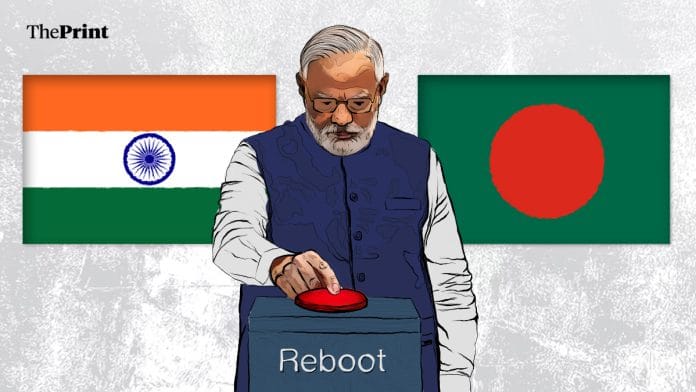



The headline of this week’s National Interest harks back to another published in August 2013, appealing to Narendra Modi, then Gujarat chief minister and on his way to being BJP’s prime ministerial candidate. There’s a reason we use the same invocation now. Please note, Bangladesh goes to the polls in less than a week.
By next weekend, or early the week after, the country will have an elected government. And while there will always be the credibility question because of Awami League’s exclusion, given the quality of democracy hereabouts, this should be a relatively fair election. Unlike Pakistan, the Bangladesh Army isn’t in the “race”, nor have they indicated a preferred candidate. The only thing the Army Chief Waker-Uz-Zaman said, as recently as last Thursday, is that they will ensure a free, fair and peaceful election.
Back to that earlier August 2013 column, headlined ‘Dear Narendrabhai’. It underlined to him that India and Bangladesh had finalised a landmark agreement to settle our border, especially the enclaves deep inside each other’s territory which had become a subcontinental version of the apartheid-era South African Bantustans. Ungoverned, ungovernable hotbeds of crime, smuggling and terror.
Nobody in Modi’s party made a case against the border deal. Then BJP chief Rajnath Singh even endorsed it. But they’d still block it in Parliament. This was mostly owed to the power struggle within the party. Would Modi then weigh in the larger national interest, get his party to relent and accept the deal? Even the Bangladesh High Commissioner then had made a visit to Ahmedabad, seeking his good offices.
Modi didn’t intervene then, but probably indicated that he would pick up the thread once he came to power. In just over a year of him as Prime Minister, the India-Bangladesh Land Boundary Agreement was ratified (6 June, 2015). Alongside, the two countries also defined and settled their maritime boundaries.
This also needed negotiation and persuasion internally with Mamata Banerjee in West Bengal, and the calming of sensitivities in Assam and Tripura. Bangladesh became India’s only large neighbour with fully settled borders. Even with Sri Lanka, Kachchatheevu—though settled formally—is often invoked by the BJP in election campaigns. The land agreement with Bangladesh, so early in his term, remains among the greatest strategic achievements of the Modi government in almost 12 years. It’s also an achievement because, in our fraught neighbourhood, it was struck in the same period as Nepal making provocative territorial claims on India.
In so many ways I would list this as not only among Modi’s biggest successes but also as evidence of how pragmatic he can be in looking at the big picture. The Bangladeshi “illegal” immigrant or lately the “infiltrator” or “ghuspethiya” has been central to the BJP’s politics, especially in the eastern states. It was also central to two West Bengal Assembly and Lok Sabha elections. Yet, he stayed committed to this agreement.
This, even as his party said rude things about what they see as a demographic invasion. Some, including former Chief of Defence Staff late General Bipin Rawat, even invoked the Nazi-era concept of Lebensraum. Hitler (who mentioned it in Mein Kampf) used Lebensraum for territorial expansion by systematically settling Germans (“Aryans”) in neighbouring countries to outnumber the natives.
Also Read: Pakistan, Dhaka have played Washington well. Back home, Modi ecosystem has an inner conflict
As was the case more than a decade ago, we’re looking at another such juncture in our history, with strategic implications and prospects even greater than in 2014. That the Bangladesh election comes just months ahead of polling in West Bengal and Assam is a blessing because the “ghuspethiya” rhetoric hasn’t yet picked up here, though the Prime Minister mentioned it in his Rajya Sabha speech.
At the same time there’s much on social media and on the many TV channels that’s hostile to Bangladesh. The fact that Bangladesh goes to the polls now instead of just after West Bengal and Assam gives the Modi government space for relative normalisation; probably also for the return of a non-hostile equilibrium, though the Sheikh Hasina-era relationship is an impossibility for now.
This is no time for anger or bitterness over India’s preferred leader in Dhaka being turfed out, the interim government under Muhammad Yunus acted like a fully empowered one and made dramatic shifts in foreign policy. Yunus has spent a year-and-a-half warming up to Pakistan, systematically carrying out provocations—like visits by Pakistani military brass—to irritate India. His government has talked of buying significant weaponry, he’s made disastrous statements about India’s “seven sisters” (the Northeast) being landlocked. He also made India’s safe harbour to Sheikh Hasina a deal-breaker. This is frightfully shortsighted from Bangladesh’s point of view and irritating from India’s. The good thing is that barring a miracle he might wish for, in another week he would’ve ceded power to an elected government. That’s the new juncture we’re talking about.
India was pragmatic in sending External Affairs Minister S. Jaishankar for Khaleda Zia’s funeral. He met her son, and Bangladesh National Party (BNP) chairman Tarique Rahman too. So far, Rahman has come across as a grown-up leader.
Also Read: An open letter to Prof Muhammad Yunus
The fact is, nobody knows who will win or whether there will be a clear verdict. Opinion polls so far put Rahman and his BNP far ahead. The respected daily Prothom Alo’s survey shows employment is the biggest issue for 83 percent of Bangladeshis, then 77 percent find the climate not conducive to business and 35 percent are disappointed with the country’s economic performance.
There’s no hunger for Islamisation, hyper-nationalism (read anti-Indianism). The mood on the street, however, might still be hostile to India, mainly because of the Hasina connection. But, the most significant finding is that 54 percent are optimistic of the new government ushering in social and religious tolerance.
A follow up Prothom Alo poll called ‘People’s Election Pulse Survey’ shows that 47 percent want Tarique Rahman as prime minister and only 22.5 percent want Jamaat-e-Islami’s Shafiqur Rahman. This still makes the most support for Jamaat ever. There will be forces, probably also Yunus, who’d prefer a hung verdict, a unity government with Jamaat in it, and an ‘empowered’ president as listed in the July Charter (2025) on which a referendum is being held simultaneously with the elections.
Under this a directly elected Lower House will select an Upper House on proportionate basis and the two will jointly choose a president by secret ballot (with no party whip). And that president will have certain oversight powers over the prime minister. If only I was a decade younger, Yunus (85) might wish.
The BNP in its manifesto released last Friday rejects these special powers for the president. They had said so in the July Charter meetings too. If they get a majority, this issue will be over.
The most important thing is, neither the BNP nor Jamaat say anything about Pakistan. Jamaat seeks “cordial relations” with India, BNP with all on “mutual respect”. This is progress. The only party that says rude things about India consists of the students who led the revolt, NCP or National Citizens Party. At this point its approval rating is 2 percent though it is aligned with Jamaat.
This sets the stage for an intriguing election with possibilities for India. It gives Narendra Modi the opportunity to reset ties with Bangladesh. It will be challenging on the eve of West Bengal and Assam elections. That’s why the appeal is the same as in 2013. Can you show a large heart to bring back strategic stability to India’s east? That would mean dialling down the anti-Bangladesh rhetoric in state elections. Or are we resigned to having a Bangla-speaking Pakistan to our east?
Also Read: PM Modi wants US to protect Hindus in Bangladesh. Hasina’s debacle must not be India’s
The ghuspethiya issue should not be construed as anti-Bangladesh rhetoric. TMC has been using Bangladeshi migrants to rig elections.
Exactly, what has TMC govt done in the past 15 years. They started with anti-business rhetoric, driving Tata out. Then implemented OPS, draining state funds, which caused reduction in spending on police hiring. And then they do jugaad of civic volunteers to cut costs. These civic volunteers do crimes themselves, as we saw in RG Kar case.
And the police hardly had capacity to stop Murshidabad anti-Waqf riots.
Sheikh Hasina may not have been your ideal democrat. But Khaleda Zia’s party was no different. Protests happened against inflation, which was caused by Western money printing post-pandemic. And West aided these protests as a means of engineering a Ukraine like situation for India, hoping that we would actually invade, like Russia did. India, smartly, didn’t take the bait.
So, reducing everything to lack of democracy and anti-Bangladesh rhetoric is not right.
Shekhar Gupta’s piece suffers from a fundamental flaw: demanding India shoulder responsibility for a relationship that Bangladesh has systematically undermined.
Mr Gupta’s blog here is unfair and imbalanced. Why is there no onus on Bangladesh, and only on India.
The record needs to be corrected..
1. India Never Disengaged—Bangladesh Did
Gupta ignores that India has maintained unbroken diplomatic engagement post-Hasina. EAM Jaishankar kept channels open despite provocations. No recalled ambassadors. No sanctions. No severed ties. India showed strategic patience while Bangladesh descended into chaos. The real question: where’s Bangladesh’s reciprocity?
2. False Precedent: The 2015 Land Boundary Agreement
Gupta invokes Modi’s 2015 Land Boundary Agreement as precedent for bold Indian leadership. This is a false analogy. That agreement resolved a mutual problem with willing partners under Hasina’s stable government. Today’s situation? A chaotic Bangladesh that hasn’t demonstrated capacity to be a responsible partner. Bold leadership requires receptive counterparts, not unilateral concessions to dysfunction.
3. “Ghuspethiya Rhetoric”? No—Legitimate Sovereignty Concerns
Gupta dismisses illegal immigration as electoral posturing India should silence for diplomatic convenience. Dangerous nonsense.
Electoral roll revisions in Assam and West Bengal proved the scale of illegal immigration—many have since returned to Bangladesh. Should India suppress factual border security issues during elections—when democratic accountability operates—to accommodate a neighbor’s sensitivities? That’s asking Indian democracy to self-censor for foreign policy convenience. Every sovereign nation enforces borders. Why must India alone compromise territorial integrity to avoid diplomatic friction?
4. Non-Interference Reflects Maryada, Not Weakness
India’s restraint in not meddling in Bangladesh’s collapse demonstrates maryada—dignified, principled conduct respecting sovereignty. We can’t solve Bangladesh’s Hindu minority crisis through intervention; Bangladesh must establish rule of law. Interventionism would help neither Hindus nor bilateral relations.
We worked productively with Hasina. Modi extended genuine outreach to Yunus. But Bangladesh’s spiraling violence against Hindus, economic freefall, rising jihadism, and governance breakdown are their problems to fix.
5. Asymmetric Expectations Expose Gupta’s Bias
He demands India “reset” while Bangladesh gets a pass on:
a) Protecting its Hindu minority from systematic violence
b) Controlling borders against illegal migration and smuggling
c) Clarifying geopolitical stance — Yunus’s troubling comments on India’s territorial integrity and China-US balancing act
d) Stabilizing its economy instead of exporting instability
The upcoming elections Gupta cites prove my point: Bangladesh knows it must reset governance. Why should India preemptively compromise when Bangladesh hasn’t addressed core failures?
6. Strategic Pragmatism Actually Favors Indian Firmness
Gupta might argue India should act first to prevent prolonged instability or Bangladesh’s deeper China tilt. This logic fails on two counts:
First, moral hazard: Rewarding dysfunction with premature concessions signals Bangladesh can fail on minority protection, borders, and terrorism while still extracting Indian accommodation. This invites more bad behavior.
Second, China alignment: Appeasement doesn’t prevent Bangladesh’s China tilt—it signals weakness that invites exploitation. Yunus’s geopolitical calculations aren’t reactions to Indian “rhetoric”; they’re deliberate choices. Rewarding that tilt with concessions would only deepen it.
Even from cold self-interest, strategic patience now establishes that India engages responsible partners. Short-term discomfort may yield long-term stability. Premature reset achieves the opposite.
7. Patience Has Limits
India has tolerated far more than Bangladesh has reciprocated. Patience without reciprocity becomes appeasement. In geopolitics, patience has limits—Bangladesh has tested ours.
The Bottom Line
If by “reset” Gupta means India should continue diplomatic engagement while articulating clear expectations—we’re already doing that. If he means India should preemptively soften positions before Bangladesh addresses failures—that’s appeasement, not diplomacy.
Bangladesh must act first: restore minority safety, control jihadist elements, secure borders, and function as a responsible neighbor. Only then can genuine partnership resume.
Reset requires two hands on the button. India’s hand has been ready. Bangladesh needs to show up.
One, as the column notes, detach domestic politics from regional foreign policy and diplomacy. That has already frozen normal dialogue with Pakistan for a decade, with no discernible gain. Second, acknowledge the past misstep in investing too much in one leader who diminished Bangladeshi democracy over fifteen years. Else, prepare for the undoing of the huge strategic gains of 1971.