





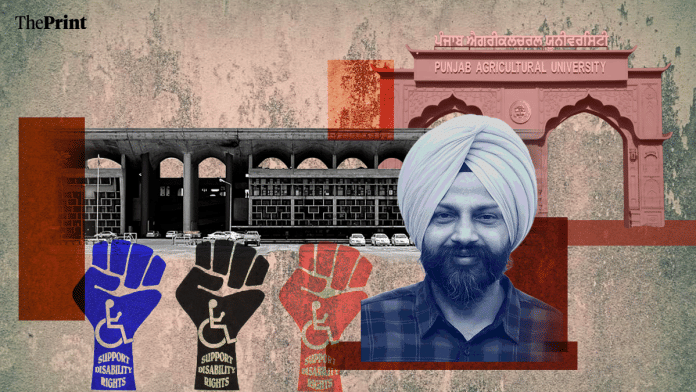



New Delhi: The Punjab and Haryana High Court has directed that a plea filed by a disabled scientist on the right to “suitable and occupationally fit” housing be treated as a Public Interest Litigation (PIL).
The plea was filed in January by Kuldeep Singh Bhullar, who has been employed with the Punjab Agricultural University in Ludhiana for over 16 years and has Post-Polio Residual Paralysis (PPRP), a condition that has led to 60 percent permanent disability. On 23 February, the High Court said that the case covers substantial elements of larger public interest, and placed it before the Chief Justice for assignment.
In his order that sets the stage for expanding the rights of the disabled to suitable housing, Justice Kuldeep Tiwari said, “Since the matter encompasses substantial elements of larger public interest, the instant writ petition shall be treated as a PIL, and it shall be placed before the Hon’ble Chief Justice on the administrative side for assignment to the bench seized of the relevant subject roster.”
Pointing to the “transcendent significance” of the controversy, and the fact that the petitioner was appearing before the court in person to fight his case, the bench also proceeded to appoint senior advocate Kshitij Sharma and advocate Tahaf Bains as amicus curiae to assist the court in the matter.
The court also made states and Union Territories like Punjab, Haryana and Chandigarh parties to the present case. “In order to ensure comprehensive adjudication, the States of Punjab, Haryana, and the Union Territory of Chandigarh are accordingly impleaded as respondents in the array of parties, through their respective Chief Secretaries,” the court noted.
Bhullar had joined the Punjab Agricultural University in Ludhiana in 2010 as an assistant professor of horticulture. PPRP is a condition which involves permanent non-progressive muscle weakness or paralysis in the limbs as a result of childhood polio.
Also Read: Win for UPSC aspirants with learning disabilities as Delhi HC upholds CAT order directing 0.5% quota
Guarantees, not privileges
“Disability rights are not special privileges but statutory and constitutional guarantees, and greater awareness among decision-makers and the public would significantly reduce barriers faced by persons with disabilities in everyday life,” Bhullar told ThePrint.
Petitioner Kuldeep Singh Bhullar has PPRP of the right lower limb with wasting and shortening, quadriceps palsy on the right side, flexion deformities at the hip and knee joints. He has been certified as having 60 per cent permanent disability in his right leg.
Bhullar first approached the university to allot him a structurally suitable and occupationally fit house, moved the High Court when he was denied this. In his plea, Bhullar also sought that the university undertake all necessary modifications, repairs, and accessibility adjustments in accordance with the Rights of Persons with Disabilities Act, 2016.
What 2016 Act says
The Rights of Persons with Disabilities Act, 2016, comprehensively caters to the grievance of the petitioner, the court noted in the February 23 order while pointing to Sections 40, 44 and 45 of the statute. Section 40 casts a statutory obligation on the Centre to consult with the Chief Commissioner, and lay down standards for accessibility pertaining to the physical environment, transportation, information and communications, and other facilities that extend to the public.
On the other hand, Section 44 prohibits granting permission to any establishment for constructing any structure unless the building plan adheres fully to the rules prescribed by the Centre.
Apart from this, Section 45 provides a timeline for making existing infrastructure and premises accessible. “The appropriate government and the local authorities shall formulate and publish an action plan based on prioritisation for providing accessibility in all their buildings and spaces providing essential services such as all primary health centres, civil hospitals, schools, railway stations and bus stops,” a part of this provision reads.
Besides this, the Rights of Persons with Disabilities Rules 2017 were also created by the Centre, under Section 100 of the 2016 Act, which essentially gives the Centre the power to come up with such rules.
Bhullar relied on Rule 15 that mandates every establishment must comply with the standards for public buildings as stipulated in the Harmonised Guidelines and Space Standards for Barrier-Free Built Environment for Persons with Disabilities and Elderly Persons, issued by the Ministry of Urban Development in March 2016.
What court did
Taking into consideration the fact that the issue in Bhullar’s plea transcended the individual grievances of the petitioner, and had wider ramifications on the rights of similarly situated disabled employees in states like Punjab, Haryana and Chandigarh (UT), the court deemed it fit to treat this plea like a PIL.
“The issue inhering the instant writ petition transcends the individual grievance of the petitioner and bears wider ramifications, inasmuch as it concerns the rights of similarly situated physically disabled employees serving in the States of Punjab, Haryana, and the Union Territory of Chandigarh, including those employed in Boards, Corporations, and Societies under the control and administrative purview” of the states and the UTs, it said.
“In the present case, a senior fruit scientist approached the Hon’ble court seeking Type 8 accommodation on priority – otherwise allotted as per seniority – as his request was rejected by the university,” advocate Tahaf Bains told ThePrint.
In his plea, the scientist said that owing to his disability, proper accommodation should be given to him, along with barrier-free access which is structurally suitable and modified for his accessibility, in line with the guidelines under the 2016 Act and rules framed thereunder, Bains added.
(Edited by Nardeep Singh Dahiya)
Also Read: ‘Judgments binding, not optional’—SC steps in again, orders NEET disability norms rewrite by March