





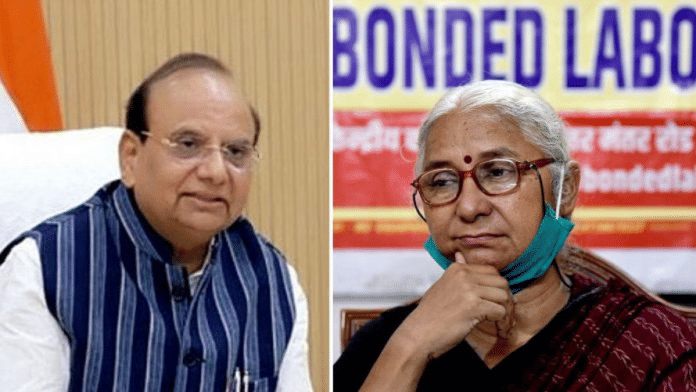



New Delhi: A Delhi court Saturday acquitted ‘Narmada Bachao Andolan’ activist Medha Patkar in a two-decade-old defamation case brought against her by V.K. Saxena, now the Lieutenant Governor of Delhi. Saxena had failed to prove “beyond reasonable doubt” that Patkar made the statements during a TV show, the court ruled.
In a detailed order scrutinising witness testimonies, Judicial Magistrate (First Class) Raghav Sharma of the Saket court highlighted glaring deficiencies in the complainant’s case, ranging from factual inconsistencies to a failure to meet mandatory procedural requirements for electronic evidence.
According to the court, Saxena failed to meet the standard-of-proof of “beyond reasonable doubt”, critical to convict someone of criminal defamation.
In a different defamation matter that V.K. Saxena raised over Patkar’s comments in a 2000 press note, a Delhi court convicted her in July 2024, sentencing her to five months’ imprisonment, which was later modified to a one-year probation of good conduct. The Supreme Court upheld this conviction in 2025, while setting aside the monetary penalty.
This time, the court found the case contradicting itself on whether Patkar was a live panellist or whether pre-recorded clips were broadcast on the TV show. Moreover, the absence of legally admissible electronic evidence left the court with no reliable basis to conclude whether Patkar even made the alleged statements.
At the heart of the dispute is India TV’s Breaking News, which aired a programme on the ‘Narmada Bachao Andolan’ in April 2006.
Saxena, then the President of the National Council of Civil Liberties, alleged that Medha Patkar had accused him of securing civil contracts for the Sardar Sarovar Project and suggested that he had financial interests in the project he supported. He called the claim false and her statement defamatory and without an “iota of evidence”.
Following the show’s broadcast, Saxena issued a notice to Patkar, seeking proof of her claims, including the video evidence she allegedly referenced during the programme. When no response was received, he filed a criminal defamation complaint under Section 500 of the IPC. Section 500 of the IPC prescribes a punishment of up to two years’ imprisonment, with or without fines, in cases of criminal defamation.
The case, initially filed in Gujarat, was transferred to Delhi pursuant to Supreme Court orders in 2010. The Saket court has now rejected Saxena’s complaint on evidentiary grounds.
The claim Saxena initially made was that Medha Patkar made defamatory statements while appearing as a panellist on a show. He later admitted that he did not know whether she was present live or via video footage.
The court noted that the clip shown appears to be only a very short excerpt from an interview or press conference and that Patkar’s pre-recorded video was played on the show.
“Due to such continuous changes in his stance and the contradictions suffered, it remains doubtful whether the accused was a panellist,” the court observed.
Another critical issue before the court was whether the video footage was admissible. Under the Indian Evidence Act, electronic records such as video files require a certificate under Section 65-B of the Act to be admissible. Section 65-B requires a person in a “responsible official position” in the operation or management of the device used to create the record to sign the certificate.
Saxena did not submit this mandatory certificate, thereby making the footage inadmissible. “…no certificate under Section 65-B was tendered by the complainant. Therefore, Ex. CW1/6 [CD of the programme tendered by Saxena] is inadmissible in evidence and is hereby declared as such,” noted Sharma.
He also rejected the footage provided by a witness from India TV because the witness, a correspondent, was not the correct authority to issue the certificate. The original footage is stored in an archive in Noida, while the witness was in Ahmedabad and did not have control over the device.
The court also made a critical distinction between the “broadcast” of a statement on a show and the original recording of a statement. Since only short clips were shown and Patkar was not present on the show, the original recording device where the interview was first captured would be required to determine whether she made the statement.
The court said that the clips played were very short and likely cut from a longer press conference or interview. Without the full recording or a witness who was physically present when the original statement was made, the court could not determine the context or veracity of the speech.
“It is also crucial to note that the clip played in the programme appears to be only a very short clipping from an interview or press conference of the accused. To make any determination, it is essential that the entire video and audio of the press conference is brought before the court or some eyewitness to that press conference/interview depose about the same; without examining the entire clip/footage of that interview, no determination can be made regarding the speech of the accused,” the court said.
“It is important to note that neither the reporter who actually recorded the audio-video nor any person who had seen the accused making the impugned statements has been examined as a witness,” the court added.
Also Read: Opposing invite to Medha Patkar, BJP MPs force cancellation of LS panel meet on Land Acquisition Act