





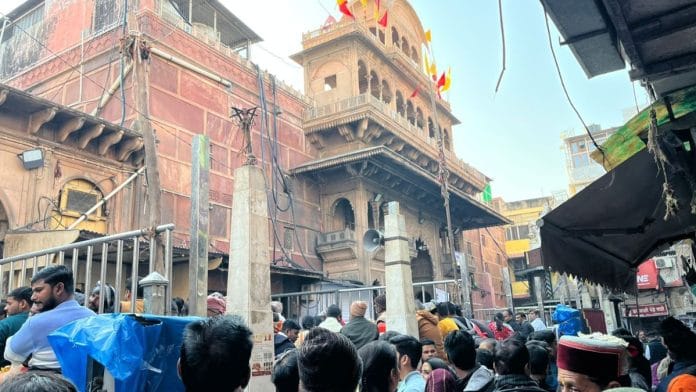



New Delhi: The Supreme Court on Monday issued notices in response to a plea challenging the halting of the Dehri Pooja performed at Mathura’s famous Banke Bihari temple and describing the action as “arbitrary, unjust and capricious”.
A three-judge bench led by Chief Justice of India Surya Kant sought a response to the temple’s plea from the Uttar Pradesh government and the high powered committee set up by the top court in August to supervise the day-to-day functioning of the Banke Bihari temple.
The plea, filed on behalf of the temple by advocate Tanvi Dubey, said Dehri Pooja (where the Dehri, or threshold, is treated as the deity’s feet and devotees offer fragrance, flowers and prayers) is performed early morning and at night, when the temple is closed off to the general public.
The plea said that an “essential” religious custom like the Dehri Pooja cannot be stopped by a court-appointed committee and doing so directly interferes with the rights of the temple, under Articles 25 and 26(b) of the Constitution, which relate to the freedom of religion and the freedom to manage one’s own religious affairs.
Apart from this, the temple’s plea also said the SC-appointed committee had passed certain “arbitrary” orders which directly interfered with the use of temple funds. For instance, after a meeting in September the committee had said car rental expenses should be paid from temple funds. This too was challenged by the petitioner as “arbitrary and unusual”.
The court will next hear the case on 7 January.
Also Read: HC orders probe into Chennai temple’s finances. The 1999 ‘public or private’ test & why it’s crucial
‘Arbitrary process’ for appointing Goswamis
Apart from this, the management committee of the Banke Bihari temple has also alleged that the high-powered committee (HPC) was interfering with the process of appointing Goswamis (Hindu ascetics). The plea said that the HPC appointed Goswamis of their own choice, showing disregard for the principle of having representatives. This also bypassed a fair procedure of appointing representatives by majority consensus, the petitioners said.
Although the management committee of the temple had requested the court-appointed committee to appoint Goswamis after an independent election process, no action was taken, and in fact three persons were appointed, who were not picked through majority consent, the petitioners told the court.
This, the plea said, infringed the rights of the Sewayats or interfered with the essential religious practices of the temple.
“As a consequence, in the last 6 weeks, the temple has witnessed stampede-like situations almost 6-7 times and there have also been two reported deaths due to suffocation in the temple,” the plea said, while adding that some Goswamis who were elected by the committee were acting at their “own whims and fancies” and refusing to hear suggestions on effective crowd management.
‘Interference by committee’
“It is made clear that besides the four members in the committee representing the Goswamis, no other Goswami or sevayat shall be associated or allowed to interfere or impede in any way in the managing of the temple’s critical functions, except in the practice of conducting puja/sewa and offering prasad to the deity,” the 8 August order had said. This led the petitioners to argue that the management committee was not authorised to interfere in the temple’s functioning by going against age-old rituals followed in the temple.
Background of the dispute
The dispute arose against the backdrop of significant changes in the temple’s governance framework. For decades, the Scheme of Management, which was introduced in 1939, governed the administration, rituals, and financial affairs of the Banke Bihari Temple.
However, this year, the Uttar Pradesh Shri Banke Bihari Ji Temple Trust Ordinance, 2025, was introduced with the objective of replacing this pre-independence scheme with a state-controlled trust, inciting debate over government’s involvement in religious institutions.
In August, while hearing a challenge to the ordinance, the top court declined to examine its constitutional validity, leaving that issue to the Allahabad High Court. It had, however, stayed the operation of the ordinance, which grants administrative control of the shrine to the state till the HC decided its constitutionality.
In doing so, the high-powered committee was set up to manage the temple’s day-to-day affairs, and given responsibilities like ensuring basic amenities for devotees, including clean drinking water, functional washrooms, shelters, dedicated crowd corridors, and facilities for elderly pilgrims.
(Edited by Viny Mishra)
Also read: ‘Where did the gold go?’ Banke Bihari toshkhana survey sparks conspiracy theories in Vrindavan