





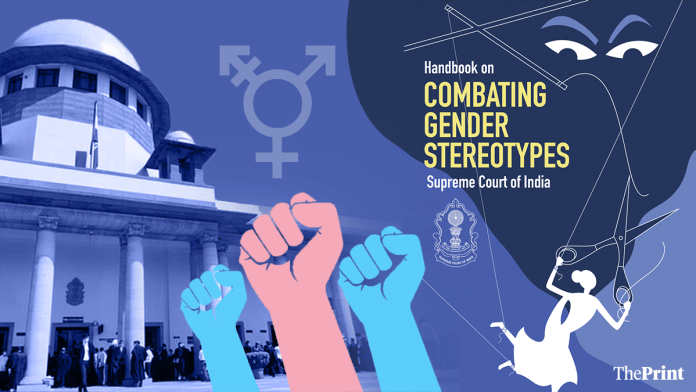



New Delhi: The ‘Handbook on Combating Gender Stereotypes’, published by the Supreme Court in 2023 under then Chief Justice of India D.Y. Chandrachud has grabbed eyeballs three years later. All thanks to current CJI Justice Surya Kant.
The handbook intended to offer guidance to judges and the legal community on how to avoid using gender stereotypes—particularly those about women — in judicial decision-making and writing.
However, on Tuesday, Justice Kant remarked that the handbook is “too Harvard-oriented”, and urged the National Judicial Academy (NJA) in Bhopal to form a panel of domain experts, academicians, and lawyers to reexamine the issue, and frame guidelines.
Once framed, the court expects the NJA to train and sensitise high court judges in batches. Senior advocates Shobha Gupta and H S Phoolka will also be lending their expertise in fine-tuning the guidelines.
Justice Kant batted for practical training, asserting that it “serves no purpose to sermonise” high court judges while sitting in the Supreme Court.
In its current form, the handbook contains a glossary of gender-unjust terms and suggests alternative words or phrases which may be used while drafting pleadings as well as orders and judgments. It also identifies common stereotypes about women that courts have mentioned in the past, and explains why these stereotypes may be inaccurate.
Former Supreme Court judge Justice M.B. Lokur asserts that a handbook “is not cast in stone”.
“There is nothing wrong in asking for a revision, if the CJI feels it is necessary. A committee of experts should carefully look into the revision along with NGOs working on gender issues,” he told ThePrint, adding that he would strongly recommend that a similar exercise be undertaken on juvenile justice issues, and adoption of child friendly language.
‘Are you talking only to high court judges? What about the judges who write in Hindi? Or in Tamil or in Bengali?’ former SC judge Justice Deepak Gupta.
Former Supreme Court judge Justice Deepak Gupta also said the initiative taken by Justice Chandrachud was good, but he feels that the handbook was “too urban” in its construct and was not vernacular.
“Are you talking only to high court judges? What about the judges who write in Hindi? Or in Tamil or in Bengali?” he asked.
“It is very important that judges are gender-sensitive and use the right language, but you can’t change the whole language overnight,” he told ThePrint, opining that former CJI Chandrachud was “over-anxious” to bring such change.
However, Justice Gupta pointed out that the handbook has not been discarded as such— it is only to be relooked into and be given a “more indigenous feel”.
“I am not a great votary of this belief that if you change the word, the pejorative part of the word gets lost. I don’t agree with it. Mahatma Gandhi started the usage of the word ‘Harijan’ or people of God but now if you use the word Harijan, it is almost like an abuse. So you can’t keep changing words,” he says.
He explained that many of the words flagged in the handbook are known words, such as the word “prostitite”.
“The handbook says, don’t use the word ‘prostitute’. But many of our judgments are going to be read by people who are not so well-versed in this western thinking. I am not saying that this term should continue to be used forever, but don’t expect to change it overnight,” Justice Gupta says.
Going forward, he said that much more important than a handbook is to actually teach judges to be more gender-sensitive. “Today, we live in a patriarchal society, where unfortunately, even the women judges have a gender bias in favour of men. It is that gender bias that we have to deal with,” he said, adding, “These semantics are not going to change the gender-sensitivity of the people.”
Also Read: More women judges a constitutional imperative for better justice, says Justice Nagarathna
‘Beyond a glossary of terms’
The foreword of the 2023 handbook had said that it was conceptualised during the Covid-19 pandemic and was originally envisaged as a part of the knowledge component of the e-Committee of the Supreme Court of India.
It then suggested use of “woman”, instead of the words like “whore”, “slut”, “harlot” or “seductress”; use of “sexually harassed/assaulted or raped” instead of “ravished”; use of the word “rape” instead of “forcible rape”; and use of the phrase “sex worker” instead of “hooker”, among other things.
However, experts said that imbibing gender-sensitivity needs more work than a handbook of glossary of terms and gender stereotypes.
Being gender sensitive, particularly for courts, goes beyond a glossary of terms, even though that too might be helpful, said Nimisha Srivastava, Executive Director of Counsel to Secure Justice, a non-profit working on access to justice for child sexual abuse survivors.
“Before a ‘relook’ at the language of the handbook, I would say an assessment of whether the suggestions made in it are being followed or not needs to be done,” she told ThePrint.
Srivastava said that she “fully agrees” with CJI Kant’s suggestion regarding sensitisation training. “From our experience in trial courts, I can say that though we definitely see improvements in usage of language that is more gender sensitive, courts still have a long way to go in terms of gender sensitive judicial procedures and pronouncements, at all levels,” she said.
Supreme Court lawyer Advocate Nipun Saxena also said that setting up a committee of domain experts rather than examining it through a less inclusive pool “is always a good gesture”.
“Policy decisions ought not to be air dropped, especially in light of the reason given that there are a few expressions that have not yet been afforded or are capable of a definition in law,” he added.
‘For such guidance to be effective, it must be available in regional languages, particularly given that much of trial court adjudication takes place outside English,’ says Swapnil Tripathi, Vidhi Centre for Legal Policy.
Saxena points out that nobody was saying that there is no need for a gender handbook, and that what was said was that it needed “tweaking”.
“There cannot be a problem with coming out with new tweaks, and best that it is done by domain experts. My only hope is that the panel would be dominantly represented by women and members of other gender identities so as to bring out an all-inclusive perspective while making such tweaks,” he told ThePrint.
Too ‘Harvard-oriented’?
CJI Kant’s remarks that the handbook was too ‘Harvard-oriented’ have also garnered attention, considering the fact that CJI Chandrachud received his master’s and doctorate in law from Harvard Law School.
However, Swapnil Tripathi, Lead at Charkha (Centre for Constitutional Law) at Vidhi Centre for Legal Policy, asserts that the label “appears somewhat misplaced”.
“The handbook does not rely on research or reports from Harvard University for its substantive conclusions; in fact, the term ‘Harvard’ appears only once, in the context of referencing an implicit bias test,” he told ThePrint.
Tripathi asserted that the handbook is “reflective of our legal system” as the examples cited within it are drawn from reported judicial decisions and remarks by courts in India.
“It refers, for instance, to observations made by certain High Courts that urged women to be dutiful to their husbands, casting aspersions on a woman’s character based on her sexual history. In that respect, the handbook is not ‘Harvard-oriented’ but rather reflective of lived judicial realities within the Indian legal system. It acknowledges institutional shortcomings and attempts to address them,” he said.
Swapnil Tripathi agreed that a handbook alone cannot effect structural reform, and it should be viewed not as a complete solution but as one institutional step within a broader and ongoing effort to address gender stereotyping in the justice system.
“As the Chief Justice rightfully observed, meaningful change requires sustained judicial training and engagement at the level of judicial academies. Further, for such guidance to be effective, it must be available in regional languages, particularly given that much of trial court adjudication takes place outside English. Any guideline or training issued in English shall ultimately be elite and inaccessible,” Tripathi asserted, adding that periodic revision would be necessary to ensure that the guidance remains responsive to evolving social contexts and contemporary forms of bias within the system.
“As the Chief Justice rightly observed, sustained judicial education and training through judicial academies is critical. Addressing unconscious bias requires continuous engagement rather than one-time guidance,” he explained.
Language, particularly in judicial decisions, Tripathi says, carries significant weight. “It is not merely descriptive but constitutive of dignity. Even where substantive relief is granted, language that stereotypes or demeans can undermine the constitutional commitment to equality and dignity.”
‘Room for fine-tuning’
Delhi-based lawyer Urvi Mohan asserted that while she did not agree with the comment that the handbook is too “Harvard-like”, she said everything has room for fine-tuning and refinement.
“A lot of terms from the perspective of being gender stereotypes, and concepts that the handbook tries to address and modify, are very much embedded in the Indian context. There may also be certain terms or certain concepts which we probably don’t see on a day-to-day basis around us, but a majority of it has actually been taken from the sort of language that advocates use in their pleadings, and the sort of language judges are using in their judgments from across the country.”
She explained that the handbook was necessary because the Supreme Court realised that the level of sensitivity necessary for judicial officers was missing.
This reality, she said, has changed, crediting the handbook for serving as a “guiding light to all stakeholders, including judicial officers and advocates”.
“Once introduced, does this handbook remain stuck in time?” she asked, answering in the negative. Mohan also asserted that a handbook, in itself, may not be of much help unless the principles in the handbook are embedded in the system and in practice across the board.
“Ultimately, the people who have to execute it are going to be judicial officers. So it has to be embedded into the system— whether it is at the level of the training academy itself for the newer judicial officers, or it is made a part of awareness or training or sensitisation programmes for currently serving officers,” she told ThePrint.
Avaantika Chawla, Assistant Professor at Jindal Global Law School, feels that the handbook that was made by CJI Chandrachud was researched and based on terms that are commonly being used by courts.
“To call it Harvard-centric is unfair. If Justice Surya Kant feels that it required some editing, it could have perhaps been worded in a better way…perhaps asking it to be looked at from the perspective of trial court judges and thinking through what are the common terms that they use,” she told ThePrint, adding that the handbook could do with translations into vernacular languages for ease of understanding rather than a full overhaul.
What did the handbook say
The handbook asserts that it is vital for judges to not only avoid relying on stereotypes in their decision-making and writing, but also actively challenge and dispel harmful stereotypes.
‘To call it (2023 handbook) Harvard-centric is unfair. If Justice Surya Kant feels that it required some editing, it could have perhaps been worded in a better way,’ Avaantika Chawla, Assistant Professor, Jindal Global Law School.
It then explains what the stereotypes are and then helps judges avoid such stereotypes by identifying language that promotes them. It contains a glossary of such stereotypes and offers alternative words and phrases. It also identifies common reasoning patterns that stem from gender stereotypes — particularly about women — and discusses why they are incorrect.
For instance, it says that instead of adulteress, the alternative preferred phrase should be “woman who has engaged in sexual relations outside of marriage”, and instead of “bastard”, the preferred phrase should be “non-marital child or, a child whose parents were not married”.
Further, it suggests that instead of “biological sex/biological male/biological female”, the phrase “sex assigned at birth” should be used, and instead of “born a girl/boy”, the phrase “assigned female/male at birth” should be used.
(Edited by Ajeet Tiwari)
Also Read: SC ruling on wedding gifts another win for Muslim women. But battle over personal laws continues