





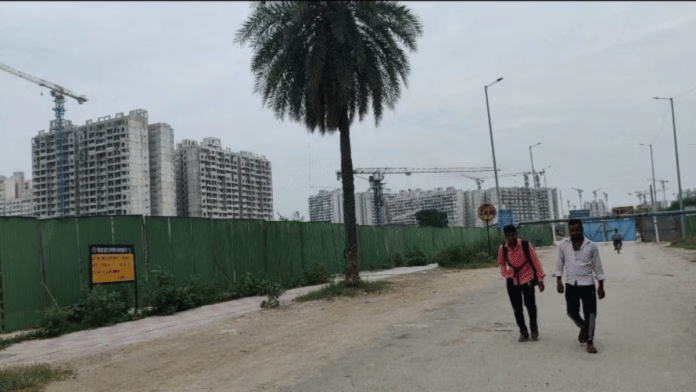



New Delhi: In a ruling that puts regulatory delays under the spotlight, the Real Estate Appellate Tribunal for NCT of Delhi & UT of Chandigarh has overturned a Rs 10 lakh fine on the Delhi Development Authority (DDA), holding that promoters cannot be penalised when regulators miss statutory timelines themselves.
The 19 January order turns on the interpretation of strict timelines under the Real Estate (Regulation and Development) Act, 2016, particularly the scope and effect of “deemed registration” under Section 5 of the Act.
The dispute arose from the DDA’s housing project titled ‘Construction of HIG (Multistoried Houses) including internal development and electrification in Sector-19B, Dwarka, Phase-II’.
On 17 June 2025, the Real Estate Regulatory Authority (RERA) imposed a penalty of Rs 10 lakhs on the DDA for alleged violation of Section 3 of the 2016 Act. The provision mandates prior registration of real estate projects with state RERAs before a promoter can advertise, market, book or sell any plot, apartment or building.
The provision is designed to prevent administrative delays, ensure predictability for promoters, and enforce accountability on regulators by making time-bound approvals a statutory obligation rather than a discretionary exercise.
The law also lays down obligations relating to ongoing projects, exemptions for smaller developments, and transparency requirements.
According to RERA, the violation stemmed from the DDA advertising and offering the project for sale under its ‘Diwali Special Housing Scheme’, launched on 30 November 2023, even though final registration had not yet been granted.
While the DDA initiated the registration process as early as February 2023, formal approval was only granted in April 2024, a delay of nearly 13 months.
Conflict over timeline
At the heart of the case was a dispute over when a statutory 30-day clock under Section 5 of the Act actually begins to run.
RERA argued that the DDA could not rely on the 30-day timeline because its initial online application, dated 28 February 2023, was incomplete.
According to the Authority, the prescribed fee had not been paid at that stage, physical documents were submitted only in June 2023, and the registration fee was deposited as late as 1 September 2023.
Counsel for RERA maintained that the statutory period “commences only upon receipt of a ‘complete application’ with all requisite fees”.
On this reasoning, the Authority justified the penalty and argued that any claim of urgency by the DDA was untenable when basic statutory requirements were not complied with.
Also Read: Why SC ruling in Ambience Mall case comes as breather for real estate projects in Haryana
DDA’s defence
The DDA, however, alleged arbitrariness and regulatory inertia. It contended that despite submitting its application in early 2023 and eventually depositing the requisite fee, the Authority “kept delaying the process of registration”, while communicating deficiencies only at a late stage.
Faced with prolonged inaction, the DDA argued that it was “forced… to claim deemed registration” under Section 5(2) of the Act and proceeded to advertise the project on 6 December 2023.
According to the DDA, once RERA failed to grant or reject the application within 30 days of receipt, the law itself treated the project as registered by default.
Tribunal rejects RERA’s interpretation
The Appellate Tribunal rejected RERA’s reading of the statute, calling it “incorrect” and cautioning that such an interpretation would render key provisions of the Act “otiose and meaningless”.
The tribunal underscored that Section 5 is clear and categorical: the Authority must either grant or reject an application within 30 days of its receipt.
Importantly, the order noted that “the statute does not make a distinction between a complete application or an incomplete application”.
Emphasising the legislative intent behind strict timelines—to curb administrative delays that can lead to “allegations of corruption and mischief”—the Tribunal said, “The Authority could not have kept the application pending and in terms of sub-section (2) of Section 5, the appellant claimed deemed registration… The intent of Section 5 of the Act is that no application should remain pending with the Authority for more than 30 days.”
Future mandate
Judicial member Lorren Bamniyal of the Real Estate Appellate Tribunal (REAT) concluded that once the DDA filed its initial application on 28 February 2023, the authority was duty-bound to either point out deficiencies and reject it, or grant registration within 30 days. Its failure to do so entitled the DDA to invoke deemed registration under the Act.
As a result, the Rs 10 lakh penalty was set aside.
Looking ahead, the Tribunal issued a clear directive to the authority to ensure “strict compliance of Section 5” and held that every application must be accepted or rejected within the statutory 30-day window.
In cases where the Authority fails to meet this deadline, it must issue the promoter a registration number and login credentials within seven days of the expiry of the period, reinforcing the Act’s emphasis on regulatory accountability and time-bound governance.
If the Authority fails to act within the 30-day window, the tribunal directed that the applicant can claim “deemed registration”.
(Edited by Sugita Katyal)
Also Read: HC upholds Relaxo’s piracy claim against Aqualite—how humble hawai chappal became an ‘object of art’