








New Delhi: Repeating the Supreme Court’s observations that an approver was “a most unworthy friend, if at all,” a Delhi court Friday pulled up the Central Bureau of Investigation (CBI) for its excessive reliance on statements from co-accused-turned-approvers in the 2021-22 Delhi excise policy case.
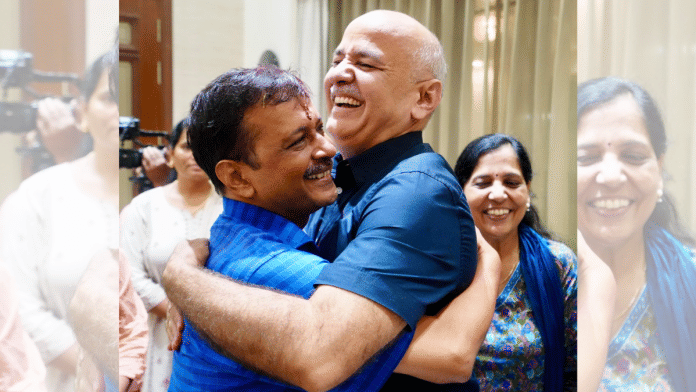
The court said this while discharging all 23 accused, including former Delhi CM Arvind Kejriwal and Manish Sisodia, in the corruption case registered by the CBI.
Saying that the prosecution witness, himself, admitted his part in the conspiracy for which others remain charged, the Rouse Avenue court of Special Judge Jitendra Singh criticised the CBI for what it called the agency’s “misconception” of legal positions.
The court was referring to Ongole’s TDP MP Magunta Sreenivasulu Reddy, the prosecution witness who confessed to attending a meeting with then-CM Kejriwal to explore Delhi’s liquor business.
The court noted that the CBI named Kejriwal an accused in the case, primarily based on Reddy’s statement, but it neither named Reddy an accused nor was he pardoned by the court. Reddy, the court said, could walk away from the matter as a mere prosecution witness, though he had a role to play, as he allegedly confessed.
“A serious infirmity that surfaces in the present matter is the apparent misconception of the legal position by the investigating and prosecuting agencies, with regard to the evidentiary value of certain witnesses. The record indicates that individuals who have, in their own statements, admitted participation in the alleged transaction have been examined merely as prosecution witnesses, without being arraigned as accused and without being tendered pardon as approvers,” Special Judge Jitendra Singh observed in his order.
“Yet, their statement appears to have been treated on par with that of wholly independent witnesses. It is equally possible that the agencies were conscious of the settled position in law, but nevertheless sought to project such witnesses as independent in order to lend greater weight to their case,” he observed.
Not only that, the court rebuked the CBI for flawed application of the law in how it recorded the statements of another co-accused, hotelier-businessman Dinesh Arora, after a pardon by a special court. In October 2023, Special Judge M.K. Nagpal pardoned Arora along with Reddy’s son, Raghav Magunta Reddy.
Special Judge Jitendra Singh observed that for its case, the CBI relied entirely on the statements of Dinesh Arora, with a “flawed” assumption that the pardon “transmuted” an approver into an independent witness. The law, however, is clear that statements of an approver and a general witness are not on a similar footing.
Special Judge Jitendra Singh also took into account that the CBI recorded Arora’s statement repeatedly—on four separate occasions—under Section 161 of the Code of Criminal Procedure, 1973, after his pardon. The section empowers investigators to record the witness’s statement, but because it’s unsigned and not on oath, it’s generally inadmissible as evidence in courts.
Special Judge Jitendra Singh noted that the case records clearly show the CBI examined Dinesh Arora for over a year after his pardon and recorded new allegations over time. All this, he added, was after Arora’s statement had already been recorded under Section 164 of the CrPC, something that is legally admissible and that also formed the grounds of his pardon.
‘Serious disquiet’
Special Judge Jitendra Singh said he did not intend to adjudicate the merits of all of Arora’s statements from all four times after his pardon but noted that Arora’s statement on 17 October 2023, which implicated AAP’s Rajya Sabha MP Sanjay Singh, was recorded nearly two weeks after the pardon.
Examining Dinesh Arora’s statement with reference to Sanjay Singh, Judge Jitendra Singh expressed being “taken by surprise” by the claims that the former allegedly delivered Rs one crore to Sanjay Singh’s aide Sravesh Mishra at the MP’s behest.
“What causes serious disquiet is that the name of Sanjay Singh does not find mention in the main charge-sheet or in any of the four supplementary charge-sheets. There is no allegation anywhere on the record attributing to Sanjay Singh any role, direct or indirect, in the formulation, approval, or implementation of the DEP-21/22,” Special Judge Jitendra Singh observed.
“While this court does not, at this stage, propose to enter into the merits of the said allegation, its very emergence at such a belated stage is indicative of the manner in which the approver’s statements have been utilised during investigation.”
The ED arrested Sanjay Singh in October 2023 in the excise policy-related money laundering case. The agency, citing Arora, said Sanjay Singh was “extremely close” to Dinesh Arora, who turned “approver” on 3 October.
The ED claimed in its chargesheet that Dinesh Arora, who, it said, arranged funds for the Aam Aadmi Party, met Sanjay Singh at Kejriwal’s residence, and later, took liquor businessman Amit Arora to Sanjay Singh’s home. Citing Dinesh Arora, the ED further claimed that Sanjay Singh promised Amit Arora a meeting with then-minister Manish Sisodia on the condition that he would give jobs to his aides.
“This lends credence to the apprehension that with each successive examination, fresh assertions are introduced to rope in persons against whom no foundational material otherwise exists. The approver appears to have been projected as an all-encompassing source for the prosecution narrative, such that on one occasion he introduces an entirely new allegation, and on another, seeks to supply explanations to fill links that are otherwise conspicuously absent in the evidentiary chain,” Special Judge Jitendra Singh observed.
The overwhelming reliance on an approver’s statement, however, should be seen with, if not corroborated with, independent materials. “An uncorroborated approver’s statement, unsupported by independent material on material particulars, ordinarily remains within the realm of mere suspicion. It assumes the character of grave suspicion only when reinforced by credible, independent evidence tending to connect the accused with the offence,” he held.
(Edited by Madhurita Goswami)
Also Read: Northeast youth resort to irony instead of outrage over Delhi racial attack
Everyone knows what has happened. Just because the court is not convinced of the evidence it doesn’t mean they are clean. Still there are other courts.