





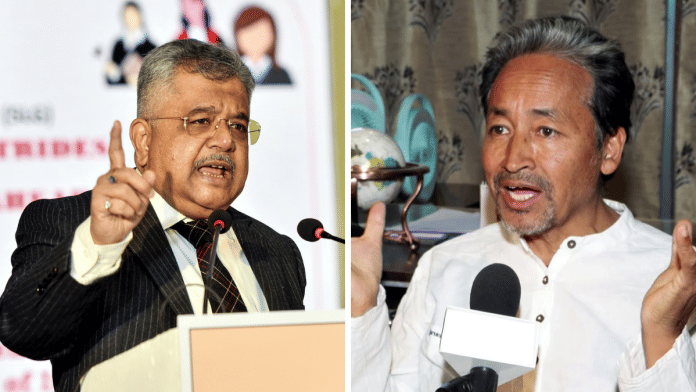



New Delhi: Climate activist Sonam Wangchuk’s reference to the Centre as “them” and to the people from Ladakh as “us” was “enough” to invoke the National Security Act (NSA)—a preventive detention law—against him, the Modi government told the Supreme Court Tuesday.
Representing the Centre, Solicitor General Tushar Mehta submitted: “There is no us and them. We are all Indians.”
Quoting Wangchuk’s speech, which led to his detention, Mehta asserted the activist should not be allowed to “spit venom”. He accused him of instigating Gen Z to “indulge in bloodbath” and “civil war,” wanting the Union Territory of Ladakh to face an agitation and violence similar to the ones in Nepal and Bangladesh.
By doing all this, he said, Wangchuk wanted to bring international focus to the Ladakh agitation. According to the government’s top law officer, Wangchuk’s choice of words—“them” and “us”—“betrayed secessionist tendencies”.
With this argument, Mehta opened his response on behalf of the Centre and the Union Territory, defending Wangchuk’s detention, which his wife has questioned before the Supreme Court. A bench of Justices Aravind Kumar and P.B. Varale is hearing the matter.
Wangchuk was detained under the NSA in September last, following the protests in Leh over demands of statehood and Sixth Schedule status for Ladakh.
Senior advocate Kapil Sibal has concluded his arguments on behalf of Wangchuk’s wife. In his submissions, he told the bench that Wangchuk has a democratic right to criticise and protest against the government, and that such sentiments do not threaten the security of the State to warrant his detention.
Mehta told the court that Wangchuk “wants Ladakh to become Nepal or Bangladesh?”, as he drew the court’s attention to a spate of violent incidents that took place in these neighbouring countries.
“The moment you say ‘ours’ and ‘theirs’ in this country, you are doing something against the country. There is no ‘they’. It is ‘our’ government,” the Solicitor General added.
To Wangchuk’s claim on invocation of Mahatma Gandhi in his speech, Mehta said it was done to cover-up, “usually done when inflammatory speeches are made.”
He asserted the District Magistrate’s authority, saying the officer had examined various factors, holistically, before passing the detention order. “The Court cannot question the sufficiency of the grounds of detention for subjective satisfaction.”
“One line, one word, one sentence cannot be couched in a manner that I was preaching what Gandhiji said. This Gen Z has their own dictionary,” the Solicitor General added, arguing Wangchuk misled the generation and hoped for a riot-like situation as in Nepal.
Wangchuk’s alleged mention of Arab Spring in his speeches were discussed during the hearing, with Mehta taking an exception, saying the reference was to the bloodbath in the Arab revolution that saw self-immolation attempts.
“This is what he wants Gen Z to do. It is an invitation to indulge in civil war with bloodbath! He says, why can’t we self-immolate? This is how he’s instigating impressionable youth,” Mehta insisted.
Highlighting Ladakh’s sensitive location and its proximity to China, he said the region was crucial to maintain supply chain to the armed forces posted on the borders.
Wangchuk had made statements for holding referendum in the region, Mehta told the bench, adding that his case was squarely covered under the NSA.
(Edited by Tony Rai)