





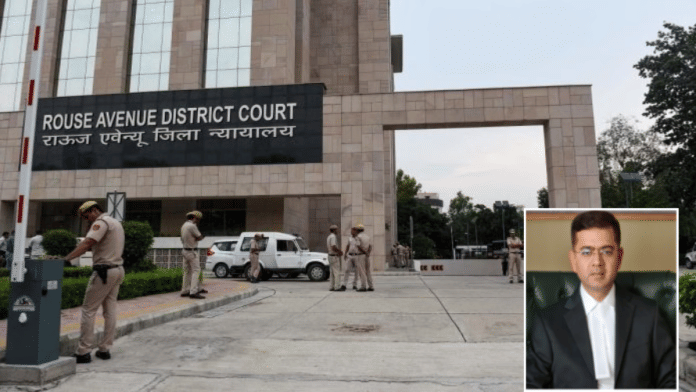



New Delhi: Special Judge Vishal Gogne has often found himself in the legal spotlight over the years for handling sensitive corruption cases involving some of the country’s most powerful figures.
This week, Gogne, posted to the Rouse Avenue Court in December 2023, was in the news again over two high-profile cases—former Bihar Chief Minister Rabri Devi’s petition seeking to transfer her cases from his court, and a landmark ruling in the National Herald case involving Rahul Gandhi and Sonia Gandhi.
Rabri Devi filed four pleas seeking transfer of her cases—which deal with the IRCTC hotels scam case, the lands-for-jobs case and the money-laundering proceedings linked to them—alleging the cases against her and her family were being heard in an unusually “hasty” manner.
Her lawyer told the court on Tuesday that 29 cases were pending before the judge, but no other matter was being heard by him with such haste as those against Devi and her family.
At the same time, Gogne was also in the news for declining to take cognisance of the Enforcement Directorate’s (ED’s) prosecution complaint, equivalent to a charge sheet, in the National Herald alleged money laundering case naming Sonia Gandhi and Rahul Gandhi.
The court cited the absence of a “foundational requirement” to investigate a scheduled offence under the Prevention of Money Laundering Act (PMLA)—the registration of an FIR.
The 117-page order stated that a complaint filed by a private person in a court under Section 223 of the erstwhile Code of Criminal Procedure (CrPC), even if it disclosed a scheduled offence, did not give the ED the jurisdiction to investigate. The basis of such proceedings stems from an FIR, as opposed to a private complaint.
The complaint in this case was filed in 2013 by BJP leader Subramaniam Swamy.
The court also said that the ED had gone against its own practice of basing its probes on the CBI’s FIRs and charge sheets even as the latter remained wary about the case’s viability, essentially “inverting the template”.
In a nutshell, the judge said that the entire probe was impermissible under the law, as it was not based on an FIR.
Stickler for procedure
Gogne joined the judiciary in 2006, after graduating from Delhi University’s three-year law programme. In the past, he served as the Senior Civil Judge-cum-Rent Controller at Dwarka District Court in 2017, followed by the post of Additional Director, Delhi Judicial Academy.
Besides this, he was also the additional sessions judge in Karkardooma court and the chief metropolitan magistrate at Rohini court in Delhi.
Over the years, he had built a reputation for being a stickler for procedure and for not shying away from examining investigative agencies in a string of high-profile cases.
As of June this year, the judge had around 21 pending cases of MPs and MLAs before him.
In August this year, while hearing the land-for-jobs corruption case lodged by the Central Bureau of Investigation (CBI) against former Bihar chief minister Lalu Prasad Yadav and his family members, the judge took a lawyer to task for being over-assertive with his court staff.
“My court staff is an extension of me. They’re government servants. They need to be respected as much as the judge,” he told the lawyer who was insisting that the court decide on his application.
That same month, he took a serious view of a counsel’s refusal to argue a case, citing a lawyer’s strike against the Lieutenant Governor’s notification, which allowed police personnel to depose before a court through video conferencing from their police stations.
The judge noted in his order that the lawyer refused to argue on the framing of charges despite being allowed to do so three different times, including through video-conferencing.
The court said the lawyer had forfeited his right to argue and the grounds for adjournment were entirely “self-serving”.
Last year, in April, Gogne pulled up the ED while hearing the bail plea of an accused in the land-for-jobs scam case, Amit Katyal.
Refusing to extend Katyal’s interim bail, the judge took issue with the use of the stringent PMLA to record the statements of doctors at Medanta and Apollo treating the accused.
The judge said history teaches that strong leaders, laws and agencies “generally come back to bite the very citizens they vow to protect”.
While declining to extend the bail given to Katyal, the court also rapped the ED for independently obtaining personal medical details about Katyal.
Gogne termed the ED’s move a “breach of the accused’s privacy”, saying the investigative agency was bound by the rule of law and cannot inspect ordinary citizens, such as the accused’s doctors who were not suspects in the case. The judge added that the ED cannot “arrogate powers to itself” and subject citizens to invalid processes.
The court also noted that the ED had no justification for invoking Section 50 of the PMLA, without any allegations of a nexus between the doctors. The provision deals with the ED’s powers to summon people, demand documents, and record statements under oath during investigations.
Father challenged Gogne’s conversion in court
Gogne was also at the centre of a personal case in 2011 when he was still a magistrate.
His father, O.P. Gogne, who had also served as a judicial officer, approached the Delhi High Court challenging his son’s conversion from Hinduism to Christianity for the purpose of marrying his maternal cousin.
His father argued that the marriage was a “sapinda” relationship, where spouses have a common ancestor within the past three to five generations, and was prohibited under the Hindu Marriage Act (HMA) of 1955.
The high court dismissed the plea as “frivolous” and Justice Suresh Kumar Kait fined the father Rs 10,000 as costs. Kait said the couple had converted to Christianity before the marriage and so their union will not fall under the “sapinda” relationship category.
The single judge had cautioned that encouraging such petitions could lead to a situation where honour killings are normalised.
His landmark judgements
Gogne is also known for other landmark judgements.
In April 2021, when he was posted at the Dwarka district court, he granted bail to a woman accused of causing the miscarriage and dowry death of her sister-in-law while keeping in mind that she had an infant. The woman was in Tihar jail with her 21-month-old son.
The court noted that denying bail to such people, especially women, essentially served as a de facto detention of their children. He added that such children could languish in jail for as long as their mother’s detention.
The court also said India is a signatory to the United Nations Convention on the Rights of the Child, 1989, which mandates that detention of children should be a last resort and for the shortest time. And even if such detention is required, children should be separated from adults.
The court granted bail to the female accused “in recognition of the rights of the child” while adding that a system built on the presumption of innocence of the accused should not subject the child of an accused to detention without cause.
“The options for pre-school and other educational enhancement would necessarily be restricted inside the Central Jail, Tihar. Since the trial has not even commenced and is likely to take a length of time to complete, the son of the accused, barely two years in age, cannot be condemned to spending his early childhood in jail. Such a fate would be a violation of his right to healthy development as an individual,” the judge noted in 2021.
(Edited by Sugita Katyal)