








New Delhi: When Sushil Gulati stepped in to stop a police officer from molesting a woman in his Rajouri Garden neighbourhood in 2000, he could not have known the act would draw him into a conspiracy so methodical that it would outlive him.
Twenty-six years on, the Delhi High Court upheld the conviction of the two men—a lawyer and a sub-inspector—who ensnared Gulati in a false rape case that now doubles as an indictment of institutional abuse of power.
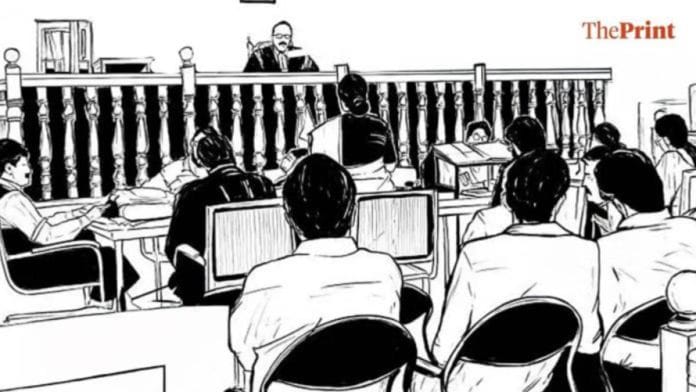
Justice Chandrasekharan Sudha, in an 85-page ruling on 4 April, dismissed appeals by Haji Mohammad Altaf, the lawyer, and Narender Singh, the sub-inspector. The two were convicted by a Rohini court in 2016 for criminal conspiracy, fabrication of evidence and extortion under the erstwhile Indian Penal Code. Their four-year jail terms were completed, though the appeal against their conviction was pending until this month.
Gulati died in 2014. While battling the rape case, he was summoned to court approximately 20 times and sent back without once being cross-examined.
“The crime committed by A1, a lawyer, and A2, a police officer, is in no way justifiable. A lawyer is an officer of the Court, whose duty is to defend his client and assist the court and not to indulge in such acts of implicating innocent persons in crimes. Likewise, A2, a police officer, whose duty is to prevent crimes, has in complete disregard to the same, indulged in acts which are in no way justifiable,” Justice Sudha said in the order.
She added, “This is a fit case in which a more stringent sentence ought to have been imposed so as to send a strong message to the people occupying such positions, be it a lawyer or a police officer, that courts would not treat such crimes lightly or turn a blind eye to such blatant misuse of their position and authority.”
The elaborate conspiracy
The plot was retaliatory in design. Gulati’s intervention in 2000 had led to the suspension of C.M. Dutta, then the chowki-in-charge at Rajouri Garden Police Station, who allegedly attempted the molestation.
Dutta, Altaf and Narender Singh devised a plan to frame Gulati in a rape case. Dutta died during the proceedings, so no charges were pursued against him.
The accused constructed a false allegation that Gulati had raped a woman in a moving car. To give the accusation form, the group took the help of a woman who was allegedly paid by them for going along with their plan.
They then staged her being thrown from a vehicle near a city hospital where she would be “discovered” by police, including the conspirator Narender Singh, case documents show.
To ensure that medical examination would corroborate the allegation, a syringe was used to insert “white semi-liquid material”—later identified through DNA analysis as semen belonging to one of the accused and an associate—into the woman’s vagina, the documents state. Blood drawn from her nostrils was separately preserved and planted inside Gulati’s car.
As sub-inspector, Narender Singh prepared false police records to support the fabricated narrative. Gulati was arrested and held on remand for several days.
Also Read: All accused equal, but some more ‘Hon’ble’? Allahabad HC sparks protocol row over FIR etiquette
How the rape case came undone
The rape case against Gulati began to unravel only after the investigation was transferred from local police to the Crime Branch.
The woman, interrogated by the Crime Branch, confessed that her accusations were false and were made to extort from Gulati. DNA reports later confirmed that the semen found on her did not belong to Gulati.
Based on these findings, a Rohini trial court discharged Gulati on 9 April 2001. By then, a counter-complaint filed by Gulati on the conspiracy against him was also underway.
HC’s latest order
The HC, in its order, criticised the trial court for permitting Gulati’s cross-examination to be deferred over approximately 20 hearings.
“It is a matter of great concern that the trial court also did not effectively step in to prevent the harassment. The request for adjournments for cross-examination is seen granted for the mere asking,” Justice Sudha wrote.
She was equally sharp about an argument the lawyer and the sub-inspector had made before the trial court: that they had no foreknowledge Gulati would die before his cross-examination was completed.
Justice Sudha called this “quite an insensitive argument”.
“Nobody need have such ‘insight or supernatural knowledge’. But they could have prevented such a situation by cross-examining PW12 (Gulati) promptly instead of seeking adjournment on every occasion possible. This is nothing but a clear abuse of the process of law,” Justice Sudha wrote.
“There was more than ample time to complete his examination. The adjournments sought for and granted is in clear or blatant violation of the order of this Court,” she added.
On the other accused, the high court acknowledged their role in the conspiracy but also noted their circumstances.
“All the said witnesses, who appear to be from the lower financial strata of the society, are seen to have fallen for the same. This court is in no way justifying their conduct. But, taking into account their financial status, they seem to have fallen easy prey to the bait offered by the accused persons,” the HC observed.
The family
While the HC was hearing the lawyer and the sub-inspector’s appeal against their conviction, the HC noted that another appeal by Gulati’s legal heirs, seeking enhanced compensation for the “enormous damage” to his reputation, had been pending for nearly ten years.
Though Gulati’s family told the court it was no longer willing to proceed with the appeal, the HC enhanced compensation from Rs 2 lakh awarded by the trial court earlier to Rs 3 lakh.
“The appeals are of the year 2016. The incident is of the year 2000. 26 years have elapsed. Sushil Gulati never got justice during his lifetime. Therefore, this court did not want to further delay the matter,” Justice Sudha noted in the judgment.
Jitin Sahni, who represented the family before the high court, said they feel “justice has been delivered”. The family declined to comment on the case.
(Edited by Prerna Madan)