





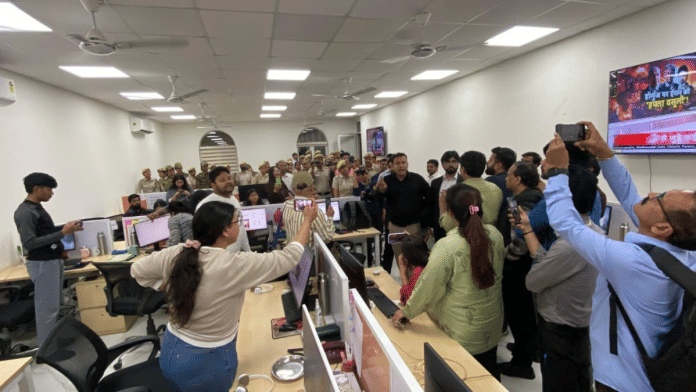



New Delhi: The Delhi Police Friday vacated the office of the United News of India (UNI) at Rafi Marg in central Delhi, hours after the Delhi High Court dismissed the agency’s petition challenging the cancellation of its land allotment. Staff members alleged mishandling during the eviction, claiming they were pushed out and verbally abused.
The action followed a detailed 98-page judgment by Justice Sachin Datta, who upheld the government’s decision to revoke UNI’s allotment of land at 9, Rafi Marg. The court concluded that UNI had “miserably failed” to fulfil its primary obligation of constructing a media office complex despite holding the land for over 45 years.
Dismissing the petition, the court directed the Land and Development Office (L&DO) to take immediate physical possession of the property. It observed that UNI had effectively “squatted on valuable public land for more than 45 years” without meeting its contractual obligations.
“Public land cannot be allowed to be held hostage by a defaulting licensee who has failed to fulfil the very object for which the licence was granted,” the court said, adding that the L&DO must ensure that future conditional allotments are enforced with “promptitude and institutional rigour”.
Sources in The Ministry of Housing and Urban Affairs told ThePrint: “It is further pertinent to note that the subject land, measuring approximately 5,289.52 sq. mtrs. at 9, Rafi Marg, has an estimated value of about Rs 409 crore at the prevailing indicative land rate of Rs 7,74,000 per sq. mtr., underscoring the high public value of the asset. Despite continued occupation of such prime government land, no ground rent has been paid by UNI for decades, reflecting persistent non-compliance with the financial obligations under the allotment.”
“The continued unauthorised occupation of such a valuable public asset without any corresponding financial discharge further aggravates the gravity of violations on part of the allottee,” the ministry sources added.
Justice Datta also noted, “The petitioner (UNI) has been afforded unusual and excessive latitude, for far too long, despite its continuing default and nonperformance, with successive allotment letters being issued from time to time notwithstanding its persistent failure to fulfil the obligations cast upon it.”
Rejecting UNI’s attempt to attribute delays to government agencies, the court said, “The attempt on the part of the petitioner (UNI) to shift the blame for its non-performance on to other entities such as CPWD and NBCC is a disingenuous afterthought that does not withstand scrutiny.”
“In any event, as already noticed, the delay from 1979 to 1999 (a period of nearly two decades) predates any involvement of CPWD or NBCC whatsoever. It is therefore wholly untenable for the petitioner to attribute its default, spanning over more than 45 years, to alleged coordination issues with agencies whose involvement was not even contemplated during the first two decades of its possession,” the court said.
Tracing the background, the court noted that the land was first allotted to UNI on 14 December 1979, for the “construction of a composite office complex” to house multiple media organisations. The original agreement required construction to be completed within two years of possession. However, despite taking possession and paying the premium, no construction work began.
Subsequent revisions in 1986 and later years altered the size and sharing arrangements of the plot, but repeatedly imposed similar construction deadlines. The court observed that “no steps were taken by the petitioner (UNI) towards construction… nor any agreement was entered into between the concerned allottees” during this period.
Further modifications in 1999 and 2000 involved additional stakeholders, including the Press Council of India, with the Central Public Works Department (CPWD) designated to construct a composite building. However, the project remained in a state of “inertia” for decades, with UNI eventually admitting in 2022 its “inability to participate in the construction… due to acute financial crunch”.
On the legal question of UNI’s rights over the land, the court rejected its claim of having acquired any “irrevocable” or perpetual interest. It held that UNI was merely a “bare licensee”, stating, “The petitioner’s rights are strictly and narrowly confined to utilising the land solely for the purpose of raising or constructing a building… the petitioner cannot claim any proprietary or exclusive entitlement.”
Invoking Section 62(f) of the Indian Easements Act, 1882, the court ruled that the licence stood revoked as the purpose for which it was granted had become “impracticable”.
With the petition dismissed and possession ordered to be taken, the court’s ruling effectively cleared the way for the government to reclaim the high-value public land.
(Edited by Viny Mishra)
Also read: DDA opens a four-decade-old knot. Supreme Court, prime South Delhi plots vs angry owners