





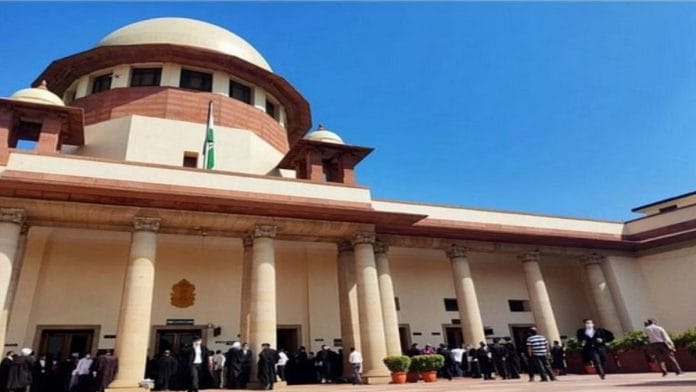



New Delhi: Emphasising that courts must ground their reasoning in “social justice adjudication”, the Supreme Court Tuesday held that a Muslim woman, upon divorce, would be entitled to recovering money, gold and other articles from her husband, which were gifted to the bride and the groom at the wedding by their friends or relatives.
In a ruling which paves the way for financial autonomy of divorced Muslim women, a bench of Justices Sanjay Karol and N.K. Singh set aside orders passed by the Calcutta High Court in November 2022 and January 2024, which had essentially rejected the wife’s claim for Rs 7 lakh and gold ornaments weighing about 350 gm.
Underlining that the scope and object of Muslim Women (Protection of Rights on Divorce) Act, 1986, is securing dignity and financial protection of Muslim women post their divorce, the two-judge bench ruled that such objective also aligns with the rights of women under Article 21 of the Constitution, which relates to the right to life.
“The construction of this Act, therefore, must keep at the forefront equality, dignity and autonomy and must be done in the light of lived experiences of women where particularly in smaller towns and rural areas, inherent patriarchal discrimination is still the order of the day,” the court ruled.
The ruling came on a plea filed by a Muslim woman, Rousanara Begum, who got married in August 2005, and divorced her husband six years later. Four years after their wedding, in May 2009, Rousanara fled from the matrimonial home, and shortly after sought maintenance from the husband and initiated cruelty proceedings against him under Section 498A of the Indian Penal Code.
After the marriage ended in a divorce in December 2011, Rousanara approached the district court at Bolpur, Birbhum, under Section 3 of the Muslim Women (Protection of Rights on Divorce) Act, 1986, seeking a total of Rs 17.64 lakh from him, inclusive of the gold ornaments, television, furniture, and other things that were gifted to him by her family at the time of their wedding.
Section 3 of the 1986 Act deals with “Mahr” (dower) or other properties which are given to Muslim women at the time of divorce. It says that a divorced Muslim woman is entitled to a reasonable and fair provision, while adding that the maintenance is to be paid to her by her former husband “within the iddat period” (a waiting period after a divorce during which the woman cannot remarry).
After a 14-year-long battle before the courts, the Supreme Court finally came to Rousanara’s rescue and ruled that she was entitled to the entire amount and the gold ornaments that her family had gifted them.
In doing so, the court remarked that the Calcutta HC had erroneously rejected Rousanara’s claim for the amount and properties that should have been returned to her.
Why the Calcutta HC ruling was set aside
Although in June 2014, a lower court had partially allowed Rousanara’s claim for Rs 8.3 lakh, both parties challenged it, and in April 2017, a Bholpur court set out to answer whether the things given to the bridegroom could be recovered by Rousanara.
After looking at the two ‘qabilnamas’ (entries in the marriage register), the court concluded that there was proof of wedding, and moreover, the husband was not able to disprove the entry of the gold and the money in the marriage register. Given this, it directed the husband to return the Rs 7 lakh and gold ornaments to his former wife. As for the other articles, including the furniture, the court said that “since there was no entry in the concerned documents regarding the furniture, there was no entitlement for the same to be returned”.
Subsequently, the case reached the Calcutta HC, since both parties were not satisfied by the 2017 order. Pointing to a ‘discrepancy’ between the marriage certificates presented by the parties before the court as evidence, the court rejected her claim for the money and gold.
Setting aside this order, the top court noted that, “It is difficult to agree with the reasoning of the High Court. The primary basis for not giving the amount and gold in question to the appellant, as it appears from the perusal of the judgment, was the apparent contradiction between the statement of the Kazi-e-marriage registrar (official who conducts the wedding) and the father of the appellant.” The father claimed that this amount was given to the husband, while the Kazi claimed that the entry never specified to whom the amount was given. The court also added that proceedings against the husband were also underway under Section 4 of the Dowry Prohibition Act.
Taking note of the fact that the evidentiary value of one statement cannot be greater than another, the court said that the wife’s claim could not have been rejected on the mere allegation that her father’s conduct was suspicious. Essentially, it meant that simply because the father had overwritten on the marriage register, it wasn’t a sufficient reason to discard his entire testimony in the case.
What courts have previously ruled
In the 2001 Constitution or five-judge bench ruling of the top court in Daniel Latifi v. Union of India, where the validity of the 1986 Act was in question, the court upheld the provision and noted that a Muslim husband is liable to make reasonable and fair provisions for the future of the divorced wife which obviously includes her maintenance as well. “Such a reasonable and fair provision extending beyond the iddat period must be made by the husband within the iddat period in terms of Section 3(1)(a) of the Act,” the court said while adding that such liability of the husband towards his divorced wife is not just confined to the Iddat period.
In the event that the woman is not able to maintain herself even after the iddat period, and has not remarried, she can even seek such maintenance, based on an order passed by the magistrate.
In July, last year, the Supreme Court had also ruled that under Section 125 of the CrPC, which is a general provision that allows for grant of maintenance, Muslim women can also seek compensation.
(Edited by Viny Mishra)
Also read: Liberals don’t want Muslim women to demand rights in the Hindutva era. There’s no right time