





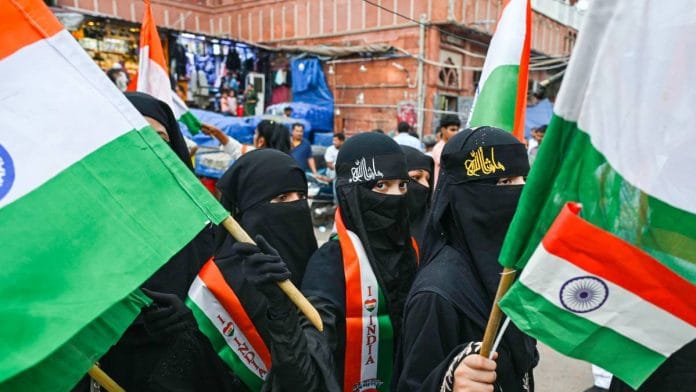



New Delhi: The Supreme Court Tuesday delivered a significant boost to the financial autonomy of divorced Muslim women, ruling that they can recover all wedding gifts—cash, gold and other valuables—given to the couple.
The ruling underscored the broader intent of the Muslim Women (Protection of Rights on Divorce) Act, 1986, to secure dignity, autonomy, and economic stability for women post-divorce.
“The construction of this Act, therefore, must keep at the forefront equality, dignity and autonomy and must be done in the light of lived experiences of women where, particularly in smaller towns and rural areas, inherent patriarchal discrimination is still the order of the day,” it observed.
This verdict is just one of the many instances where Indian courts have stepped in to the aid of Muslim women in recent times, amid an uptick in women from the community approaching courts for the realisation of their rights. However, the battle continues when it comes to practices like “talaq-e-hasan” and questions of maintenance, polygamy and divorce.
The journey commenced with the passage of the Dissolution of Muslim Marriages Act, 1939, followed by the Muslim Women (Protection of Rights on Divorce) Act,1986, and then the Muslim Women (Protection of Rights on Marriage) Act, 2019, culminating in several rulings that have helped them attain a life of dignity and equality.
When it comes to judgements given by the Supreme Court and high courts, the fight for Muslim women’s rights gained momentum with the Shah Bano (1985) and Shayara Bano (2017) cases, which essentially upheld a Muslim woman’s right to maintenance beyond the iddat (waiting) period, and abolished triple talaq as unconstitutional, respectively.
In July last year, the Supreme Court bench of Justices B.V. Nagarathna and Augustine G. Masih in Mohd Abdul Samad vs State of Telangana enhanced the rights of Muslim women by ruling that they can, in addition to the 1986 Act, also seek maintenance under the general maintenance provision under Section 125 of the Criminal Procedure Code (CrPC).
While the 1986 Act deals only with the rights of divorced Muslim women, the provision under the CrPC allows for maintenance to those who are unable to provide for themselves.
The court in Mohd Abdul Samad’s case simply broadened the choice for divorced Muslim women to get maintenance under both statutes. In doing so, it also dismissed the husband’s claim that the wife must seek maintenance under the special law (1986 Act), arguing that the special law must prevail over the general law.
Delhi-based advocate Miriam Fozia Rahman, who has practised as a lawyer for over 15 years, told ThePrint that these landmark rulings have not only ensured financial autonomy and dignity for Muslim women but also upheld equality.
“The Supreme Court’s decision to allow divorced women to reclaim gifts, provisions of maintenance beyond the iddat period, and upholding their inheritance rights are truly commendable,” she said.
She underlined that the abolition of triple talaq and the proactive judicial approach prioritising women’s rights showcases “India’s strong commitment to promoting gender justice and aligning with constitutional values”, adding that she was proud of the Indian judiciary for championing the cause of Muslim women.
Senior advocate Madhavi Divan, who assisted the Union of India in the Shayara Bano case which abolished instantaneous triple talaq, told ThePrint: “Courts have certainly helped to shake the inertia among lawmakers. For some reason, there has always been this ostrich-like attitude, but the Shayara Bano judgement certainly helped to move the needle.”
Highlighting instances where women within the community have been standing up against practices like triple talaq, Divan said: “There is progress among the Muslim women. One can see the movement. But what happens to personal laws if they are unconstitutional?”
In the 1951 case of Narasu Appa Mali, a resident of Maharashtra who was convicted under the Bombay Prevention of Hindu Bigamous Marriages Act, 1946, for marrying a second time, the Supreme Court held that personal laws were immune from constitutional scrutiny but rejected the argument that the state legislature had infringed upon religious freedom of Hindus by prohibiting bigamy. The court saw the 1946 Act as a valid social reform, not a violation of religious practice.
Interestingly, in 2018, former Chief Justice D.Y. Chandrachud had said in the Sabarimala case, that the decision in Narasu Appa Mali was flawed in holding personal laws as immune from constitutional scrutiny.
This view, legal experts believe, might have encouraged Muslim women to take up their fight for more autonomy.
Court clarifications
Back to 2001, the top court had overseen the challenge to the 1986 Act in Danial Latifi’s case. The petitioner had challenged the Act as unconstitutional as it seemed to limit maintenance to the iddat period.
The court upheld the Act’s provisions and gave clarifications on them. It ruled that a Muslim man’s liability to pay maintenance to his divorce wife was not confined to the iddat period, and such maintenance must be fair and reasonable.
Speaking to ThePrint, Dr Noor Ameena, assistant professor of law and co-director of the Centre for Women and the Law, National Law School of India University, Bengaluru, said the 1986 Act came after the Shah Bano judgement and was challenged in Danial Latifi.
According to Ameena, it did not limit the payment of maintenance to three months of the iddat period, and said a fair amount must be given which supported the woman for the rest of her life, unless she remarried.
“If this maintenance is not given, you can go to court to secure that. Courts can even order to give this in instalments, or even as a one-time lump sum payment,” she said.
Advocate Rishad Ahmed Chowdhury talked about the 2017 judgement that held instant triple talaq as unconstitutional.
“Interestingly, one of the judges on the five-judge bench was Justice Kurian Joseph who said that what is held to be bad in the Holy Quran cannot be good in Shariat and, in that sense, what is bad in theology is bad in law as well,” he said. The judgement involved study of the Quran to check the validity of the instant triple talaq practice.
Advocate-on-Record Paras Nath, pointed to a slew of SC judgments, like the Sarla Mudgal (1995) case, which denounced the practice of Hindus converting to Islam to escape the consequences of bigamy.
In this case, a three-judge bench had expressed the need to develop a Uniform Civil Code (UCC) for the country and ruled: “We, therefore, request the Government of India through the Prime Minister of the country to have a fresh look at Article 44 of the Constitution of India and ‘endeavour to secure for the citizens a uniform civil code throughout the territory of India’.”
Speaking to ThePrint, BJP leader and chairman of Uttarakhand Waqf Board Shadab Shams said Muslims in the state were governed by the UCC.
“Our daughters and sisters have a share in their father’s property. These daughters make up half the population, so why should there be any inequality towards them? Only if we take them along can any real change come,” Shams said, welcoming the legislation brought by the Uttarakhand government.
Issues that can be decide further
While the Supreme Court had struck down instant triple talaq as unconstitutional in 2017, it left other forms of unilateral divorce, including talaq-e-hasan, untouched. This is now under scrutiny.
The court is currently seized with a batch of petitions seeking to challenge the practice of talaq-e-hasan, in which the husband pronounces “talaq” once a month for three consecutive months to end the marriage.
Last month, prior to becoming the Chief Justice of India, Justice Surya Kant had led an SC bench hearing a petition by journalist Benazeer Heena, who argued that talaq-e-hasan was a violation of fundamental rights, specifically Articles 14, 15, 21, and 25 of the Constitution
The bench sought responses from bodies like the National Commission for Women, the National Commission for Protection of Child Rights and the National Human Rights Commission, and noted that while Benazeer had the resources to fight the case, there were many other women like her who did not.
The court is also hearing pleas seeking a ban on female genital mutilation, prevalent among the Dawoodi Bohra community, a sect among Shia Muslims.
Last month, a bench of Justices B.V. Nagarathna and R. Mahadevan sought responses from the central government on a plea filed by NGO Chetna Welfare Society, which argued that the practice was not part of the “essential practices” of the Islamic faith, and was not mentioned anywhere in the Quran or hadith.
In September 2019, a three-judge bench led by then CJI Dipak Misra had referred to a larger five-judge bench the constitutionality of the practice of female genetic mutilation.
Also Read: From Shah Bano to marriage laws: What SC said about maintenance for Muslim women
High court steps in too
In the last few months, the Kerala High Court has significantly paved the way for rights of Muslim women.
In one of the rulings, it stated that whatever be the reason for a husband’s second marriage, the wife is entitled to maintenance from him. It also asserted that the majority of men in the Muslim community are monogamous, even if they have the wealth to maintain more than one wife.
The court was acting on a plea by one Muhammad Shareef, 44, and put to rest the legal conundrum pertaining to the registration of a Muslim man’s second marriage, in line with the Kerala Registration of Marriages Rules, 2008.
In this case, the man’s first marriage was still subsisting and he had two children with Abida, his wife. The court noted in its October ruling that during the pendency of this marriage, Shareef developed a “love relationship”. In August 2017, he married his second wife and told the court that he had married with his first wife’s permission.
But once he decided to register his second marriage before the local self-government institution or the registering authority in this case, he was denied the same, without a valid reason, he claimed.
Contending that Muslim men can have up to four wives under their personal law, the man argued that the registrar was bound to register his second marriage. This led the court to ask whether under the Kerala Registration of Marriages Rules, a second marriage can be registered behind the back of the first wife, while a marital relationship between the husband and wife still exists.
Putting the conundrum to rest, the court said that while it’s true that under Muslim customary law, a man can marry more than once, it is allowed only “in certain situations”.
Citing the 129th Quranic verse from Chapter IV, the court concluded that “the spirit and intention of these verses is monogamy, and polygamy is only an exception”. “The Holy Quran greatly stresses justice. If a Muslim man can give justice to his first wife, second wife, third wife and fourth wife, then only marriage more than once is permissible,” it noted.
Polygamy (up to four wives) in Islam is allowed only as a rare exception, strictly conditional on a man’s ability to treat all wives with perfect justice and equal provision, something the Quran acknowledges is nearly impossible, thus favouring monogamy.
In a September ruling, Jubairiya vs Saidalavi, the same bench of the Kerala High Court had ruled that monogamy is the rule, while polygamy is an exception in Islam.
In doing so, it said the court cannot compel a beggar to pay maintenance to his wife while dealing with the plea of a man who lived on alms, but had married twice.
His second wife had sought maintenance of Rs 10,000. Although the court said the state must look after the women who were the victims of polygamy in this case, it pointed out that if a blind man begging in front of the mosque was marrying one after another women, without having knowledge of the fundamental principles of Muslim customary law, he must be counselled by the authorities.
Justice Kunhikrishnan in his order said the “small minority” among Muslims who are following polygamy are forgetting the verses of the Holy Quran.
Although the Quran is silent about the consent of the first wife for a man’s second marriage when the earlier marriage is in existence, it does not prohibit the option of obtaining consent from the first wife, or at least informing her before he marries again, the court said. Gender equality is a constitutional right of every citizen, the court asserted, adding that men are not superior to women.
Legal experts point out that the phenomenon of courts ruling on personal laws, including the issue of Muslim women’s rights, is not new.
Advocate Malavika Rajkotia told ThePrint that many times personal laws may have problematic positions on the place of Hindu women in society or the place of women generally too.
The lawyer has practiced over 40 years on divorce and family law matters, and has authored the book Intimacy Undone: Marriage, Divorce and Family Law in India.
“The issue of women’s rights is quite sensitive, especially in current times as efforts are being made to show Muslim women as worse off than women from other communities. Of course, concepts like ‘triple talaq’ and ‘halala’ are deeply problematic, but the change must come from within the community. It’s up to the Muslim women to lead this fight, and to be honest many of them are, but it takes a lot of courage,” she told ThePrint.
She also pointed to the possible existence of a “communal angle” to the issue. She said there was a risk that problematic personal laws may be used as an excuse to bring in the Uniform Civil Code, as has been done in Uttarakhand.
Rajkotia added that an element of patriarchy was common to all religions and led to the continuation of problematic practices such as triple talaq.
She further pointed out that the All India Muslim Personal Law Board also dealt with matters like divorce, marriage and inheritance, and could have taken a better position as opposed to defending the practice of talaq-e-hasan.
(Edited by Nida Fatima Siddiqui)
Also Read: SC judgement on triple talaq: What’s monumental about it and what’s not