





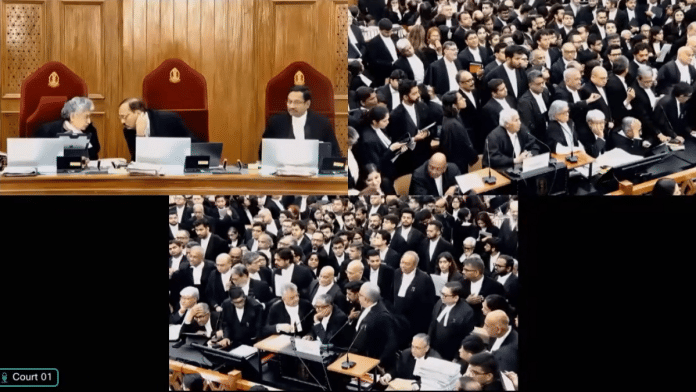



New Delhi: The Supreme Court Wednesday asked if a non-devotee can challenge the Sabarimala temple’s custom of prohibiting entry to women of menstruating age and if such a petition was maintainable.
The nine-judge bench led by Chief Justice of India Surya Kant raised this legal question towards the end of the second day’s hearing on the reference arising from the Sabarimala case.
The over four-hour long proceedings also saw the Centre making strong arguments against the subjective concept of constitutional morality, which the top court has invoked in the last few years to invalidate criminal laws as well as the entry ban in Sabarimala.
Justice B. V. Nagarathna—the sole woman judge on the bench—raised the first question on whether someone not impacted or affected by the ban could have moved the court against the ban that is said to be a custom. She posed this soon after solicitor general Tushar Mehta addressed his arguments on one of the questions referred to the bench, which is whether a person not belonging to a religious denomination or religious group can question a practice of that religious denomination or group by filing a PIL.
It may be recalled that SC’s Sabarimala judgment, delivered in 2018, came on a PIL filed by an organisation named ‘Indian Young Lawyers Association’. The court had then upheld the maintainability of the petition, rejecting the temple board’s contention that someone not directly impacted by the ban cannot demand it be struck down.
“They are not devotees. A non-devotee, a person who is not concerned with the temple, challenges it. Can this court entertain the writ petition?” she asked.
She further added: “No devotee has challenged it… it (the petitioner) is the person who has no concern.”
If the organisation would have filed a civil case, challenging the custom, it would have been rejected on the ground of having no cause of action, she observed.
CJI Surya Kant concurred with Justice Nagarathna’s view and summed up her and Mehta’s contention. “Your objection is that Articles 25 and 26 are personal issues and somebody who has grievance can only come to the court,” he said.
Article 25 allows an individual to practise, profess and propagate one’s religion, while Article 26 gives right to a denomination or a section to run a religious institution. Both are, however, qualified and can be restricted to maintain public order and health.
However, since the 2018 judgment had held that a third party can intervene when a grave constitutional issue is being raised before the court, the present bench would have to look into the issue.
The CJI, however, felt it would be unnecessary to lay down general principles regarding PIL, as prayed by Mehta who argued against courts entertaining “motivated PILs”.
At the outset, Mehta stressed that a secular court cannot determine whether a religious practice amounts to superstition and that only legislative intervention can curb a custom or ritual that is superstitious.
Though the bench had reservations over his argument on this point, Mehta persisted with his submission, contending judges don’t have scholarly competence.
Mehta later raised a serious concern over previous Supreme Court judgements that tested the validity of laws on the basis of an individualistic concept of constitutional morality, which, he said, cannot serve as an independent ground to adjudicate claims under Article 25 of the Constitution.
Giving reasons to oppose the term ‘constitutional morality’, Mehta argued that it is subjective and may vary from one judge to another, making it an uncertain standard for adjudication of constitutional matters.
Constitution framers had envisaged constitutional morality as governance doctrine, to govern the conduct of ministers and public functionaries. “This was never meant to be applied as a standard to adjudicate religious claims,” Mehta said.
The solicitor expressed serious objections to the “emergence of a new trend” by which judicial pronouncements of constitutional morality substituted social morality.
He read out paragraphs from the Delhi High Court judgment in the Naz Foundation case that quashed section 377 of the Indian Penal Code (IPC), which criminalised homosexuality. Though this ruling was overturned by SC, later in the Navtej Johar decision, the top court had finally struck down section 377 as unconstitutional.
Mehta read out paragraphs from former CJI DY Chandrachud’s concurring opinion in Joseph Shine case that decriminalised adultery. CJI Chandrachud was a member of the five-judges bench that was led by then CJI Dipak Misra.
Mehta had “serious reservations” to Justice Chandrachud’s opinion quoting extensively from books authored by American lawyers on constitutional morality, a “vague doctrine” to outweigh social morality.
On Justice Chandrachud’s opinion in the Sabrimala case, Mehta said it incorrectly understood public morality as being synonymous with constitutional morality.
By the time the Navtej Johar case was decided, constitutional morality took “centerstage” as a “tool” to decide validity of laws. With its observation that constitutional morality cannot be martyred at the altar of social morality, the court put an individual and subjective view on a higher pedestal.
“Now social morality goes and is replaced by a vague term constitutional morality which never had a meaning, which the courts have started giving,” Mehta argued.
On determination of essential religious practices, Mehta said unlike other religions, Hinduism not only has plurality, but has internal plurality.
“There is no one originator, no one creator, no one God, no single religious scripture. At times, it becomes impossible to demonstrate what is “essential”. It creates an arbitrary situation,” he argued.
If a religious practice is questioned on the ground that it violates an individual right, then such a claim must be tested against a corresponding right of another individual or a denomination, he said while concluding his arguments.
(Edited by Viny Mishra)