





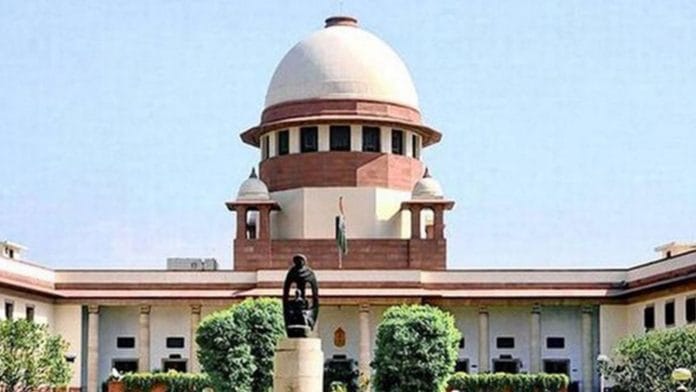


New Delhi: The Supreme Court Friday imposed a ban on recording, uploading, posting, reposting, disseminating and editing of judicial proceedings and their transmission on social media and other digital platforms without appropriate permission from the registrar general or secretary general of the concerned High Courts or Supreme Court.
A three-judge bench led by Chief Justice of India (CJI) Surya Kant passed the interim order while issuing notice on a Public Interest Litigation (PIL) to regulate the transmission of court proceedings. The petition claims selective and decontextualised circulation of courtroom exchanges is severely impacting the dignity of courts and leading to commercial gains for a select few.
The bench clarified that its order shall not be treated as a gag order on reporting of court proceedings. It issued notices to the Centre, asking it to identify the nodal ministries that could implement the reliefs sought in the petition. It further asked all High courts to submit their reports on adoption of SC’s guidelines on livestreaming and explain the impact of continuous livestreaming of proceedings.
Proceedings of several High Courts are recorded from their YouTube Channels where the hearings are telecast live. Instances where High Courts don’t have their own Youtube channel, litigants and lawyers record virtual proceedings, which can be accessed officially by advocates and their clients whose matters are listed. Even in the Supreme Court, lawyers and litigants whose matters are scheduled for a hearing can access online links to attend court proceedings virtually.
Online appearance of lawyers and litigants was permitted in March 2020, in the aftermath of the Covid-19 lockdown. This measure was undertaken to ensure court hearings do not get disrupted due to lockdown restrictions.
Many High Courts also took to YouTube to telecast proceedings live. This aligned with the SC’s 2017 judgement that backed live telecast of judicial proceedings for transparency and saw it as a crucial step towards improving access to justice.
Later, even after Covid restrictions were lifted, the court, on the request of the legal fraternity, continued with virtual hearing and accepted the hybrid hearing model that gave lawyers the discretion to appear online, without warranting their physical appearance to argue their case.
However, the rampant circulation of edited clips of court hearings became a cause of concern for the judiciary.
Appearing for petitioner, journalist Harshita Grover, senior advocate Vikas Singh, recalled the ruckus that broke out before a vacation bench led by Justice KV Viswanathan. He said the clip had become hugely viral, making the judiciary a joke before the lay people.
Advocate Singh was referring to an incident earlier this month, where proceedings in the Supreme Court were thrown into disarray during the hearing of an appeal filed by a petitioner-in-person, who engaged in “incoherent and unparliamentary utterances”, hurled case papers in the courtroom and also used foul language against the CJI.
Justice Joymalya Bagchi, who was one of the three members on the bench, accepted it was time to rethink on livestreaming, saying it should be an “exception than a norm”. He added courtroom proceedings are not a source of entertainment.
The judge highlighted how online hearing links were shared indiscriminately and said such access also required regulation. “Regulating data is one of the biggest challenges in digital space… so we should ensure limited access and therefore restrict livestream itself. Parties must expressly make a prayer that they want to see. It can’t be a 24/7 entertainment channel by court.”
Solicitor General Tushar Mehta, appearing for the Centre, found merit in the petitioner’s request. He flagged the dangers posed by Artificial Intelligence, warning that edited courtroom videos could be altered to add words that were never spoken.
“Suppose your lordships are saying something to me and I am responding. There are AI tools. With the same lip movement, my and your lordships’ words can be changed in our respective voices,” he told the bench, complaining against the selective extraction and distortion of court proceedings.
The CJI acknowledged that misinformation was arising due to distorted reporting and it was a concern.
According to the petitioner, while live-streaming and video-conferencing of court proceedings were introduced to advance the principles of open justice, transparency, and public access to the judicial process, the absence of any regulatory framework governing the republication and monetisation of such material has resulted in widespread misuse.
“Isolated courtroom exchanges, oral observations, and preliminary remarks are frequently extracted from lengthy hearings and circulated without the factual or legal context in which they were made,” the plea said, adding that such clips are often accompanied by misleading captions, sensational commentary, and clickbait headlines designed to maximise public engagement and commercial gain.
(Edited by Gitanjali Das)
Also Read: SC forms panel to curb unauthorised online access to courtroom hearings in age of AI, hackers