








Gurugram: A lawyer who allegedly told traffic cops that he was a judicial magistrate when stopped for a violation has failed to convince the Punjab and Haryana High Court to drop the case against him.
Justice Surya Partap Singh refused to accept lawyer Parkash Singh Marwah’s claim that the entire episode was fabricated by vengeful police officers. On 9 December, the judge dismissed his petition, saying the truth could only come out in a proper trial.
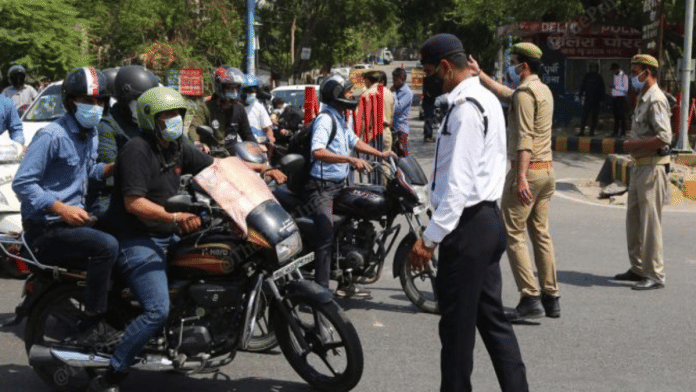
The incident that landed Marwah in trouble happened on the evening of 18 May last year at a busy Chandigarh intersection. Assistant Sub-Inspector (ASI) Ajit Singh and Constable Yogesh were on duty at the crossing near Sectors 45/46/49/50 when they spotted a Scorpio with a partially covered number plate.
According to the policemen, the driver didn’t stop at the zebra crossing as he should have when it was flagged to do so. When constable Yogesh started recording video and asked for the driving licence, the man behind the wheel reportedly said his name was Parkash and that he was a judicial magistrate.
The police say that when they sought confirmation, he simply nodded and allegedly drove off.
Upon inspection of the SUV’s registration, it was found not to belong to any magistrate, even as there was a judge’s sticker on the windshield. That’s when they registered FIR No. 26 at Sector-49 police station. Two days later, on 20 May, Marwah was arrested.
In his petition, Marwah projected himself as a young lawyer with a clean record who has always been interested in social service. He submitted that he had filed multiple complaints about government lapses, including one against a Traffic Police DSP, and claims this made him a target.
The lawyer claimed that he was driving his elderly, sick mother across the intersection that evening when plainclothes officers abruptly stopped him. He insists the entire case is fabricated to get back at him for his activism. “It’s a conspiracy to trap me in a non-bailable case,” he argued.
Marwah’s lawyers said the case was technically flawed because Section 186 of the erstwhile Indian Penal Code, which deals with obstructing public servants, requires a written complaint from the officer concerned, not just an FIR. Marwah had become so depressed after his arrest that he was undergoing counselling and should be protected under laws dealing with unsoundness of mind, according to the lawyers.
Justice Singh pointed out that nobody was disputing that Marwah was at that intersection driving the car. This, he noted, was a classic he-said-she-said situation that only a trial could resolve.
“Who’s telling the truth—the police or the petitioner? You can’t decide that without hearing witnesses and seeing evidence,” the judge observed, adding that trying to determine the facts at this stage, without a proper trial, would be doing things backwards.
The court referred to several Supreme Court rulings that say quashing of FIRs should happen only in the ‘rarest of rare cases’—not as a routine matter. The Supreme Court, it noted, repeatedly said the police should be allowed to investigate and the courts shouldn’t jump in too early.
On the technical point about Section 195 of the erstwhile Code of Criminal Procedure (CrPC), Justice Singh noted that Marwah was charged with two separate things—impersonation (pretending to be a judge) and obstruction.
Even if there was a problem with the obstruction charge, the impersonation charges could proceed independently. “If you have an issue with one charge, raise it when charges are framed at trial,” the judge said.
As for the depression and mental health claim, the court was clear: “You’re saying you became depressed after the incident. But you’re not saying you were mentally unfit when it happened. That’s not grounds to quash the FIR.”
Justice Singh added that if Marwah genuinely felt he wasn’t fit to stand trial due to mental health issues, he could raise that before the trial court—but that wasn’t a reason to kill the case at this stage.
“Without proper evidence, reaching a conclusion now would likely result in miscarriage of justice,” the HC said, clearing the way for the case to go to trial.
(Edited by Tony Rai)