








New Delhi: On the eve of the Republic Day, the Union government announced 131 Padma awards for 2026, comprising five Padma Vibhushan, 13 Padma Bhushan, and 113 Padma Shri.
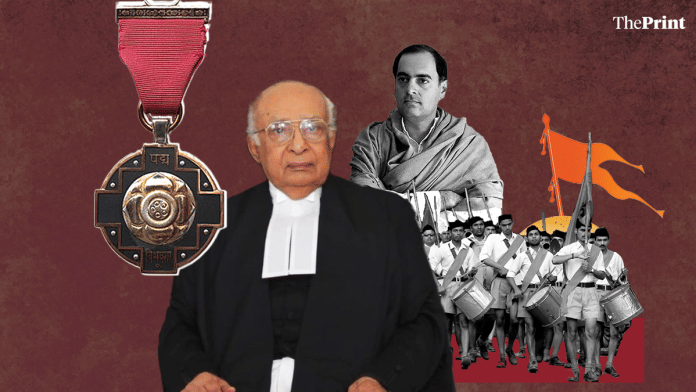
Among the recipients is former Supreme Court judge Justice Kallupurackal Thomas Thomas, 89, who has been awarded India’s second-highest civilian honour, the Padma Vibhushan, in the public affairs category.
Before this, Justice Thomas was conferred the Padma Bhushan in 2017.
Born in 1937 in the Kottayam district of Kerala, Justice Kallupurackal Thomas enrolled as an advocate at the Kerala High Court in 1960. He joined government service in 1977 as a district and sessions judge.
In 1985, he was appointed as an Additional Judge of the Kerala High Court and was confirmed as a permanent judge within a year. He was elevated to the Supreme Court of India in 1996, where he served until his retirement in 2002.
Following his retirement, Justice Thomas declined an appointment to the National Human Rights Commission. He is particularly known for his death penalty jurisprudence.
Also Read: Political messaging in Padma awards: Poll-bound Kerala & Bengal figure high in cross-party outreach
Rajiv Gandhi assassination case
Justice Thomas was part of a three-judge bench, alongside Justices D.P. Wadhwa and Syed Shah Mohammed Quadri, which on 11 May 1999, upheld the conviction of seven persons in the assassination case of former prime minister Rajiv Gandhi.
Four of the convicts—Murugan, his wife Nalini, Santhan and A.G. Perarivalan—were sentenced to death, while three others were awarded life imprisonment.
While Justice Thomas led the bench, he gave a dissenting verdict regarding Nalini in 1999, advocating life imprisonment rather than the death penalty. The other two judges supported the death sentence for Nalini.
Justice Thomas held that Nalini should instead be awarded life imprisonment, observing, “She is the mother of a little female child who would not have even experienced maternal huddling as that little one was born in captivity. Of course, the maxim ‘Justicia non novit patrem nee matrem’ (Justice knows no father nor mother) is a pristine doctrine.
“But it cannot be allowed to reign with its rigour in the sphere of sentence determination. As we have confirmed the death sentence passed on the father of that small child, an effort to save its mother from the gallows may not militate against justice so that an innocent child can be saved from imposed orphanhood.”
Nalini was awarded the death sentence in accordance with the majority verdict. But it was later commuted to life imprisonment by the Tamil Nadu Governor in 2000.
Eventually, all seven convicts, including Nalini, were released from prison by order of the Supreme Court in November 2022, after serving more than 30 years. Simultaneously, the Union government had ordered a judicial inquiry into the assassination of Rajiv Gandhi.
Initially, while awarding the death sentence, the court applied the principle of “constructive liability”, holding that the accused were guilty due to their active involvement in planning, organising, and providing support for the assassination. The bench held that the accused shared a common intention to commit the offence and confirmed that the death sentences were appropriate given the seriousness of the crime and its impact on national security.
Views on capital punishment
In a public interview in 2013, Justice Thomas said he was inclined to agree that “capital punishment in India is judge-centric in the present system.”
“If suggestion (castration for rape convicts) is implemented, it’d eventually lead to dismemberment of vital limbs of human body for certain other crimes. With advancement of civilization & modern approach to human rights, any punishment affecting human body is considered barbaric,’ Justice Thomas.
In the same context, he explained why castration could not be imposed as a punishment for rape, “If the suggestion is implemented, it would eventually lead to dismemberment of vital limbs of (the) human body for certain other crimes. In fact, such types of punishment existed in early times. With the advancement of civilization and modern approach to human rights, any punishment affecting (the) human body is considered as barbaric. I am unable to reconcile to the suggestion to impose castration as a punishment in any case.”
Letter to Sonia Gandhi
In October 2017, when the Tamil Nadu government’s decision to grant remission to the Rajiv Gandhi assassination convicts was opposed by the Centre in the Supreme Court, Justice Thomas wrote a letter to then Congress President Sonia Gandhi, urging her to “show magnanimity” towards her husband’s assassins.
The letter read, “Perhaps the Union government would agree if you and Rahulji (if possible Priyankaji also) would write to the President of India, conveying your willingness to grant remission to these persons who have already spent the longest period of their life in prison. It appears to me as a matter of human consideration which you alone can help. As the judge who passed the judgment against these persons, I now feel that I should address this letter to you so that you can show magnanimity in the situation.”
Justice Thomas later told The Indian Express that he was seeking compassion for the convicts due to “serious flaws” in the CBI’s investigation, particularly concerning the seizure of Rs 40 lakh from the accused.
He also reflected on whether the severity of punishment was influenced by the profile of the case, stating, “If it was not a high-profile case, what would have been the outcome? I don’t have answers.”
‘If it (Rajiv Gandhi assassination case) was not a high-profile case, what would have been the outcome? I don’t have answers,’ Justice Thomas in 2017 letter to Sonia Gandhi, appealing for remission for convicts.
RSS and secularism
In an address delivered in Kochi on 1 August 2011, Justice Thomas praised the RSS for its discipline and said that the propaganda portraying the organisation as anti-minority was “baseless”.
According to a report by Press Trust of India, speaking at a function attended by RSS chief Mohan Bhagwat, he said the “smear campaign” alleging RSS involvement in Mahatma Gandhi’s assassination must end.
“There is a smear campaign that RSS was responsible for Gandhi’s assassination just because the assassin was once an RSS worker,” he said, adding the organisation had been “completely exonerated” by the court. “This smear campaign must end against the RSS.”
In October 2011, Justice Thomas criticised the proposed Communal and Targeted Violence Bill, calling it “divisive” and “against” the Constitution of India. “Secularism is not related with religion. It is related to human dignity. The prevalent notion of secularism is wrongly interpreted,” he had said at a public meeting.
(Edited by Ajeet Tiwari)