





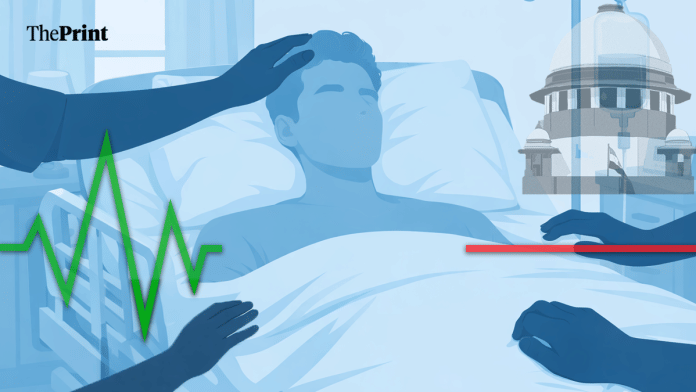



New Delhi: Allowing the parents of 32-year-old Harish Rana to let their son “leave with dignity” after 13 years of “continued vegetative existence”, the Supreme Court acknowledged that while medical science could have kept Rana’s heart beating, it could no longer restore his life.
The 338-page judgement, with the decision to withdraw Harish’s life support for his “best interests”, comes with appreciation of the family’s choice, while noting the “true meaning” of love—which, the two-judge Bench said, is “to care”.
Writing the leading judgment, Justice J.B. Pardiwala went beyond the “Shakespearean dilemma of ‘to be, or not to be…’” to explore the emotional core of the case. He noted with his “immense respect” that Harish’s family stood as “unyielding pillars of support”, exhausting every human effort to care for him. From hospital visits to home, Harish’s family, including his parents and two siblings, have been his caregivers since his accidental fall 13 years ago.
For Justice Pardiwala, the case revealed a fundamental truth about human existence: “The greatest tragedy in life is not death, but abandonment”. Describing the family’s commitment as a “testament to the true meaning of love”, he said that “to love is nothing but to care deeply, softly, and endlessly”, even when the horizon is devoid of hope. The decision to allow the withdrawal of life support was not an act of surrender, but one of “profound compassion and courage”.
Concurring with the outcome, Justice K.V. Viswanathan also provided a deeply empathetic perspective focused on the “harsh reality” of the family’s suffering, highlighting that the parents and siblings had “left no stone unturned” in ensuring Harish received the best treatment, until reaching a point of “no return”.
To elucidate the hidden toll on the caregivers, Justice Viswanathan quoted the ancient Sanskrit Shubashristha: “Between the funeral fire and the mental worry, it is the mental worry which is more devastating. While the funeral fire burns only the dead body, the mental worry burns the living one.”
He added that while the legal principles of “best interest” governed the order, it would be “naive to ignore” the 13 years of agony the family members had endured while watching Harish’s silent struggle.
Also Read: SC allows passive euthanasia in Harish Rana case: What it means for end-of-life care in India
‘A space between logic & mercy’
While analysing legal principles and precedents for Harish’s “best interests”, the Supreme Court admitted that the ruling was not born of strict legalism alone. In a poignant passage, the bench observed: “Our decision today does not neatly fit within logic and reason alone. It sits in a space between love, loss, medicine and mercy.”
The bench clarified that the point was not to “choose death”, but to stop “artificially prolonging life”, when medical intervention could no longer heal or meaningfully improve existence. Harish’s survival, maintained by tubes and machines, was not the same as “living”. By allowing nature to take its course, the court sought to provide a “smooth exit from life” for a man, the Bench said, who had no voice to ask for it.
Family’s heartbreaking plea
The judgment humanised the clinical facts by detailing the court’s personal interaction with Harish’s father, mother and younger brother last month, whereby the family shared memories of a once “extremely energetic” young man who loved football and the gym, now reduced to an emaciated state where his hands had to be bound to prevent him from reflexively pulling out his feeding tubes.
Following her interaction with Harish’s family in December 2025 and January this year, the Additional Solicitor General (ASG) Aishwarya Bhati had submitted a report highlighting that they had provided care to their “full capacity… emotionally, physically and financially” for over 13 years. She had noted that during the interaction, the family appeared “fully conscious, coherent, and consistent”, expressing their views “calmly, repeatedly, and without any sign of coercion, confusion, or external pressure”.
Her note further clarified that their decision to seek withdrawal of life support was not a “momentary or impulsive reaction”, but the result of “long contemplation over many years”, and a deep-seated “moral responsibility to speak for [Harish]” in his state of total incapacity. She reported a “clear, unequivocal and well-considered view” from the primary caregivers that continuing medical intervention was futile, no longer serving any purpose other than to “prolong [the] agony of the applicant”.
Harish’s sister had told the ASG that at the time of the incident, they were children, and today she herself is a mother. She had also shared that the family has lived through years of hardship, and that the decision being taken is, in their belief, in the dignity and best interests of their brother.
His mother had told the court that the “greater distress” had been “watching him suffer continuously in his present state”, rather than the prospect of his passing. His father had expressed a “deep worry” common to ageing parents of the permanently disabled—who would care for him once they were gone. The siblings had echoed the sentiment, adding the decision had been taken with “great difficulty”, and was rooted entirely in their brother’s “dignity and best interests”.
Affirmation of dignity
The top court directed that Harish be admitted to the AIIMS Palliative Care department to ensure his final days are marked by the “alleviation of pain and distress”, rather than the mechanical prolongation of agony. Justice Pardiwala addressed the family directly, assuring them they were not giving up.
“You are allowing him to leave with dignity. It reflects the depth of your selfless love and devotion towards him,” he noted. “It is the decision to withdraw life-sustaining treatment when that treatment no longer heals, restores, or meaningfully improves life. It is allowing nature to take its course when medicine can only delay the inevitable because survival is not always the same as living.”
(Edited by Mannat Chugh)