





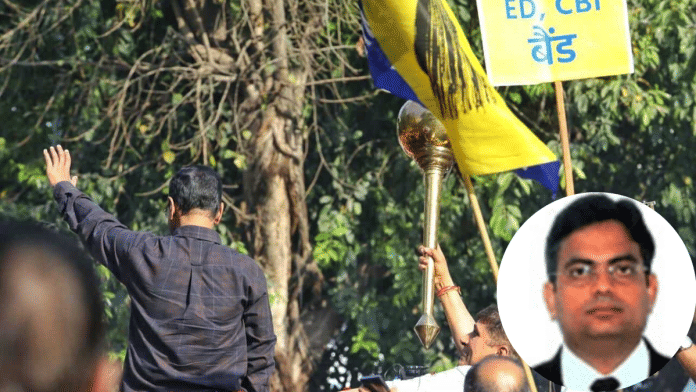



New Delhi: On Friday, Delhi’s Rouse Avenue Court discharged former chief minister Arvind Kejriwal and his then deputy Manish Sisodia in the Delhi Excise Policy case registered in August 2022, with judge Jitendra Pratap Singh observing “there was no overarching conspiracy or criminal intent in the excise policy”.
In a 598-page order, Special Judge (Prevention of Corruption Act) Jitendra Pratap Singh also lambasted the “manner in which the investigating agency has proceeded, by repeatedly recording the statements of the approver without justification and over a prolonged duration”, saying it reflects an exercise of discretion that cannot be characterised as fair or reasonable.
“If left unchecked, such conduct risks converting the exceptional mechanism of pardon into an instrument for narrative construction rather than truth discovery, thereby causing serious prejudice to the accused and eroding confidence in the criminal justice process.”
His order read, “Where the exercise of power, though ostensibly within jurisdiction, results in the dilution of statutory safeguards and erosion of foundational principles of criminal jurisprudence, the Court cannot remain a mute spectator.”
Pulling up the CBI over its chargesheet, which he described as “conjecture rather than concrete evidence”, the judge recommended a departmental inquiry against the CBI Investigating Officer.
A closer look at special judge Singh’s judicial record shows a consistent pattern: strict scrutiny of prosecutorial conduct, insistence on constitutional safeguards, and repeated reminders that State agencies are bound by the rule of law.
Jitendra Pratap Singh is a senior judicial officer of the Delhi Judicial Service and is currently posted as Special Judge (PC Act) at the Rouse Avenue Court complex in New Delhi.
In this capacity, he presides over cases under the Prevention of Corruption Act, particularly those investigated by the Central Bureau of Investigation. He was transferred to Rouse Avenue Courts in 2024 when Delhi High Court transferred more than 200 judicial officers.
Also Read: How CBI case against Kejriwal, Sisodia unravelled. ‘Failed to establish even policy manipulation’
Kapil Mishra case
On 7 March 2025, Judge Jitendra Singh dismissed a plea by BJP leader Kapil Mishra challenging the correctness of a trial court’s decision to summon him in an electoral malpractice case tied to allegations that he made communal statements to seek votes in the 2020 Delhi Assembly polls.
The case stemmed from an FIR registered in 2020 on the basis of a complaint by a returning officer.
The complaint cited tweets and public statements made by Mishra during the election campaign, including references to the polls as an “India vs Pakistan” contest on February 8 (election day), and remarks that a “mini Pakistan” was being created in Shaheen Bagh, the site of protracted anti-CAA protests.
Alleging that the Aam Aadmi Party (AAP) and the Congress had created a “mini Pakistan” in Shaheen Bagh, Mishra had written on X (then Twitter), “Delhi mein chhote chhote Pakistan bane. (Mini-Pakistans have come up in Delhi. Shaheen Bagh mein Pak ki entry.”
Following these statements, Mishra was booked under Section 125 of the Representation of the People Act, 1951 (RP Act), for promoting enmity between classes to gain an advantage during the elections.
The prosecution also alleged violations of the Model Code of Conduct.
In June 2024, the additional chief metropolitan magistrate summoned Mishra in the matter. Challenging that summoning order, he approached the Rouse Avenue Court in revision.
Dismissing Mishra’s petition, Special Judge Jitendra Singh remarked that his usage of the word Pakistan to refer to a Muslim populated area was “a brazen attempt to promote enmity on the grounds of religion”.
“The word ‘Pakistan’ is very skilfully weaved by the revisionist in his alleged statements to spew hatred, careless to communal polarisation that may ensue in the election campaign, only to garner votes”.
“….the implicit reference underlying the particular ‘country’ in the alleged statement is an unmistaken innuendo to persons of a particular ‘religious community’, apparent to generate enmity amongst religious communities. This can be effortlessly understood even by a layman, let alone by a reasonable man,” the judge said.
Observing that there has been an increasing trend in India to resort to communally charged speeches to garner votes during elections, the court added, “This is the outcome of politics of divisiveness and politics of exclusion which is a threat to the democratic and plural fabric of the country. Divide and rule policy of the colonialists are sadly still in practice in India”.
Reflecting judicial concern over communal polarisation in electoral politics, the judge further emphasised institutional responsibility in maintaining the sanctity of elections.
“The Election Commission is under a constitutional obligation to prevent candidates from indulging in vitriolic vituperation with impunity, vitiating and contaminating the atmosphere for free and fair elections,” the court said.
July 2025: On ED’s responsibility
In a separate case in July 2025, Judge Jitendra Singh dealt with a defamation complaint arising out of statements attributed to BJP MLA Bansuri Swaraj in relation to alleged remarks concerning AAP’s Satyender Jain.
The court examined whether Swaraj’s statement constituted an independent act of defamation or if it merely reflected material already placed in the public domain by the Enforcement Directorate. Upon consideration, the court held that Swaraj’s statement merely echoed the ED’s June 2022 tweet, finding no independent or malicious intent to defame Jain.
The complaint was dismissed for lack of prima facie case.
While granting relief to Swaraj, the court made a strong observation about the conduct of investigative agencies, particularly the Enforcement Directorate. It held that any dissemination of information by such agencies must be “accurate, non-misleading, and free from sensationalism.”
“It is incumbent upon an investigative agency such as the ED to act impartially and uphold the principles of fairness and due process,” the judge said.
Extending the court’s scrutiny beyond individual criminal liability to the broader responsibility of investigative bodies, he said, “Presentation of facts in a misleading or scandalous manner can undermine the integrity of the agency and amount to an abuse of power, besides violating the fundamental right to reputation under Article 21”, the court said.
Thus, it concluded that presenting facts in a misleading or scandalous manner could “undermine the integrity of the agency”, violating one’s fundamental right of reputation.
Delhi Waqf Board case
In November 2024, judge Singh granted bail to an accused in the Delhi Waqf Board case involving Aam Aadmi Party (AAP) legislator Amanatullah Khan, observing that the Central agency’s “entire thrust” has been on keeping him in detention without trial.
This case related to alleged irregularities in appointments at the Delhi Waqf Board during Khan’s tenure as its chairman. He was granted bail in the absence of prosecution sanction.
According to the ED, Kausar Imam Siddiqui acted as a middleman for him, and purchased a property on his behalf from the proceeds of the crime.
However, noting that Siddiqui has been in custody since 24 November 2024, the special judge observed that there is not even the “remotest possibility” for the trial to conclude in near future.
“The State and its agency are expected to be equal votaries of liberty. Instead of channelising their energy and resources for speedy trial, it appears that the entire thrust of the prosecuting agency is to keep the accused in detention without trial,”
the court observed while granting him bail.
It added that the prosecuting agency cannot shy away from the responsibility in contributing towards speedy trial.
“Pre-trial detention undermines the rule of law and adversely affects the credibility of the State towards its commitment in protecting the basic human rights of an individual,” it said.
“Now, at this stage, when ED has an opportunity to admit its responsibility for violating the fundamental right of speedy trial of the accused (causing delay in trial as explained above) by way of not opposing the bail, it has opted to oppose the bail with full vigour and vehemence, which is nothing short of defiance of mandate of Supreme Court,” the judge said, emphasising on personal liberty and speedy trial as fundamental rights under Article 21.
Calling out conduct in court
In November 2024, Special Judge Jitendra Singh summoned the Special Director of the Enforcement Directorate (ED) after a counsel appearing for the probe agency addressed the judge in an offensive and derogatory manner with a loud tone.
He directed the official to remain present physically at the next hearing, and said the presence was necessitated to initiate appropriate action for upholding the dignity of the court.
The court was hearing the money laundering case involving Karnataka Deputy Chief Minister DK Shivakumar and other accused. Two days later, the Enforcement Directorate told his Court that the counsels appearing for the probe agency shall be sensitised, regarding making false submissions and their conduct, through a special programme.
(Edited by Ajeet Tiwari)
Also Read: CBI case against Kejriwal & Sisodia falls flat. What agency alleged in Delhi excise policy case